


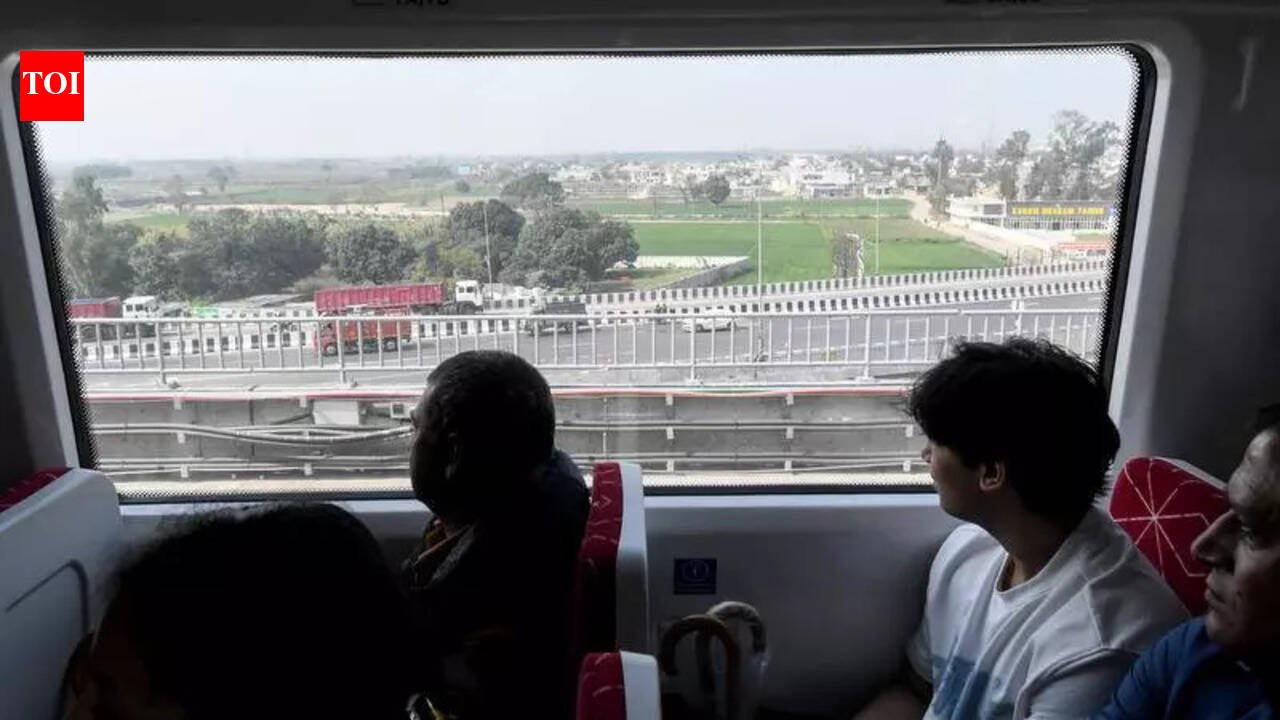
Ghaziabad: The concourse at Sarai Kale Khan rapid rail station felt oddly suspended in time — silent, scrubbed clean, and guarded by security personnel and a handful of NCRTC officials moving with quiet urgency. There were no commuters, no queues, no announcements echoing through the hall.With 48 hours to its inauguration, the Namo Bharat rapid rail, at its pre-launch trial on Friday, covered 82 km in just 40 minutes—touching the top speed of 159kmph—though with no stopovers in between. The Namo Bharat trains have a design speed of 180kmph but a maximum operational speed of 160kmph. At precisely noon, the train sped out of the elevated station, before the handful of passengers had settled into the wide recliner seats of the premium coach. Footrests clicked open, screens flickered to life, and the city slipped away below. At traffic junctions below, lines of cars waited for signals to turn green. Elsewhere, vehicles sped along service roads, suddenly sluggish by comparison. While the rapid rail trains are to complete their run from Delhi to Modipuram in less than an hour, the distance is covered by road in around one and a half hours, which sometimes stretches to around two hours during peak traffic.Within four minutes, the train crossed New Ashok Nagar station. The speed display oscillated between 80 and 100 kmph, climbing steadily as the skyline opened up. Soon, the train was gliding over the Yamuna, offering a fleeting aerial view of the DND Flyway on one side and the Signature Bridge near Wazirabad on the other. A staff member pointed out that the 1.3-km bridge beneath the train was Delhi’s longest over the river, and one of several engineering milestones along the route.Groves of kikar trees and scattered water bodies sped past as the train dipped underground near Anand Vihar at 12.10 pm. This is the corridor’s first subterranean station, where the Namo Bharat threads past the Delhi Metro’s Pink and Blue lines and the Anand Vihar railway station above. The pressure change was distinct — a mild ear pop, like the sensation during take-off on a flight. “Keep chewing,” a fellow passenger advised with a grin.Emerging from the tunnel at Sahibabad, the train surged ahead. Between Sahibabad and Duhai, it briefly touched 160 kmph. Dense clusters of buildings and shanties soon gave way to open farmland. Moments later, a calm announcement broke the quiet: “We have reached Meerut.” Industrial sheds and smoking chimneys marked the approach to Meerut South and Shatabdi Nagar. Then, just as abruptly, the train slipped underground again at Begumpul, before resurfacing at Modipuram at 12.39 pm. Forty minutes. Eighty-two kilometres. No halts.The corridor, stitched together by elevated viaducts, deep tunnels and massive pre-cast segments, has already been dressed for its formal inauguration by Prime Minister Narendra Modi on Sunday. Sarai Kale Khan Namo Bharat station in Delhi, which will be a multi-modal integration with Delhi Metro (Pink Line), Hazrat Nizamuddin railway station, Veer Haqeeqat Rai ISBT and city bus services, will be commissioned along with Shatabdi Nagar, Begumpul and Modipuram in Meerut. The Jangpura station in Delhi will be constructed later.The total project completion cost is Rs 30,274 crore. Currently, a 55km section across 11 stations from New Ashok Nagar to Meerut South is operational.Sarai Kale Khan station will serve as the converging point between all three corridors — Delhi-Panipat-Karnal, Delhi-SNB-Alwar and Delhi-Ghaziabad-Meerut — under the first phase of RRTS. “This interoperability will allow passengers to travel between corridors without changing trains,” said an official of National Capital Region Transport Corporation, which is executing the RRTS project.After the other two corridors are completed, the length of Delhi’s mass transit system, including Delhi Metro, will be 743km, which is more than the length of London Crossrail, Hong Kong MTR and Paris RER, said officials.(With inputs from Priyangi Agarwal)


