






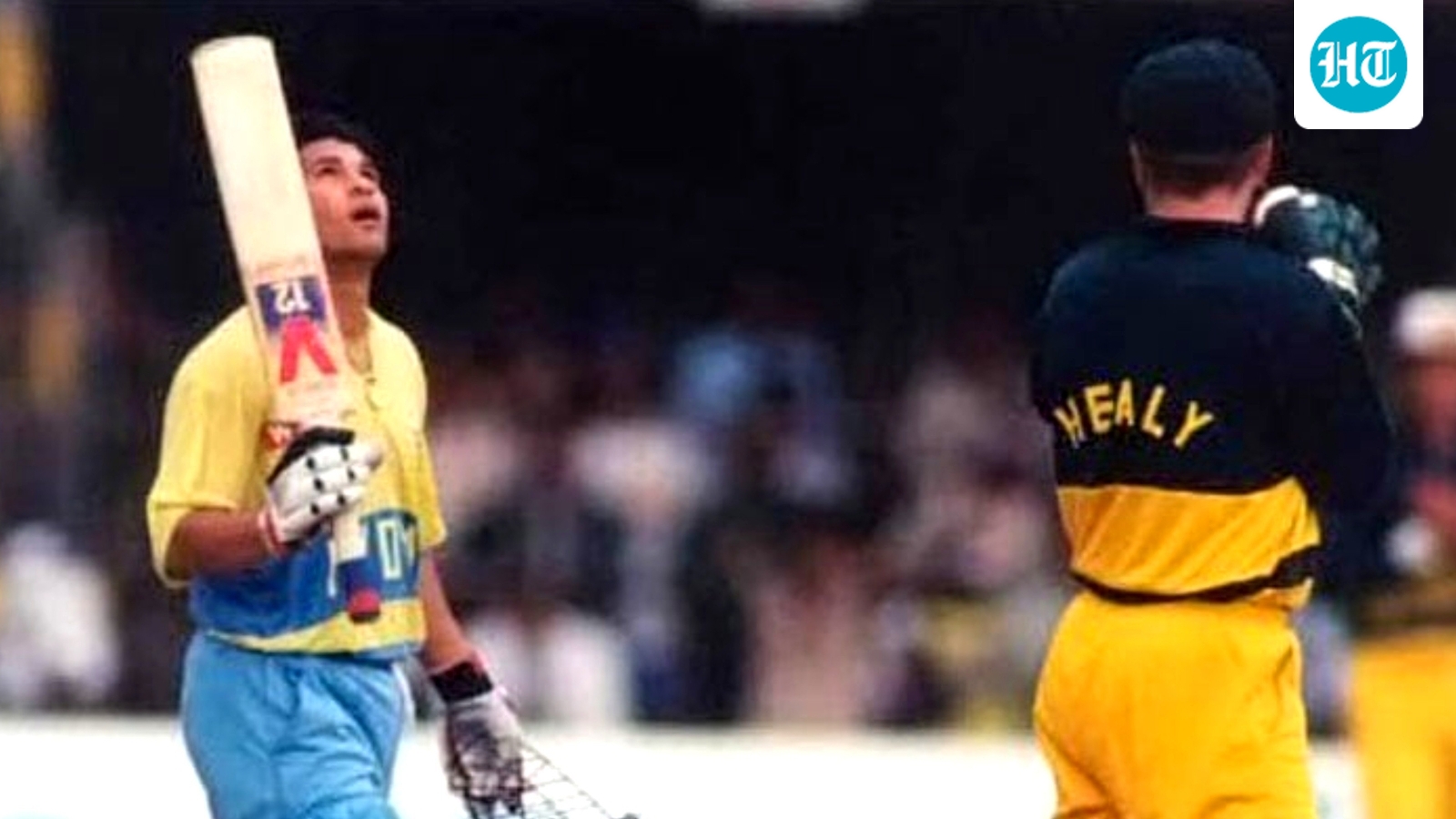
On September 9, 1994, Sachin Tendulkar finally crossed a line that had resisted him for almost five years. Against Australia at Colombo’s R Premadasa Stadium, the 21-year-old made 110 off 130 balls, with eight fours and two sixes, carrying India to 246/8 before Australia were bowled out for 215. The attack included Glenn McGrath, Craig McDermott and Shane Warne; Tendulkar was eventually yorked by McDermott. India won by 31 runs, and the innings became the first of his 49 ODI hundreds.
The striking part, with hindsight, is how long that first hundred took. Tendulkar had played 78 ODIs before arriving in Colombo. Across his first 75 innings, he had scored 2,126 runs at an average of 32.70 and a strike rate of 78.28. He had crossed fifty 17 times without once reaching three figures.
A 44 per cent jump in average
Excluding the maiden hundred itself and comparing everything before it with everything that followed, Tendulkar’s numbers changed dramatically. Before Colombo, he had 2,126 runs in 75 innings at 32.70. After that innings, he scored another 16,190 runs in 376 innings at 46.93.
That is a 43.5 per cent increase in batting average. Runs per innings rose from 28.35 to 43.06, a jump of almost 52 per cent. So the post-breakthrough Tendulkar was not simply accumulating more because he played for another 18 years; his output every time he walked out to bat was substantially higher.
A before-and-after split cannot prove that scoring the first hundred itself caused the transformation. Age, experience and the evolution of his batting all mattered. But as a statistical dividing line, September 9 is remarkably sharp: the player after that date operated at a different level.
More runs, and at a faster rate
Often, a rising average comes with a decline in scoring rate. Tendulkar went the other way. Before his maiden hundred, his strike rate was 78.28. After it, it rose to approximately 87.41. That is an increase of about 11.7 per cent in scoring speed while his average simultaneously climbed by more than 43 per cent. The combination is what matters. Tendulkar was surviving longer, scoring more heavily and doing it faster.
For an ODI batter, that is a far more meaningful transformation than merely piling up career runs. His post-hundred phase produced both greater consistency and greater aggression.
The real shift was in big-score frequency
Before September 9, Tendulkar had 17 fifty-plus scores in 75 innings. That meant a fifty-plus score once every 4.41 innings, or in 22.7 per cent of his visits to the crease. After the maiden hundred, he registered 127 fifty-plus scores in 376 innings: 79 fifties and 48 hundreds. His fifty-plus frequency improved to once every 2.96 innings, or 33.8 per cent of innings.
That represents an increase of roughly 49 per cent in the likelihood of Tendulkar producing a substantial score. Before the breakthrough, fewer than one in four innings reached fifty. Afterwards, almost one in three did. The conversion numbers are even more dramatic. His first 17 fifty-plus scores produced no century. After the maiden hundred, 48 of his next 127 fifty-plus scores became hundreds, a conversion rate of 37.8 per cent.
In other words, before Colombo, he repeatedly got himself into a position to make a hundred without finishing the job. After Colombo, more than one in every three of his fifty-plus scores ended in three figures.
From zero in 75 innings to one every eight
The cleanest statistic remains the century rate itself. Tendulkar’s first 75 ODI innings produced none. His next 376, after excluding the maiden 110, produced 48. That works out to a hundred every 7.83 innings.
The change was not instantaneous. Tendulkar followed the 110 with three successive ducks, a reminder that careers rarely move in neat statistical lines. Yet within 49 days, he had his second ODI hundred, 115 against New Zealand at Vadodara, and two weeks later made 105 against West Indies in Jaipur. After waiting almost five years for his first, he had three within little more than two months.
Colombo looks bigger in retrospect
The September 9 hundred mattered because it ended a conspicuous gap in Tendulkar’s record. But the deeper data gives it greater meaning. Before it, he averaged 32.70, struck at 78.28 and produced a fifty-plus score every 4.4 innings. After it, those numbers became 46.93, 87.41 and one fifty-plus score every three innings.
The first hundred did not create Sachin Tendulkar, and it would be simplistic to claim that it did. What it provides is a remarkably clean marker between two statistical versions of the same batter. Before Colombo, Tendulkar was already an exceptional young player still searching for his first ODI century. After Colombo, the numbers begin to resemble the ODI giant history remembers.


