



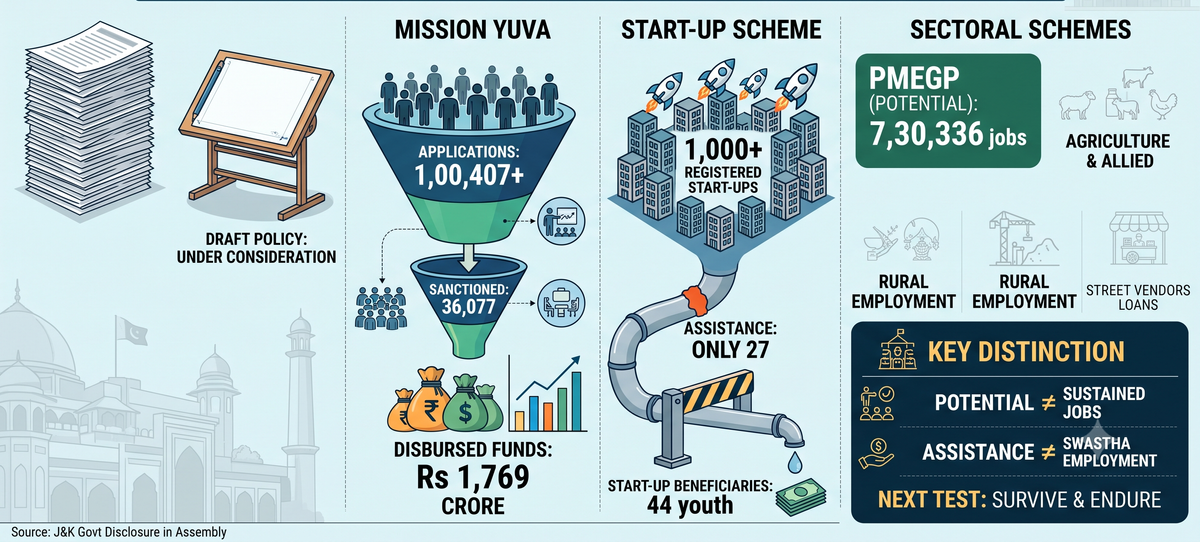
Srinagar, Sep 23: Jammu and Kashmir has rolled out a vast network of employment, self-employment and entrepreneurship schemes with an estimated employment potential running into several lakhs, but a dedicated youth employment policy is still being considered by the government even as Industries and Commerce claims 7.30 lakh job potential.
The disclosure was made in the Legislative Assembly in response to a query raised by Devsar MLA Peerzada Feroze Ahmad, with the reply furnished by the Minister-in-Charge, Labour & Employment Department, a portfolio held by Chief Minister Omar Abdullah.
The figures reveal the scale of the government’s employment intervention — but also highlight the distinction between employment potential, scheme beneficiaries and actual sustained jobs.
“Under Mission YUVA, the government’s flagship entrepreneurship initiative, 1,00,407 applications had been received as on August 31, 2026. Of these, 36,077 cases were sanctioned and 32,156 disbursed by banks, involving credit disbursement of Rs 1,769 crore,” the reply reads.
The Labour & Employment Department separately reported 7,755 youth beneficiaries under three major self-employment schemes since inception — 5,130 under Mumkin, 1,823 under Tejaswini and 802 under the Spurring Entrepreneurship Innovative Scheme.
“Mission YUVA has also established 20 Small Business Development Units, 82 Business Help Desks and 295 training institutions across J&K. More than 36,000 training completions have been recorded, while 477 mentors have been onboarded and 2,500 applicants have completed enterprise mentorship,” the reply states. “The biggest number in the Government’s response, however, comes from the Prime Minister’s Employment Generation Programme (PMEGP).”
According to the Industries & Commerce Department, 91,292 units/cases have been established or disbursed under PMEGP over the last decade, with margin money assistance of about Rs 1,875.51 crore and an estimated employment potential of 7,30,336.
“Under JKREGP, another 6,675 units/cases have been established or disbursed since inception, with an estimated employment potential of 40,050. The government has also reported 1,400 start-ups registered under its Start-up Scheme during 2025-26, although only 27 had received the first instalment of assistance and 44 youth were listed as beneficiaries,” according to the reply.
‘Huge network, uneven outcomes’
The Assembly reply shows that J&K’s employment strategy is spread across virtually every major economic sector. “Agriculture and allied activities, for instance, account for thousands of beneficiaries. The government reported 8,844 beneficiaries under the Integrated Sheep Development Scheme, 6,296 under the Integrated Dairy Development Scheme, 797 under the Integrated Poultry Development Programme and 8,224 under the Holistic Agriculture Development Programme,” the government reply reads.
‘Rural wage employment major source of livelihood’
During April-June 2026, under the erstwhile MGNREGA, 2,12,080 persons were provided employment, generating 34.90 lakh person-days. Following implementation of VB-G RAM G from July, another 2,14,020 persons were provided employment, generating 34.44 lakh person-days up to September 10. “In the urban sector, DAY-NULM was closed in September 2024. During its implementation, however, 10,885 youth received skill training, while 21,220 self-employment loans were disbursed,” the reply states, adding that under PM-SVANidhi, Rs 52.55 crore has been disbursed to 17,952 street vendors. The Cooperative Department said its initiatives had benefited 1,303 youth, while 80 food-processing units established during 2024-25 and 2025-26 generated around 240 direct jobs.
‘Youth policy still awaited’
Despite the extensive array of programmes, the government has stopped short of announcing a dedicated youth employment policy.
Asked specifically whether such a policy was proposed, the government said the need for one was “being considered” in the broader context of employment generation and skill development.
It said the objectives, anticipated outcomes, consultations and budgetary requirements would be finalised once the policy is formulated under the prescribed procedure.
The response also points to a growing emphasis on private-sector employment. Job fairs, Rozgar Melas and Model Career Centres are being used to connect employers and job seekers, while Mission YUVA is intended to facilitate enterprise creation through credit, subsidies, training and market linkages.
The Skill Development Department is meanwhile preparing programmes in emerging sectors such as electric vehicles, renewable energy, IoT and drone technology under PM SETU. The government is also establishing eight AI Data Labs in J&K to provide training in artificial intelligence and data-driven technologies.
The figures collectively present a formidable employment ecosystem. But the government’s own response also leaves an important distinction–employment potential is not necessarily the same as jobs actually created, while training or financial assistance does not automatically translate into sustained employment.
“For thousands of young people seeking stable incomes, the next test for these schemes will therefore be measured not simply by applications sanctioned or loans disbursed, but by the number of enterprises that survive, jobs that endure and incomes that are generated,” the reply reads.
For now, the government has supplied the schemes and the numbers. A comprehensive youth employment policy, however, remains a work in progress.
