



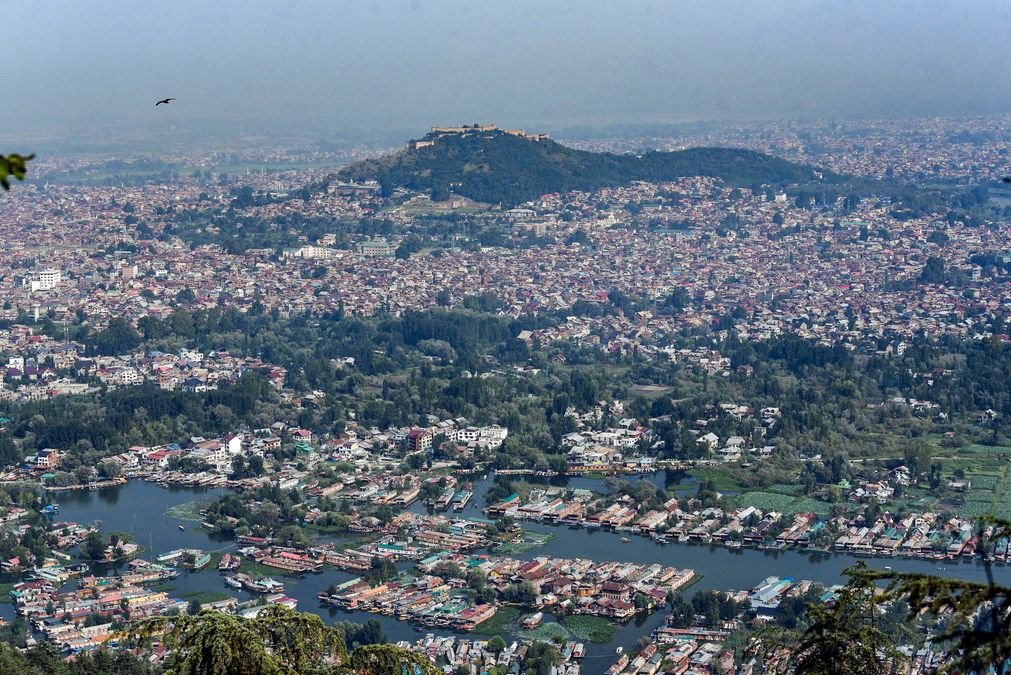
Srinagar, Oct 06: Nearly six out of every 10 parts of Srinagar assessed under a new Environmental Quality Index now fall in the “poor or very poor environmental quality categories”, a fresh study has found.
The study, “Quantifying the environmental impacts of urban expansion in Srinagar City, Jammu & Kashmir, India through remote sensing and geostatistical analysis”, by Amjed Ali, Kheraj and Arshad Ahmed, examined the city’s environmental transformation between 2001 and 2021 using satellite and geospatial datasets.
Published in GeoJournal in 2026, the research developed an Environmental Quality Index (EQI) combining three key indicators — land-surface temperature (LST), vegetation cover (VC) and PM2.5 — to assess how urbanisation has altered environmental conditions across Srinagar.
The detailed EQI classification shows that the combined share of areas falling into the “poor and very poor” categories expanded to 58.3%, indicating what the researchers describe as widespread environmental degradation. “The deterioration, however, has not occurred uniformly across Srinagar,” the study reads.
It identifies the central and southwestern parts of the city as particularly affected, with these areas witnessing stronger increases in surface temperature, vegetation loss and pollution. The researchers link the deterioration in these corridors to urban congestion, transportation infrastructure and industrialisation.
The findings show that Srinagar’s environmental problem is increasingly becoming a question of where people live and how intensely their neighbourhoods have urbanised. Srinagar’s changing land-use pattern forms the backdrop to the environmental changes.
The study’s land-use analysis shows a marked expansion and densification of built-up areas between 2001 and 2021. “Several areas that previously had relatively more open or less-developed land experienced increased construction, while existing urban areas became increasingly dense,” the study reads. The researchers describe this as a combination of urban infill and outward expansion, driven by population pressure and economic activity.
The environmental contrast between central and peripheral Srinagar is particularly significant. The Srinagar’s environmental deterioration is not simply a citywide rise in one pollutant or one temperature indicator. Instead, the study identifies a convergence of three pressures — more heat, less vegetation and more fine particulate pollution — in areas experiencing intensive urbanisation.
The researchers developed the EQI using a framework linked to the United Nations’ sustainable-development approach. “The index combines changes in PM2.5, LST and vegetation cover and classifies environmental conditions into five categories: Very Good, Good, Moderate, Poor and Very Poor,” the study reads. “A higher EQI value represents a higher level of environmental deprivation.”
The study’s spatial analysis therefore provides a picture of where environmental stress is concentrated, rather than relying solely on citywide averages. Its findings have implications for urban planning in Srinagar, particularly as construction continues to expand into previously open and vegetated areas. The researchers call for integrated urban planning, green infrastructure development and pollution-control strategies, linking their recommendations to Sustainable Development Goal 11 on sustainable cities and communities.
The study also highlights an emerging environmental inequality within Srinagar– areas undergoing greater urbanisation are experiencing substantially greater environmental stress, while less densely developed peripheral areas retain comparatively better vegetation conditions.
For Srinagar, the message from the 20-year satellite record is stark: the environmental cost of urban growth is no longer confined to the loss of open spaces. It is being reflected simultaneously in the city’s heat, vegetation and air-quality indicators. And with 58.3% of the assessed area now classified as poor or very Poor, the researchers’ findings suggest that the environmental consequences of urban expansion have become a citywide planning challenge rather than a problem limited to isolated pockets.
