



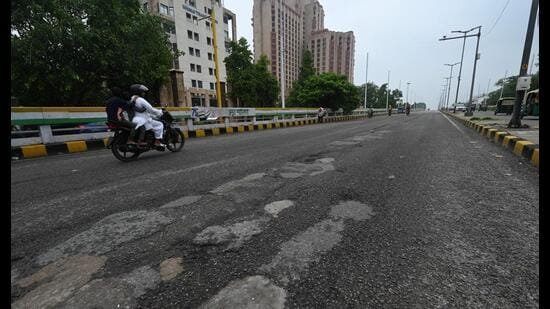
Built during a period of unprecedented infrastructure expansion, when the Capital was preparing for the 2010 Commonwealth Games and grappling with a surge in vehicle ownership, these structures became the backbone of Delhi’s road network. But after years of carrying ever-growing traffic loads, many of the city’s busiest flyovers have crossed the 15-year mark, prompting the Delhi government to shift its focus from building new infrastructure to preserving existing assets.


The Public Works Department (PWD) has initiated plans for structural audits of 44 ageing flyovers and bridges across the city, a move officials said will help identify urgent repair requirements and prioritise rehabilitation work.
Officials familiar with the exercise said most, if not all, of the structures selected for audit are expected to require some degree of repair. “Generally, flyovers older than 15 years need periodic rehabilitation besides periodic maintenance. The audit will help us determine which structures require immediate intervention and which can be taken up later,” said a senior official.
PWD minister Parvesh Verma said, “Many of our flyovers have been serving citizens for more than 15 years and carry a lot of commuters every day. By initiating a comprehensive structural audit of such flyovers, we are taking a scientific approach to assess their condition and plan timely interventions. As Delhi continues to grow, the safety and reliability of our infrastructure becomes increasingly critical. Our government is committed not only to creating new infrastructure but also to ensuring that existing public assets remain secure.”
PWD currently maintains more than 104 flyovers and bridges. According to officials, the government has sanctioned ₹11 crore for the audit exercise and an expert agency will soon be appointed to carry out detailed structural assessments.
“The proposal covers 44 flyovers that are more than 15 years old. Some of these structures are now over two decades old and have not undergone any major rehabilitation since they were built,” the official said.
Among the flyovers identified for audit are the Safdarjung-AIIMS flyover built in 2003, Sarai Kale Khan flyover (2003), Ring Road-NH-24 bypass flyover (2003), Bhishma Pitamah Marg flyover, Maa Anandmayee Marg flyover (2004), Wazirabad Road flyover (2008), Africa Avenue-Asaf Ali Marg flyover (2009), Shastri Nagar flyover (2009), RR Kohli Marg flyover (2009), Azadpur grade separator (2010), Salimgarh flyover (2010) near the Velodrome, Ghazipur flyover (2010), Neela Hauz flyover (2010) and the Apsara Border flyover (2010).
Officials said some structures have been included because of recurring complaints regarding their condition, including the Andrews Ganj flyover, the Lajpat Nagar-Srinivaspuri flyover and the Naraina flyover.
The exercise will also cover older structures dating back to the 1980s and 1990s, including those that have previously been refurbished such as the Ring Road-IP Estate intersection flyover, built in 1982, and the Shakti Nagar road-under-bridge from 1990. Officials said these may be due for another cycle of major rehabilitation.
While repairs are expected to improve safety and extend the lifespan of the structures, officials acknowledged that closures or traffic restrictions could worsen congestion on already crowded roads.
“Based on the audit findings, repairs will be phased carefully. We will ensure that two flyovers on the same corridor are not taken up simultaneously,” the official said.
The rehabilitation work is expected to include repairs to spalled concrete, treatment of honeycombing, replacement of damaged expansion joints and installation of new elastomeric bearings. Honeycombing refers to voids that form within concrete, while spalling occurs when layers of concrete break away, often due to corrosion of embedded steel.
Previous repair projects have demonstrated the challenges involved. In 2023, rehabilitation work on the Chirag Delhi flyover triggered weeks of severe traffic snarls and commuter complaints. Other flyovers repaired in recent years include those at Shahdara, Loni Road, Nangloi, Okhla, Janak Setu and Pul Mithai.
Delhi’s flyover network has evolved over more than five decades. The Shadipur flyover, built in 1971, is among the city’s oldest and marked its golden jubilee in 2021. As Delhi’s population and vehicle numbers grew through the 1980s and 1990s, flyovers emerged as a solution to increasingly congested intersections. Structures such as the Oberoi Hotel flyover, IP Estate flyover, Moolchand flyover, Hanuman Setu, ISBT Kashmere Gate flyover, Chirag Delhi flyover and IIT flyover followed. The biggest expansion came in the early 2000s, when Delhi added nearly 47 flyovers and bridges in a decade.
According to Dr S Velmurugan, former chief scientist and head of the traffic engineering and safety division at the Central Road Research Institute, depending on the design, flyovers can have a life span of 50-100 years but they need periodic maintenance after a 15 year cycle depending on the type of material used.
“CWG games was a special event which led to the construction of many flyovers to boost the city infrastructure and now those infrastructures are demanding repair. It may cause traffic snarls and PWD must make sure that no two successive flyovers on the same route are taken up for repair at the same time,” he added.


