



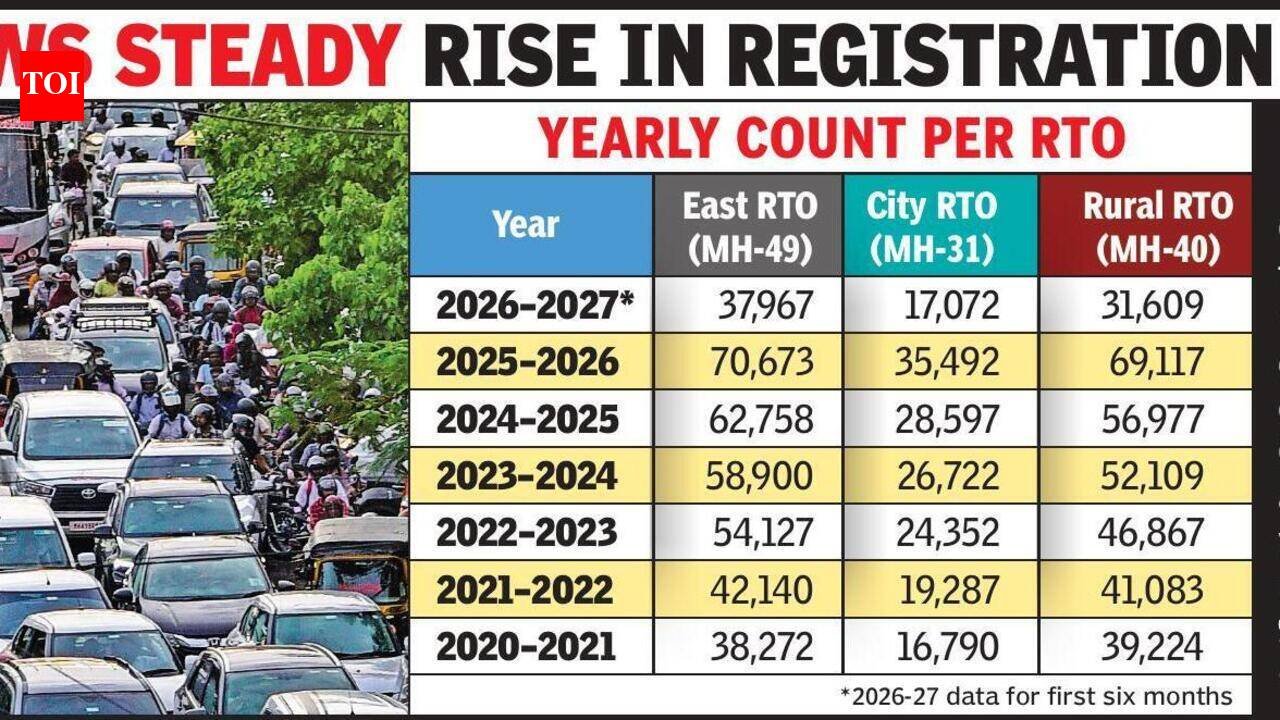
Nagpur: Once known for its wide roads, smooth traffic flow and hassle-free driving, Nagpur is gradually losing its reputation as a motorist-friendly city. Traffic jams have become an everyday affair, mainly due to an increase in vehicular population, which has touched 32.42 lakh.Figures from the three Regional Transport Offices (RTOs) show that vehicle registrations have consistently increased over the past six years. As per the data, City RTO (MH-31) accounts for 15.08 lakh vehicles, followed by Rural RTO (MH-40) with 9.19 lakh and East RTO (MH-49) with 7.83 lakh.The registration figures reflect how rapidly the number of vehicles has grown. East RTO recorded 38,272 new registrations in financial year 2020-21, which increased to 70,673 in 2025-26, a rise of nearly 85%. Similarly, City RTO registrations more than doubled from 16,790 to 35,492 during the same period.Rural RTO also witnessed substantial growth, with annual registrations increasing from 39,224 to 69,117.Together, the three RTOs registered 1,75,282 vehicles in 2025-26, compared to 94,286 in 2020-21, an increase of nearly 86%.During the first six months of 2026-27 alone, the three RTOs registered 86,648 vehicles, which translates into an average of approximately 475 new vehicles every day.These figures represent only vehicles registered in Nagpur district. Add to them thousands of vehicles registered in neighbouring districts and other states which ply on city roads daily. A considerable number of people from outside Nagpur have settled here for employment, education and business, while many others visit the city regularly, further increasing traffic volume.As per DCP (Traffic) Aditya Mirkhelkar, the increase in the number of vehicles is one of the main reasons for traffic jams. “If we compare other cities of similar size, Nagpur’s traffic is still better. Besides increased vehicular population, migration, infrastructure works and lack of proper parking are behind the problem. Apart from proper traffic management, increased use of public transport can ease traffic congestion in city,” said Mirkhelkar.Traffic congestion has become common on major roads, at busy junctions and along commercial stretches. Even outside peak hours, motorists frequently encounter slow-moving traffic. While new flyovers and wider roads have improved connectivity at several locations, the continuous addition of vehicles is putting pressure on the available road space.As per traffic experts, there is a need to look beyond infrastructure expansion. Better traffic management, improved public transport, stricter parking enforcement and measures to reduce dependence on private vehicles could play an important role in easing congestion.
