


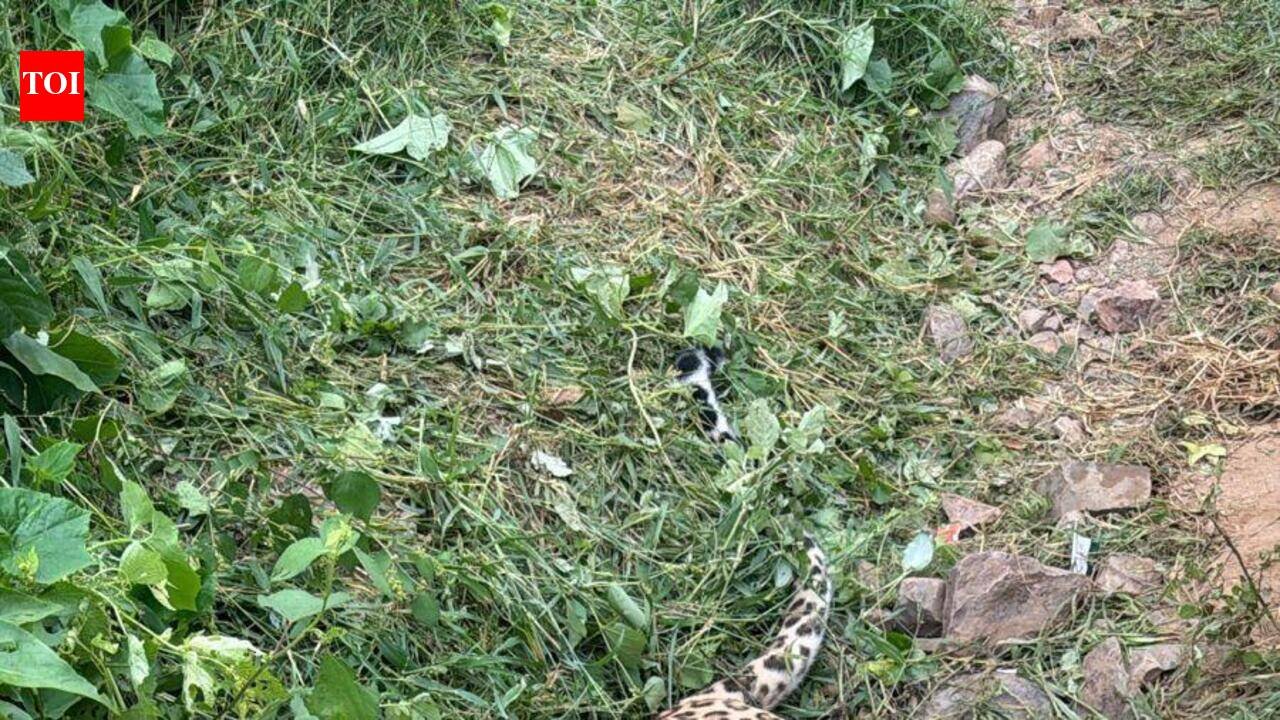
Gurgaon: A three-year-old leopard was found dead in the Aravali foothills near Paldi village in Nuh on Friday morning, prompting wildlife officials to investigate the cause of death. The animal had no visible external injuries and appeared healthy, deepening the mystery around its sudden death, a wildlife official said.A woman noticed the carcass near a cemetery at the foothills and alerted villagers, who then informed the forest and wildlife departments. A team reached the spot and recovered the body.Veterinary board officials conducted the postmortem examination, while samples of the leopard’s viscera are being sent to Bareilly for forensic analysis to check for poisoning or other toxic substances. The possibility of a snakebite or an attack by another venomous animal is also being examined, though it has not been confirmed so far.“There is no external injury mark on the leopard. Action will be taken based on the report and surveillance in the area will be increased,” said Ram Kumar Jangra, DFO (wildlife), Gurgaon.The leopard’s death in Paldi is the eighth reported fatality in Gurgaon-Faridabad-Nuh Aravalis over the past decade. Recorded cases include two deaths in 2019 and one each in 2020, 2021, 2022, 2023 and 2025. Most known deaths were caused by road accidents.In Aug 2025, a female leopard died after being hit by a vehicle on Gurgaon-Faridabad road. In March 2023, a leopard carcass was found in Bandhwari. In Jan 2022, another leopard died after being hit by a vehicle on Western Peripheral Expressway in Mewat. Two female leopards were also killed on Pali Road in Faridabad, one in June 2021 and the other in June 2020. In 2019, two leopard deaths were reported — one on Pali Road and the other in Faridabad.Since there was no injury mark on the leopard carcass found at Paldi, officials said the forensic report will be critical in establishing if the death was caused by poisoning, envenomation, disease or other factors.The death comes at a time when the leopard population in south Haryana’s Aravalis has risen significantly. A 2017 survey by Wildlife Institute of India recorded 31 leopards in the region, nearly four times the eight recorded in its previous survey in 2012.Leopard movement is frequently reported across the Nuh Aravalis, including around Paldi, Padheni, Bhangvo and Bissar Akbarpur. Wildlife conservationists have sought a detailed probe into leopard deaths and stronger monitoring of the fragmented Aravali habitat.“Leopard populations in the Aravalis have been rising, and several incidents of livestock being killed by leopards point to increasing human-wildlife conflict. In such circumstances, poisoning or electrocution cannot be ruled out, especially when an animal is found dead without any visible external injuries. The cause of death must be determined through a detailed postmortem and forensic examination,” said wildlife expert Sunil Harsana.Officials said surveillance in the area would be increased, and further action would depend on the forensic findings.
