



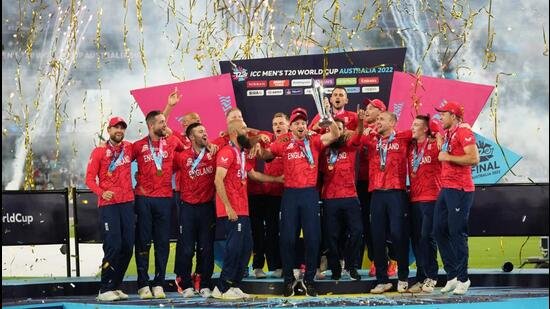
New Delhi: If there was one tournament that symbolised the tectonic shift in T20 cricket, it was perhaps this. England, having shown what an unshackled mind could achieve at the 50-over World Cup in 2019, had just started to go on an attacking overdrive in Tests, and it was only a matter of time before the game’s shortest format was reimagined.
Held in Australia just a year after Aaron Finch led them to a maiden trophy, the 2022 T20 World Cup saw Jos Buttler’s England win their second T20 title. That meant England became the first, and so far the only, team to hold the 50-over and 20-over titles—a damning statement of their superiority in white-ball formats.
The 2022 T20 World Cup was a resounding reality check to a number of traditional traits that form the building blocks of the game. Conservatism, the English philosophy boldly stated, could yield results sporadically, but consistent success was paradoxically down to relentless risk-taking.
The paradigm had been turned on its head. England, having infused the freshness that white-ball cricket had been craving, rendered the metrics of averages and runs — the very core of batsmanship — irrelevant. On the field, it translated into an inexorable assortment of big hitters ready to go from the first ball. Only West Indies matched them for firepower and intent, but losses to Scotland and Ireland in this tournament meant the Caribbeans were sent home at the group stage itself.
Much like Australia, which rode on their all-rounders a year before, England had plenty of multi-discipline players that gave them balance and options. While Moeen Ali, Sam Curran, Ben Stokes, Chris Woakes, Chris Jordan, and Liam Livingstone gave Buttler enough depth, an enviable top-three of Alex Hales, Phil Salt and Buttler meant opposition bowlers were consistently put under the pump.
They won five of their seven matches, the only blip was a five-run loss via DLS to Ireland early in the competition. The match against Australia was abandoned due to rain. England’s biggest win came in the semi-final against 2007 champions India; a match that laid bare India’s timidity while simultaneously underscoring England’s unabashed free spirit.
After stopping India at 168/6 in Adelaide, England romped home without losing a wicket with four overs to spare. Buttler and Hales tore into the Indian attack and took England into the final where Pakistan awaited. Both finalists were eliminated at the semi-final stage in the previous edition, but here a year later, they had gone a step further. Much like India, Pakistan played T20s in the 50-over mould but it was their pace attack, led by Shaheen Shah Afridi, that had come together admirably in Australia.
Put in to bat at the iconic Melbourne Cricket Ground after England won the toss, Pakistan never really got going. Sam Curran, with his variations and deceptive pace, proved to be a handful, claiming three wickets for 12 runs. Fellow pacer Chris Jordan and leggie Adil Rashid struck twice each as Babar Azam’s Pakistan ended their innings at 137/8.
The writing was pretty much on the wall, and even though Pakistan reduced England to 45/3 in the powerplay, Stokes scored a mature half century to win it for England. It was only fair that Stokes was at the crease when the winning run was scored — via a wide — having played a key role in their 50-over triumph three years before.
For India, the biggest takeaway was the announcement of Suryakumar Yadav at the world stage. With 239 runs in six outings, Surya was the third-highest run-getter of the tournament, behind Virat Kohli (296) and Max O’Dowd (242). That he did it at a strike rate of 189.68 — the highest among top 15 scorers — spoke volumes of his intent and talent.
The tournament is also remembered for Kohli’s masterclass in the chase against Pakistan. Chasing 159, India had lost three of their top-four inside the Powerplay. 26/3 soon became 31/4 when Hardik Pandya joined forces with Kohli, and the experienced duo went about rebuilding the innings.
With 48 needed in the last three overs and Indian batters struggling to clear the long MCG boundaries, few gave India a chance. That’s when Kohli magic unfurled. Haris Rauf ran in to bowl the penultimate over and India needed a few sixes to give themselves a fighting chance. The fifth ball was a back-of-length slower ball that gave the batter no room to swing. Kohli stood his ground and launched it straight back over the bowler for a six that has since been watched countless times on loop. Rauf ran in again, this time going full, fast and straight, but perhaps a touch leg side. Kohli brought his strong wrists into play and simply flicked him over the square leg fence for another six.
The two sixes shifted the momentum completely India’s way and even though Pakistan had 16 to defend in the last over, an ice-cool Ravichandran Ashwin trumped a nervy Mohammad Nawaz on the last ball. India exited from the last-four stage and the result prompted them to adopt a free, fearless approach that has since become their overarching template.


