


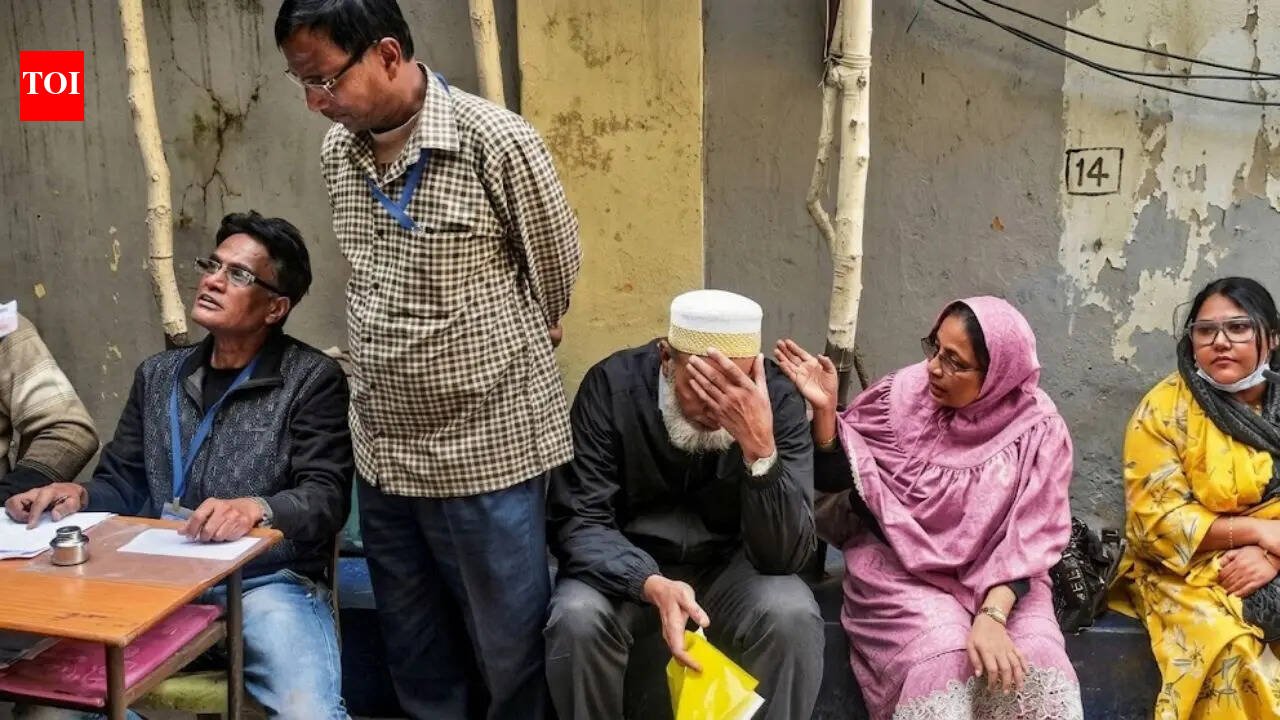
The Special Intensive Revision (SIR) of electoral rolls has emerged as the most dominant and contentious issue in the 2026 Bengal assembly polls, eclipsing traditional campaign themes such as welfare politics, industrial stagnation, corruption, and identity.SIR in the state began on Nov 4, 2025. A month-and-a-half later, a draft roll on Dec 16 listed about 7 crore voters after excluding 58.2 lakh names that were marked as ASDD (absent, shifted, dead, or duplicate). This figure subsequently rose to 63 lakh, but deletions in Bengal remained significantly lower than that in states like UP, Tamil Nadu, and Gujarat.However, the roll revision suddenly entered an anxious and uncertain phase when 1.5 crore of Bengal’s 7 crore voters (after initial enumeration) were flagged for “logical discrepancies”.
Bengal’s 2026 assembly polls are dominated by a contentious electoral roll revision.
Voters were checked against a highly contentious five-point list even if they were mapped in the SIR rolls for 2002 — the base year for the current revision, with Election Commission (EC) saying that its new AI algorithm had identified five types of discrepancies: spelling differences between names in the 2002 and 2025 rolls; cases where more than six voters linked themselves to a single ancestor; age gaps between a voter and their parent falling outside the 15-to-45-year range; cases where the difference between a grandparent’s age and that of the voter was less than 40 years; and instances where the voter’s gender did not align with the name provided.This saw more than 60 lakh voters placed in the “Under Adjudication” category and excluded from voting, pending verification. Later, Supreme Court handed 60 lakh of these1.5 crore cases to judicial officers to act as referees after state election officers and microobservers disagreed. These judicial officers struck down 27 lakh names at a time when no window remained for appeal.TMC on warpathTrinamool Congress (TMC)had questioned the timing and scale of the exercise. “We pointed out that the last intensive revision in 2002 took nearly two years. How could this be completed in barely two months without errors? Many valid voters and well-known names have been omitted in the list prepared by EC, whichis working under the instructions of BJP,” said party spokesperson Kunal Ghosh.BJP strongly backed the process, calling it a necessary correction. “This process is about cleaning up the voter list — identifying illegal entries and removing bogus voters. TMC is objecting because it haslong allowed infiltration and turned such individuals into their main voter base,” said Bengal BJP chief Samik Bhattacharya. Suvendu Adhikari, Leader of Opposition in the assembly, told ‘The News Minute’ media outlet that after SIR, “the contest is over”, claiming there was rampant bogus voting previously in the state.An analysis by Sabar Institute of Bhowanipore assembly seat — where sitting MLA and CM Mamata Banerjee faces Adhikari — showed that nearly 52% of voters flagged for logical discrepancies were Muslim, despite Census 2011 placing the Muslim population at 20% of the constituency. The study noted that while Muslims accounted for 22.7% of ASDD deletions (broadly matching the population), this changed sharply in the logical discrepancies list. The final roll suggested that nearly 56.7% of voters flagged under the ‘Under Adjudication’ category were Muslim — nearly three times their share in the state’s population.Issue to beat all issuesThe SIR row, said political analyst Udayan Banerjee, was expected. “This was inevitable as the SIR exercise was started late and rules were constantly changed. Voting rights are a massive issue for the poor because an EPIC card determines access to govt assistance. Now, issues like RG Kar and recruitment scams have taken a back seat and the deprivation of voting rights is the main issue.”Sabir Ahamed, researcher at Sabar Institute, said that “while polls should be based on the performance of representatives, the focus has shifted to voter anxiety and the struggle to retain voting rights”. “From the perspective of democracy, the true purpose of an election is defeated when people must spend three months proving citizenship through heavy documentation.”
