


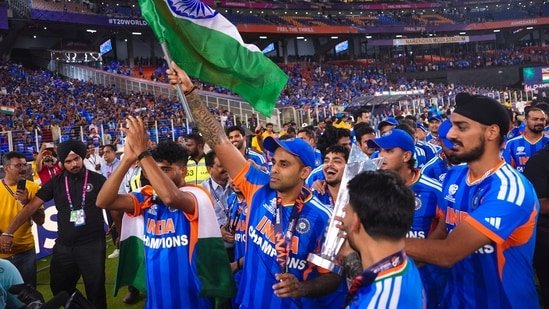
There was history to be written and rewritten, as well as unfinished business to attend to. The tantalising prospect of a third T20 World Cup title was balanced out by the reality of a shattering loss in the final of another World Cup, of a different hue, at the same venue two and a quarter years back. Sunday began full of promise and apprehension, and ended in undiluted joy for millions, who basked in the glory emanating from Suryakumar Yadav’s men reaching the Promised Land with their most comprehensive performance of the tournament.
After a stutter and a stumble that left them needing to win four matches in a row to become the first side to lift the T20 World Cup on home turf, India roused themselves into action, slipping back into the dominant mode that has characterised their play over the last 20 months. It was as if they needed the crushing loss to South Africa, by 76 runs in their opening Super Eight encounter a fortnight back, to rediscover themselves. At the same venue where Australia had smashed their dreams in November 2023 and where Aiden Markram’s men had given them a rude wake-up call on February 22, India laid the so-called jinx of the Narendra Modi Stadium to rest, battering New Zealand, admirable New Zealand, into submission with a commanding all-around performance.
The first five matches of India’s campaign weren’t underwhelming so much as unexpected, though their middling totals were more due to somewhat tricky surfaces than anything else. Against the Proteas, they were shot out for 111, a horror night that meant they had to win their two remaining Super Eight games, and then the semifinal and the final, if they were to extend their grasp on the crown won under Rohit Sharma in June 2024.
When pushed into a corner, with elimination a genuine possibility, different sides react differently. Most become timid and diffident, overcome by the fear of failure. The chosen few use that as a springboard to greater things, divorcing themselves from hesitancy and leaden-footedness. Freed up mentally despite the prospect of an early exit, India embraced the avatar that has intimidated so many so often for so long. India flexed their batting muscles with impunity and authority; out came scores of 256, 253 and 255 in the three innings where they batted first, while their hunt of West Indies’ 195 in their final Super Eight contest, a virtual quarterfinal, was as clinically professional inasmuch as a flamboyant approach could be thus.
By the time India reached the final, it was clear that the oomph was back, the strut had returned, and the swagger of old had resurfaced at the most opportune moment. The unlikely figure of Sanju Samson proved to be the catalyst, not because he doesn’t possess the skill, but because of his recent and repeated dalliances with failure and his inconsistent response to pressure.
Samson reignited India’s challenge with 24 in Chennai against Zimbabwe, then embarked on a stunning sequence of 97 not out, 89 and 89 that earned him the Player of the Tournament honours. Having got used to the sweet scent of success in his two previous outings, the opener was at it again on Sunday against the Kiwis, but this time, he was content to play second fiddle to the man expected to set the tournament alight, who came into the title clash with just one innings of substance in seven hits.
Abhishek Sharma played it smart, giving the first few balls to the bowlers, but once he got past the first over of spin from Glenn Phillips, he moved through the gears at the bat of an eyelid. The fluency of old came rushing back, and even Samson, a gorgeous timer of the ball, watched awe-struck as the young man rained boundaries. It was Abhishek’s way of saying thank you for the faith the leadership group had shown in him. Out of form? Well, take an 18-ball half-century in the biggest match of his life.
When New Zealand finally got rid of him after a 98-run alliance with Samson, out strode the little figure of Ishan Kishan, one of the fairytale stories of this campaign. Rising like the proverbial Phoenix from the ashes, he has resurrected his career in the last two months, and he got on the bike and sped away. If New Zealand had believed Abhishek’s fall would spell respite, they were in for a rude shock as Kishan blended precision with power while Samson kept teeing off in a feast of stroke-production that had nearly 90,000 uproarious fans eating out of their hands.
Having come very close to three figures twice in a row, Samson could have been forgiven for dawdling with a hundred imminent, but this side doesn’t operate that way. Trophies before milestones is the mantra, and Samson played true to that credo; if he was disappointed that he was dismissed for 89, it wasn’t because he fell 11 short but because he hadn’t given himself the chance to wreak even further havoc.
After a mini-collapse that threatened to stymie their march, India found another hero in Shivam Dube, the classic example of someone’s worth expressed in just eight balls, which was all he needed to conjure an unbeaten 26. It pushed India to 255, the game sealed and delivered, almost.
India had to stretch every sinew to defend 253 in the semis against England, so they were taking nothing for granted.
New Zealand had an opening pair who had put on 463 runs in the competition, but this time, all they managed was 31. India were switched on, energised, high on spirit and adrenaline but not madly excited or unduly overcharged. There was calmness – that word again – in the way they went about the job, and while they celebrated wickets, which came in a rush with Axar Patel and Jasprit Bumrah – oh, that man again, that magician whose sorcery is beyond mortal understanding – in the forefront, they didn’t go overboard or lose focus of the larger picture.
Bumrah’s execution was on point, and when that’s the case, the opposition has no chance. Nada. Zilch. The construction of his overs was a joy to behold, an abject lesson in clarity of mind and excellence in execution. If there is a better bowler of his generation, he has chosen to remain invisible.
The final margin, 96 runs, was neither flattering nor undeserved. India played like the champions they are. New Zealand were only slightly off, but such is the aura around this team that when it plays at full potential, and the opposition isn’t at its very best, the gulf becomes humongous, impossible to bridge. For weeks, India’s selections were discussed and debated and dissed, Abhishek and Varun Chakravarthy, the No. 1 T20I bowler, dismissed and discarded. But within the contours of the team environment, everyone from the coaches to the other support staff to all the players closed ranks.
They mourned with Rinku Singh when he lost his father, they were around with hugs and warm words when Kishan’s cousin succumbed to a road accident the evening before the final. They celebrated small victories and unsung contributions with gusto in the privacy of the dressing room, and were like that happy family that finds multiple silver linings in every cloud. Suryakumar was a picture of composure and inspiration, and Gambhir was the older brother whose benevolence shone through.
If Rohit’s Class of 2024 set the tempo, Suryakumar’s Band of 2026 has ramped it up a notch. You thought 20 months ago that the pinnacle had been reached, but clearly, that was just another step in the ascent to the summit. Where is the summit now, you ask? All we can say is: We are as excited as you are to find the answer to that question.
