


In December, a photograph circulated on Russian social media showed a group of schoolchildren in St. Petersburg attending a so-called “lesson of courage,” part of a patriotic education program in which servicemen speak to pupils.
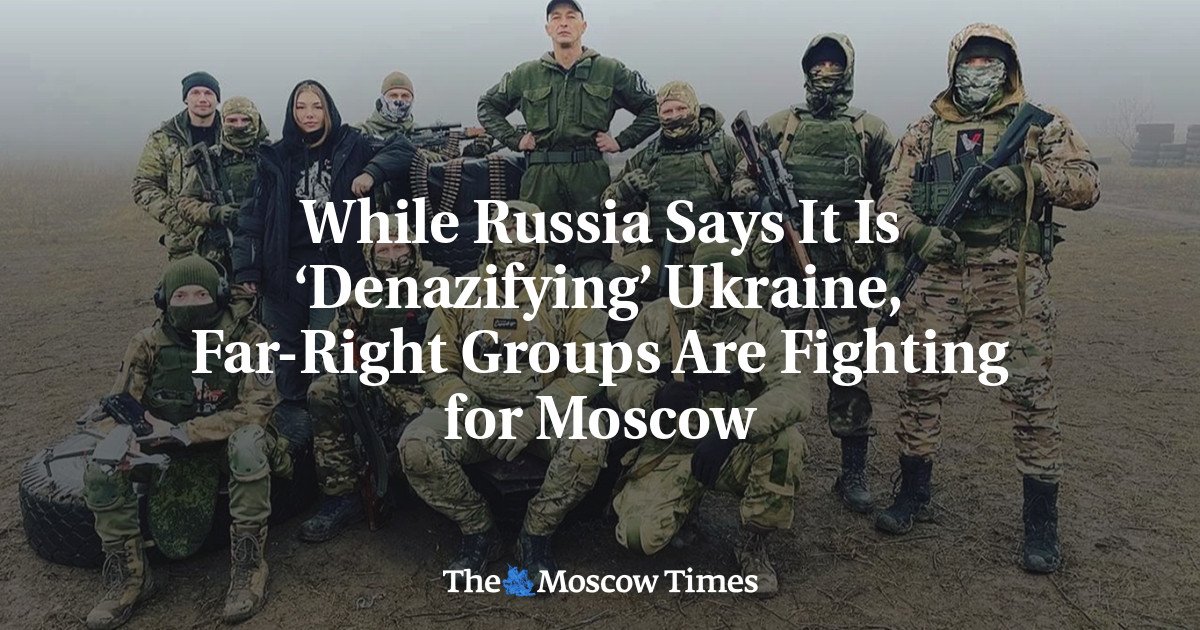
But the men visiting these students, who appeared to be 12 or 13 years old, were not soldiers from Russia’s conventional military. They were fighters from Rusich, a neo-Nazi paramilitary unit battling alongside Russian troops in Ukraine that has earned a reputation for brutality.
Four years ago, President Vladimir Putin sent troops into Ukraine with the stated goal of “denazifying” and “demilitarizing” the country.
This has not stopped the Kremlin from tolerating far-right paramilitary groups fighting on its side, despite occasional criticism.
Away from the front lines, experts say Kremlin-loyal nationalist groups have become increasingly active since the invasion of Ukraine — and the views they espouse have become more visible in the public discourse.
“The war itself has not made such views, the Nazi ones in particular, more widespread, but it has made people feel more like expressing them publicly,” an expert on far-right movements in Russia told The Moscow Times on condition of anonymity.
“The state is generally willing to tolerate almost any view, as long as a person actively supports the war,” he said.
@dshrg2 / Telegram
Rusich may be best known for its members publicly posing in front of the mutilated bodies of Ukrainian soldiers and for openly calling for Ukrainian prisoners of war to be tortured.
After the St. Petersburg school visit, the group’s founder, neo-Nazi Alexei Milchakov, received a letter of thanks from the school administration that praised him “for his contribution to civic-patriotic education” and for conducting the “lesson of courage at a high level.”
The school later sought to distance itself from the incident, saying it had been attended by two other servicemen who fought in Ukraine, one of whom was a student’s relative. It remains unclear whether they were members of Rusich.
Milchakov meanwhile responded to criticism of the lesson by promising that such lessons “will be conducted by unit fighters on a regular basis.”
Rusich, led by Milchakov, fought alongside pro-Russian separatists in southeastern Ukraine in 2014-2015. He later reportedly fought with the Wagner mercenary group in Syria.
Milchakov himself first gained notoriety in 2011 after posting footage that appeared to show him killing and eating a puppy. In other images, he posed in front of a flag bearing a swastika.
“I am a Nazi. I won’t go into details — nationalist, patriot, imperial direction and so on. I can raise my arm,” Milchakov said in a 2020 interview, alluding to the Nazi salute.
“When you kill a person, you feel a hunter’s thrill. If you’ve never gone hunting, try it,” he said during the same interview.
The Rusich Telegram channel, which currently has around 243,000 subscribers, has repeatedly posted calls to kill Ukrainian servicemen instead of taking them as prisoners of war; to rape Ukrainian women serving in the army; and once asked for one Ukrainian POW, preferably a Crimean Tatar, to be provided “for a ritual sacrifice to the Slavic gods.”
The call to “sacrifice” Ukrainian soldiers prompted Mikhail Sheremet, a lawmaker from annexed Crimea, to ask law enforcement authorities to investigate Rusich for extremism.
He was not the only official to sound the alarm.
Lawmaker Anatoly Wasserman appealed to the Investigative Committee, Russia’s top investigative body, in 2022, accusing Rusich of war crimes.
“The Russian state has always been multinational and multiethnic. Those who advocate for ethnic division are its enemies,” lawmaker Yevgeny Fyodorov said in 2025, adding that the fight against these enemies had been “weakened.”
Rusich responded by saying that “Russian nationalists could stab [Fyodorov] like a dog, and nothing would happen to them.”
Still, the group has not yet faced formal prosecution.
When asked in 2023 about neo-Nazis fighting on Russia’s side, lawmaker Andrei Kartapolov, a co-author of amendments to the law on “discrediting” the army, said there was no proof that these groups supported fascism.
“I think they’ve already removed their [swastika] tattoos and no longer give the Nazi salute,” he said. “If they are carrying out tasks as part of Russian military units, it means they have already reformed.”
Researchers say that nationalist ideas once considered marginal have moved closer to the mainstream in Russia, while support for the war in Ukraine serves as “a source of legitimacy for nationalists and often serves as a license for their other activities.”
The Sova Research Center, which monitors nationalist and racist movements in Russia, said pro-government nationalist groups regularly send humanitarian aid and supplies to the front line, publish pro-Kremlin news and recruit war veterans to expand ultra-right paramilitary networks.
Nationalists have continued to build ties with the government by “aligning with the authorities on key positions, such as support for the [war in Ukraine], opposition to liberal values and their proponents and moral conservatism,” Sova said.
“The Kremlin does not like openly declared Nazis, but it does cooperate with pro-government far-right radicals,” said Nikolai Mitrokhin, a sociologist at the University of Bremen who specializes in Russian nationalism, noting that their activity is largely limited.
Svitlana Kirgan / armyinform.com.ua
Rusich is not the only ultranationalist formation to fight on Russia’s side in Ukraine.
Espanola, which was formed by far-right Russian football hooligans, took part in the battle for the Ukrainian city of Mariupol, including the siege of the Azovstal steel plant, as well as in combat operations in the Kherson and Zaporizhzhia regions.
The group announced its dissolution in 2025 after its leader, Stanislav Orlov, died under unclear circumstances.
The exiled investigative outlet IStories reported that Espanola was allegedly financed by Viktor Shendrik, head of security at Russian Railways and a former security chief for close Putin associates Arkady Rotenberg and Boris Rotenberg.
Another formation is the Russian Imperial Legion, the armed wing of the Russian Imperial Movement, which the United States designated as a terrorist organization in 2020.
By contrast, far-right nationalists who oppose the war have remained “largely invisible” in Russia, the Sova Center said. Many have been imprisoned or forced into exile, while others have been fighting on Ukraine’s side since 2022.
Among those fighting for Ukraine are members of the Russian Volunteer Corps (RVC), a far-right paramilitary unit that is led by alleged neo-Nazi Denis Kapustin.
According to Matrokhin, the pro-Kremlin far-right “has never had any real significance” on the battlefield.
Russia’s attempts to replicate what it sees as Ukraine’s use of nationalist formations — like with Espanola — had largely failed, he said.
At the same time, he warned that “the problem is that among Russian military personnel — especially GRU Spetsnaz and airborne troops — far-right views and a culture of violence and sadism are widespread.”
“The Kremlin does not root this out,” he said. “It encourages it.”
A Message from The Moscow Times:
Dear readers,
We are facing unprecedented challenges. Russia’s Prosecutor General’s Office has designated The Moscow Times as an “undesirable” organization, criminalizing our work and putting our staff at risk of prosecution. This follows our earlier unjust labeling as a “foreign agent.”
These actions are direct attempts to silence independent journalism in Russia. The authorities claim our work “discredits the decisions of the Russian leadership.” We see things differently: we strive to provide accurate, unbiased reporting on Russia.
We, the journalists of The Moscow Times, refuse to be silenced. But to continue our work, we need your help.
Your support, no matter how small, makes a world of difference. If you can, please support us monthly starting from just $2. It’s quick to set up, and every contribution makes a significant impact.
By supporting The Moscow Times, you’re defending open, independent journalism in the face of repression. Thank you for standing with us.
Continue
Not ready to support today?
Remind me later.
×
Remind me next month
Thank you! Your reminder is set.
