
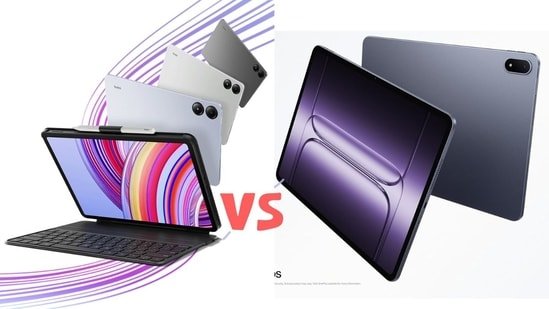
Tablet buyers often look beyond specifications when choosing a device. They consider how the tablet will fit into daily work, study, entertainment, and travel. The Xiaomi Pad 8 Pro and the OnePlus Pad 3 target different usage patterns. One focuses on portability and balanced performance at a lower price, while the other leans toward a larger screen and extended productivity. Here is a clear comparison of both devices to help readers understand which model meets specific needs.
Xiaomi Pad 8 Pro vs OnePlus Pad 3: Design and Display
The Xiaomi Pad 8 Pro comes with a 5.8mm aluminium body and weighs under 500 grams. Its lighter frame makes it easier to carry and hold for reading, browsing, or gaming. The compact design supports handheld use for long periods.
In contrast, the OnePlus Pad 3 weighs 675 grams and features a larger body. Its size makes it more suitable for desk-based tasks such as typing and split-screen work. However, it may feel heavier during extended handheld use. The difference in weight and size directly affects daily usability.
Xiaomi Pad 8 Pro vs OnePlus Pad 3: Performance and Software
Both tablets are powered by the Snapdragon 8 Elite processor built on a 3nm process with the Adreno 830 GPU. This setup ensures similar performance levels in gaming, multitasking, and content creation.
The Xiaomi Pad 8 Pro runs on Android 16 with HyperOS 3. The OnePlus Pad 3 runs on Android 15 with ColorOS 15. Both systems support smooth operation and app handling. Xiaomi offers UFS 4.1 storage in most variants, while OnePlus uses UFS 4.0 storage. Both deliver fast read and write speeds.
Xiaomi Pad 8 Pro vs OnePlus Pad 3: Productivity and Multitasking
The larger 13.2-inch display on the OnePlus Pad 3 makes document editing and multitasking easier. Xiaomi’s 3:2 aspect ratio suits reading and browsing. Both models offer configurations with up to 16GB RAM, which allows heavy applications to run without slowdown.
Also read: Oppo Reno 15 Pro vs Oppo Reno 15: What do you get for the extra cost?
Xiaomi Pad 8 Pro vs OnePlus Pad 3: Battery and Accessories
The Xiaomi Pad 8 Pro houses a 9200mAh battery with 67W fast charging. It also supports 22.5W reverse wired charging.
In comparison, the OnePlus Pad 3 houses a 12140mAh battery and supports 80W charging. The larger battery gives it an advantage for longer usage sessions.
Xiaomi Pad 8 Pro vs OnePlus Pad 3: Stylus and Extra Features
Both tablets support stylus and keyboard accessories. Xiaomi integrates magnetic stylus support into its design and also includes an infrared port for controlling compatible devices. OnePlus focuses on its large display to enhance keyboard-based productivity.
Also read: Xiaomi 18 leak suggests major chipset change ahead of launch: Here’s what that means
Xiaomi Pad 8 Pro vs OnePlus Pad 3: Camera
Xiaomi Pad 8 Pro features a 50MP rear camera and a 32MP ultrawide front camera. The OnePlus Pad 3 includes a 13MP rear and 8MP front camera. Xiaomi supports 4K video recording at 60fps, while OnePlus also supports 4K recording with electronic stabilisation.
Xiaomi Pad 8 Pro vs OnePlus Pad 3: Prices
The Xiaomi Pad 8 Pro is priced at around Rs. 35,000, offering high-end performance at a lower cost. The OnePlus Pad 3 is priced at Rs. 48,000 and focuses on a larger display, bigger battery, and stronger speaker output.
Buyers who want strong performance at a lower price may prefer Xiaomi. Those who want a larger screen, longer battery life, and stronger audio output may find the OnePlus worth the higher cost.
