


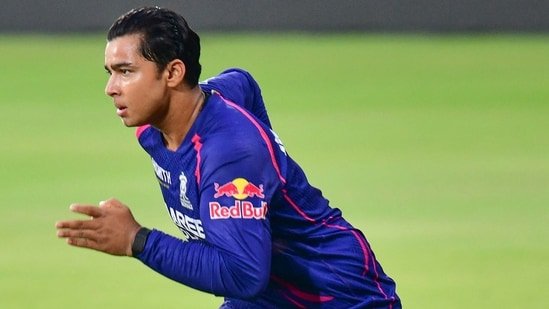
Vaibhav Sooryavanshi’s rise has moved so fast that Indian cricket is already confronting an uncomfortable question: when does recognition become acceleration, and when does acceleration become excess? After his 17-ball 52 for Rajasthan Royals against Chennai Super Kings on March 30, the noise around him stopped sounding like fan excitement and started sounding like a selection conversation. Mohammad Kaif and Piyush Chawla have publicly backed a fast track into India’s T20 set-up. Ambati Rayudu, while praising the talent, has also pointed out that breaking into a reigning world champion side is a very different challenge.
The central issue, then, is no longer whether Sooryavanshi is special. The evidence for that is already overwhelming. The real question is how much evidence should be enough before India move a 15-year-old from prodigy status into the senior international scheme of things. That is where this debate becomes serious, because “senior thinking” and “senior selection” are not the same thing.
Why the fast-track calls are no longer irrational
The easiest mistake here would be to treat the latest IPL innings as the entire case. It is not. That innings only amplified a body of work that has been building across levels for months. In IPL 2025, Sooryavanshi scored 252 runs in seven matches at a strike rate of 206.55, a remarkable return for a debut season at the highest franchise level. One of those knocks was a 35-ball century, the fastest IPL hundred by an Indian.
Since then, he has not retreated into novelty. He has expanded the case. In the Vijay Hazare Trophy in December 2025, he smashed 190 off 84 balls for Bihar, reaching his century in 36 balls and his 150 in 59. The 59-ball 150 was the fastest in men’s List A cricket. The broader tournament numbers also underlined how extreme his scoring has been: he finished that Vijay Hazare campaign with a strike rate of 235.10.
Then came the Under-19 World Cup in early 2026, where he did not merely contribute; he excelled. He dominated. He finished with 439 runs, was India’s top scorer, and in the final against England produced 175 off 80 balls. That innings was not just the highest score in an Under-19 World Cup final; it was the highest individual score in any ICC tournament final, senior or junior, men’s or women’s.
And then, at the start of IPL 2026, he opened with 52 off 17 against CSK, getting to his fifty in 15 balls as Rajasthan chased 128 in only 12.1 overs. That is why fast-track calls are no longer fringe. They are rooted in a multi-level, repeatable cycle of violence.
Fast-track him where, exactly?
This is the question that should define the discussion. Because there are at least four distinct meanings of “fast-track,” and Indian cricket risks blurring them into a single dramatic demand.
One, he can be brought into a closer selector watch as a serious white-ball project. Two, he can enter the broader senior pathway conversation through camps, shadow tours or developmental exposure. Three, he can be viewed as a near-future squad option. Four, he can be picked straight into India’s T20 XI. These are very different stages, with very different consequences.
The problem with public debate is that it usually jumps straight from hype to XI. That leap is exactly what needs resisting. India are not rebuilding from a vacuum. They entered the 2026 T20 World Cup as one of the strongest sides in the format and went on to win it, with a batting ecosystem already built around established names and defined roles. That matters because selection is never only about the ceiling. It is also about timing, fit and displacement.
When does quick become too quick?
It becomes too quick when a player is picked more as a symbol than as a solution.
That is the sharpest line in this debate. Sooryavanshi has almost certainly done enough to enter India’s senior thinking. But entering India’s thinking is not the same as forcing India’s hand. Franchise success, youth-world domination and domestic destruction together create a compelling argument for accelerated planning. They do not automatically create room in a champion side.
Rayudu’s caution matters for exactly that reason. His point was not that Sooryavanshi lacks talent. It was that India’s current T20 side is already stacked, and dislodging established players from a World Cup-winning structure is harder than public excitement tends to admit.
That is where age should be handled carefully. Age is relevant, but not as a moral argument. The issue is not that 15 is “too young” in some abstract emotional sense. The issue is that a 15-year-old, no matter how gifted, is still working with a relatively short senior sample when measured against the demands of international role clarity. The question is not whether he looks extraordinary. The numbers already say he does. The question is whether India should convert extraordinary promise into immediate international selection before they have to.
The sensible middle path
The most defensible conclusion is that it is no longer too early for Vaibhav Sooryavanshi to become part of India’s senior conversation. It may still be too early for India to confuse conversation with commitment.
That distinction gives Indian cricket the best of both worlds. It avoids the old mistake of making prodigies wait so long that the system looks blind, and it avoids the newer mistake of turning every breathtaking teenage run into a public demand for instant caps. With Sooryavanshi, the correct response is neither dismissal nor overreach. It is structured acceleration.
Because the evidence already says he belongs in the scheme of things. It just does not yet prove that the scheme of things must be rearranged around him.
