


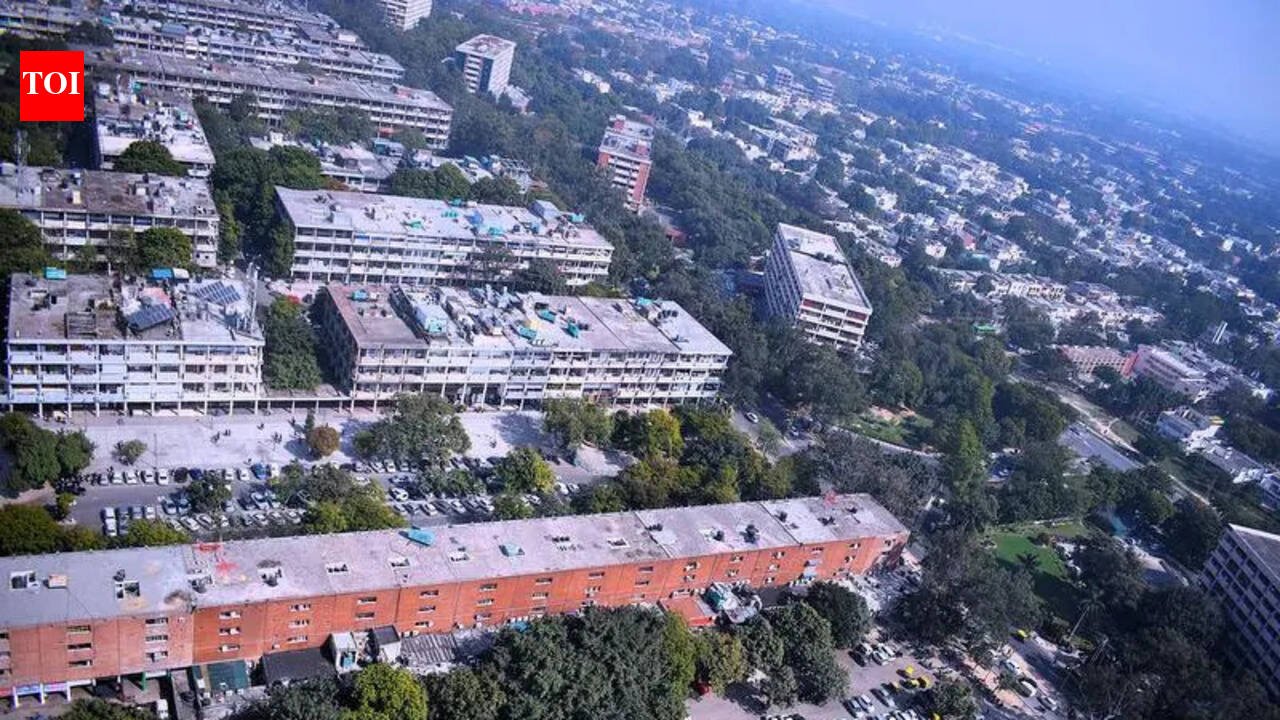
Chandigarh: In a major development, the Chandigarh administration is actively considering increasing the permissible floor area ratio (FAR) for commercial properties in areas other than ‘heritage sectors’.The administration has already declared its intention to increase the FAR in the Industrial Area Phase I and II. The administration is all set to increase permissible FAR in Phase I and II to 2.0, from the current 0.75 and 1.0.“The decision on increasing the permissible FAR is now pending with the top echelon of the administration. The proposal is to double up the FAR in the Industrial Area Phase I and II, and for the commercial properties in areas beyond the heritage sectors,” said sources. Following an increase in the FAR, regulations regarding the coverage area and permissible building heights are also under active consideration. “An increase in the FAR will entail changes in the coverage area and permissible height. Consequently, an increase in these is also on the table,” said sources. Increasing permissible FAR, coverage area and building height for the commercial properties will have a dramatic impact on the city’s skyline, specifically in the southern sectors, and new commercial area will be added to the city. Post the 2005 scheme for conversion of land use in the Industrial Area Phase-I and II, the city witnessed addition of 35,48,880 sq ft of new commercial space. Under the policy, the FAR was doubled from 1 to 2, and building height was increased up to 30m as compared to 18.29m. The policy was, however, discontinued from Sept 18, 2008. In 2000, an increase in FAR from 0.75 to 1.0 and a 10% increase in ground coverage from 50% to 60% for construction of cycle sheds was permitted to all industrial plots of up to one acre. But few have opted for it because of “prohibitive” charges imposed for availing the increase. The changes in the FAR for the commercial and industrial plots follow the administration pursuing the goals of ‘Deregulation 2.0′. The administration constituted a committee under the deputy commissioner to examine and recommend changes in the building bylaws and regulations. A UT official reiterated, “There will be no changes in the FAR, height or coverage area in the heritage sectors. Heritage sectors comprise the first phase of the city (Sectors 1 to 30), meticulously planned by Le Corbusier and his team to reflect modern urbanism principles. The Supreme Court in a landmark judgment in 2023 mandated strict preservation of Chandigarh’s Phase I (Sectors 1-30) heritage, banning the conversion of single dwelling units into apartments and freezing the floor area ratio (FAR) to prevent chaotic urban growth. BOX1: Mixed development in Industrial Area phase-III The Chandigarh administration is considering adopting a mixed land use approach for the development of the industrial area phase-III. “A portion of the 153-acre industrial area phase-III is reserved for warehousing, open areas etc. For other land chunk, allowing mixed land use is being planned,” said sources. The mixed land use in the city is mainly proposed on the transit-oriented-development (TOD) on the Vikas Marg. To expedite infrastructure development in the long-pending 153-acre Industrial Area Phase-III, the administration is also planning to involve the private sector through the Public-Private Partnership (PPP) model. The phase I and II are fully developed, having more than 1,800 plots, the phase-III remains undeveloped. BOX2: Existing FAR, ground coverage There is no single uniform FAR, coverage, etc for commercial sites (SCOs, etc) – it is site-specific and prescribed in the architectural control sheets/zonal controls. For hotels, ground coverage is 35% and FAR is 1.50; For Banquet Hall/Marriage Palace, ground coverage is 40% and FAR 0.80.In the industrial areas (phase I and II), in plots governed by zoning plans, up to 1 acre plots, 60% ground coverage is allowed and FAR of 1.0. In plots in excess of 1 acre, 40% ground coverage is allowed and FAR of 0.75.
