
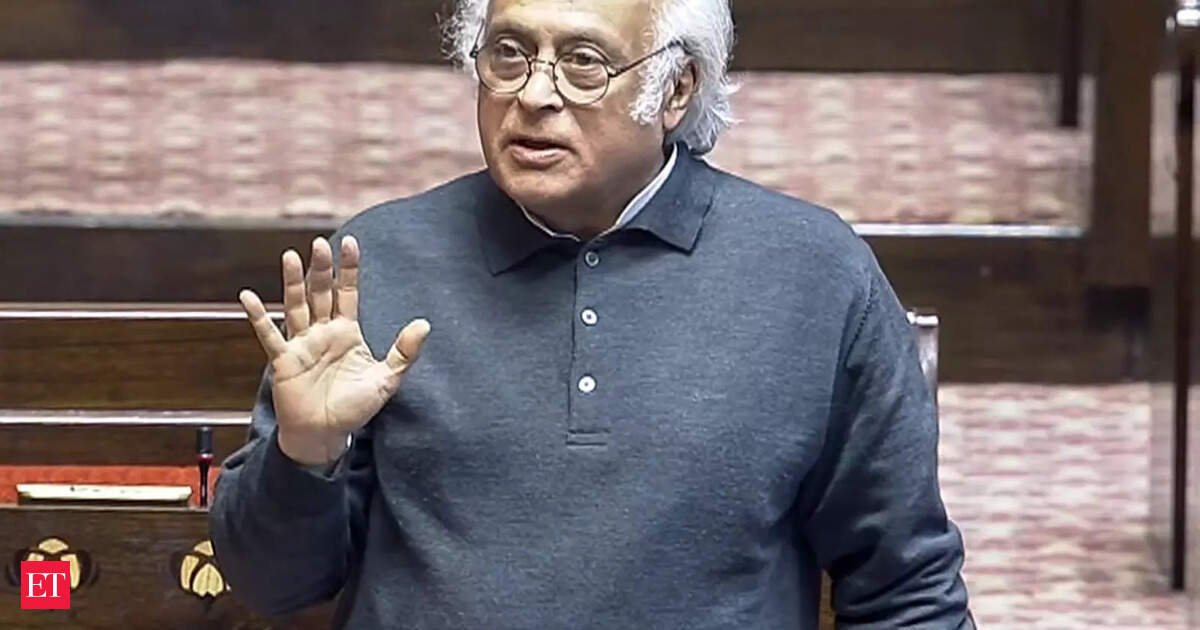
Congress general secretary in-charge communications Jairam Ramesh said the terms of the framework for the interim agreement must be renegotiated and the clause talking about import liberalisation, especially of agricultural products, must be scrapped.
Ramesh said an agreement is about give and take but India had only given under the interim trade pact.
“Prime Minister Narendra Modi had given a slogan in Houston in 2019 -‘Abki baar Trump Sarkaar‘ but this framework for an interim agreement is proof of ‘Abki baar Trump se haar’,” Ramesh told PTI Videos.
What happened on February 2 that there was a need for the prime minister to “force” President Trump to announce the trade deal, Ramesh asked.
“This is directly linked to Mr. Rahul Gandhi‘s attack in Parliament on the PM on the failures on the external security front. So this announcement of the deal was part of managing the news and the headlines,” Ramesh alleged.
The framework for the interim trade agreement states that in the event of any changes from either side, the US and India agree that they can modify their commitments, Ramesh pointed out.President Trump has changed the tariffs so India has every right to change its commitments, he argued.
“The first commitment we have made is to reduce or eliminate tariffs on a wide range of food and agricultural products. Our demand to the PM is to put this in cold storage,” Ramesh said.
India committed to eliminate or cut down import duties on all US industrial goods and a wide range of American food and agricultural products, he pointed out.
This commitment in the joint statement must be changed because as per this statement, India has every right to do so, Ramesh said.
“The direct impact of this commitment is going to be felt on soyabean farmers, maize farmers, fruits and nuts cultivators, cotton farmers. It will impact farmers in J&K, Bihar, Madhya Pradesh, Rajasthan, Maharashtra, Himachal Pradesh to begin with. Then there is mention of additional products in the joint statement. What is meant by that,” Ramesh asked
‘Our second question is that when the PM, the commerce minister (Piyush Goyal), knew from December that any time (now) the Supreme Court verdict could come, many believed that it could be struck down. Why did you hurriedly strike a deal when you knew the verdict could go against Trump,” Ramesh said.
“I hope in light of the massive confusion that surrounds this issue, this joint statement is put on cold storage, we renegotiate the terms, this is a one-sided deal. This will be detrimental to the interests of lakhs and lakhs of farmers in different states of the country,” Ramesh said.
On the one hand the US president and the US secretary of state are claiming that India has stopped buying Russian oil, but the government is saying India is going to maintain our strategic autonomy, so what is the clarity on all these issues, Ramesh asked.
“So, I am afraid these tough questions that are being asked of the prime minister and the PM is evading all these questions,” he alleged.
Any agreement is about give and take but India has only given, he claimed.
On the Congress’ agenda, Ramesh said the first in the series of Kisan Maha Chaupals will be held in Bhopal on February 24, the second in Maharashtra on March 7, and the third in Sri Ganganagar.
“Our objective is to fully protect the interests of farmers,” he asserted.
“The PM was forced to withdraw the three black anti-farm laws in 2021. Our objective is to ensure the interests of the farmers are fully protected in any agreement that we sign,” he added.
On the change in tariffs by Trump, Ramesh said there is massive confusion and uncertainty.
“The best course for India is to put this framework agreement into cold storage, renegotiate the terms of the engagement to fully protect the interests of farmers,” he said.
In a major setback to what was Trump’s pivotal economic agenda in his second term, the US Supreme Court, in a 6-3 verdict written by Chief Justice John Roberts, ruled that the tariffs imposed by Trump on nations around the world were illegal and that the president had exceeded his authority when he imposed the sweeping levies.
Earlier this month, as the US and India announced they reached a framework for an Interim Agreement on trade, Trump issued an Executive Order removing the 25 per cent punitive tariffs imposed on India for its purchases of Russian oil, with the US president noting the commitment by New Delhi to stop directly or indirectly importing energy from Moscow and purchasing American energy products.
Under the trade deal, Washington would charge a reduced reciprocal tariff on New Delhi, lowering it from 25 per cent to 18 per cent.
Shortly after the court verdict, Trump asserted that there is “no change” in the trade deal with India.
“I think my relationship with India is fantastic and we’re doing trade with India… India was getting its oil from Russia. And they pulled way back at my request, because we want to settle that horrible war where 25,000 people are dying every month,” Trump had said at a news conference Friday in the White House.
Trump said his relationship with Prime Minister Modi “is great”. He then went on to repeat the claim that he stopped the war between India and Pakistan last summer using tariffs.
When asked about the deal with India, Trump said, “Nothing changes. They’ll be paying tariffs, and we will not be paying tariffs.
“This is a reversal for what it used to be, as you know, India — and I think Prime Minister Modi is a great gentleman, a great man, actually. But he was much smarter than the people that he was against in terms of the United States, he was ripping us off.
“So we made a deal with India. It’s a fair deal now,” Trump said.
