


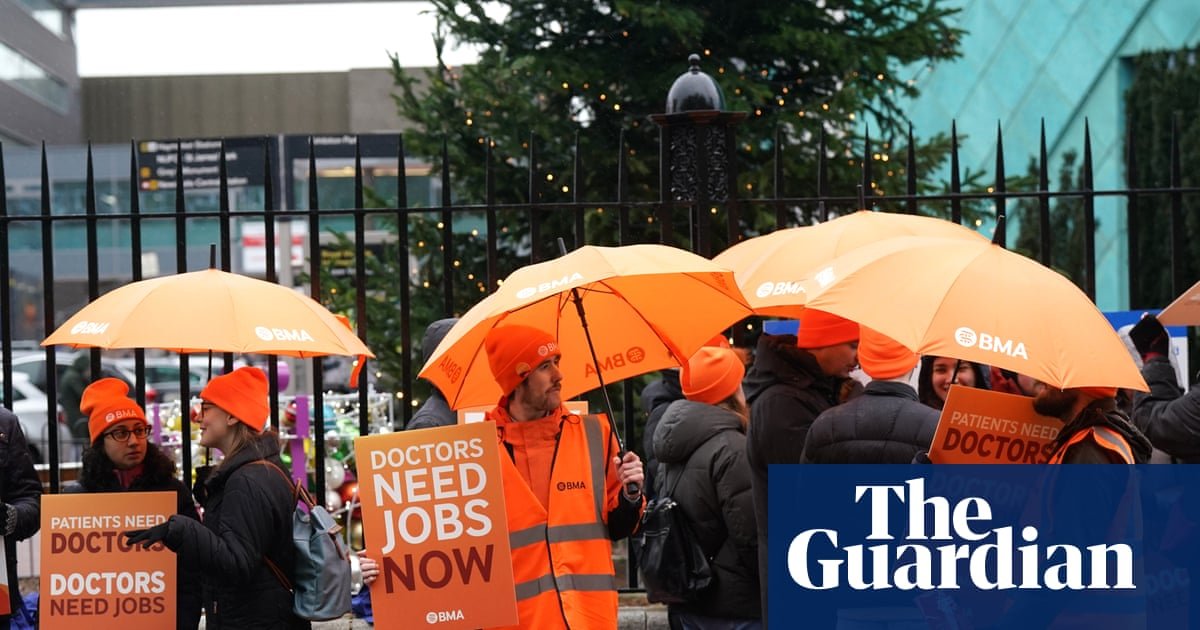
Trade unions have privately expressed qualms about the forthcoming doctors’ strikes, expressing frustration at the conduct of the talks and the demands of the British Medical Association.
The BMA is pushing for a pay rise higher than the 3.5% offered to doctors by the government, with strikes planned for next week.
However, more than a million NHS staff who are not doctors – including nurses, physiotherapists, midwives, healthcare assistants, ambulance workers and hospital porters – are due to receive an even lower pay rise of 3.3%, set via the Agenda for Change (AfC) system.
The decision of the BMA to push for more than 3.5% has caused some other unions with NHS staff to be aggrieved, especially some of those with pay set via AfC. “The deals we have been able to present to our members are becoming a much tougher sell,” one senior union figure said.
Another said they believed that the leadership of the union by resident doctors, rather than professional negotiators, meant the talks had been conducted in a chaotic fashion. “I think it stops from taking any kind of pragmatic approach.”
The first union source said they thought having resident doctors lead the negotiations resulted in less willingness to do a deal on pay and conditions that would affect people entering the workforce. “You need to zoom out sometimes and I don’t think they can see the bigger picture.”
A third senior union source said there was “undoubtedly resentment” among unions representing NHS staff who were not doctors, and a sense that the government always “seemed more willing to listen to the doctors”, but added that the BMA was doing its job for its members by pushing for the best deal possible.
Another union, the GMB, is in dispute with the BMA because of a pay offer the BMA has made to its own staff.
Staff at the BMA union are due to go on strike to coincide with the six-day resident doctors’ strike on 7 April. The BMA’s most recent pay offer to its staff of 2.75% is lower than the latest recommendation of 3.5% to resident doctors.
A BMA spokesperson said: “The BMA is the trade union for doctors and medical students. Doctors have seen their pay fall by more than a fifth since 2008-09 and we’ve been very clear in recent years that our goal is to see this restored. So this year’s award of 3.5% was never going to be acceptable as it makes no progress whatsoever at reversing these real-terms pay cuts. We are taking industrial action to achieve better for doctors. We cannot speak for other unions’ strategies or why they think it is their role to justify an inadequate government pay award to their members.
“In talks with the government, the BMA is represented by elected resident doctor leaders, alongside expert BMA staff from the BMA, bringing together invaluable on-the-ground insight from working doctors and professional negotiating expertise.
“Doctors are in a very different position to our staff. They have experienced far greater cuts in their pay in real terms since 2008 as well as a deterioration in their overall working conditions. Whilst the UK is losing doctors because pay is so low, we have very competitive pay and benefits at the BMA, extremely good staff retention and very low rates of turnover.”
NHS staff under the AfC deal are yet to begin talks about the wider structure of their pay, and their unions are likely to push for reform to pay scales. A recent Unison analysis of NHS data for England over three years shows no marked improvement, and a decline in some cases, in pay satisfaction levels for workers on AfC contracts.
Medical and dental staff are the only group where pay satisfaction levels have risen to any extent, with an 18-percentage-point increase since 2023. Unison said these findings demonstrated how many NHS employees continued to feel undervalued and that nothing had changed under the new government.
