


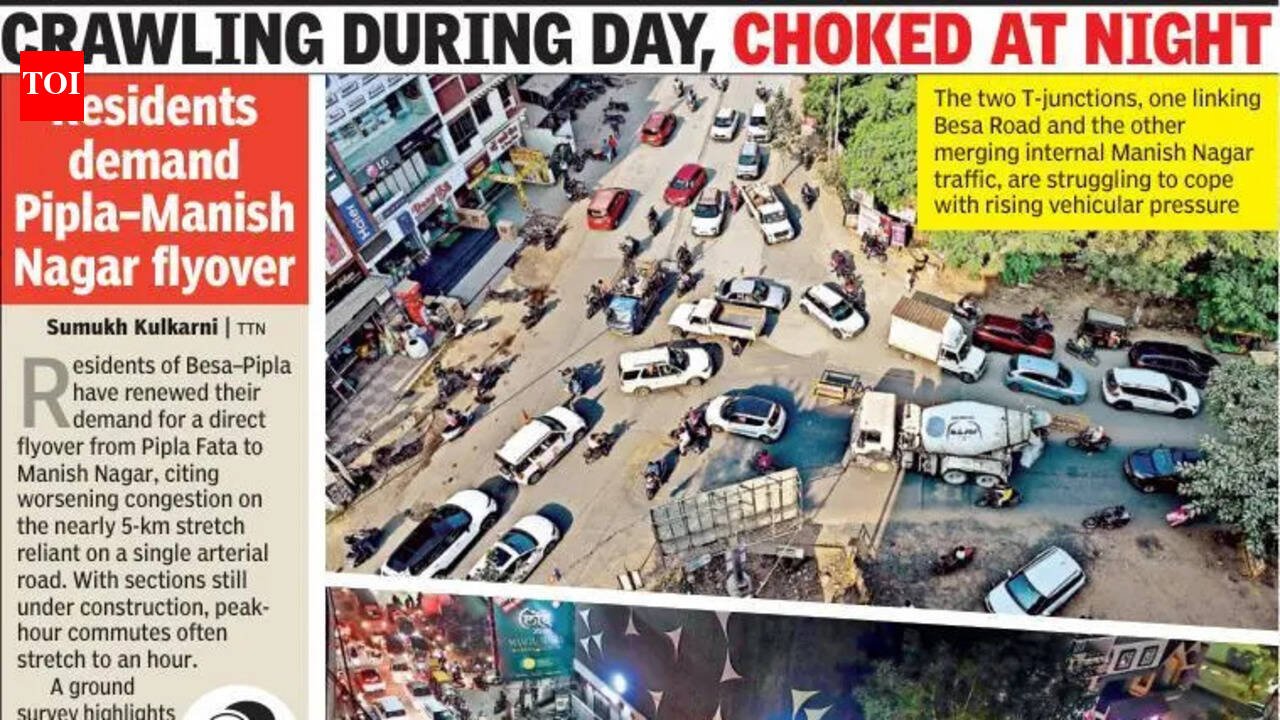
Nagpur: A chaotic web of criss-crossing vehicles, abrupt turns, and shrinking road space has turned the twin T-point stretch in Manish Nagar into one of the most frustrating traffic bottlenecks in Nagpur. Located barely 50 metres apart, the two T-junctions — one linking Besa Road and the other merging internal Manish Nagar traffic — are struggling to cope with rising vehicular pressure, leaving commuters stuck in long, disorderly queues. An aerial view of the junction reveals the scale of the problem: vehicles from multiple directions attempting simultaneous turns, two-wheelers squeezing through gaps, and heavy vehicles like trucks and cement mixers blocking entire lanes. The absence of lane discipline, coupled with haphazard roadside parking and encroachments, worsens the situation during peak hours.“It takes me nearly 20-25 minutes just to cross this stretch in the evening,” said Rohit Sharma, a daily commuter. “There’s no proper traffic management, and everyone is trying to move ahead at the same time.” Residents say the problem is not new, but it has intensified in recent months due to increasing population density and commercial activity in the area. Small vendors, roadside stalls, and parked vehicles have further narrowed the already constrained carriageway, leaving little room for smooth traffic flow.“The road is too narrow for the volume of traffic it handles,” said Neha Deshmukh, a local resident. “Even a single truck or tempo turning here creates a complete standstill. Authorities need to either widen the road or redesign the junction.” Officials from the traffic department acknowledge the challenge. Sources said the Ajni traffic division is responsible for a vast jurisdiction, making it difficult to station personnel at every congestion point throughout the day. Though constables are occasionally deployed at the junction, their presence is often limited to peak hours or special drives. “The twin T-point layout itself is flawed for current traffic levels,” said a senior traffic official on condition of anonymity. “Without structural changes or expansion, the problem will persist.”
