


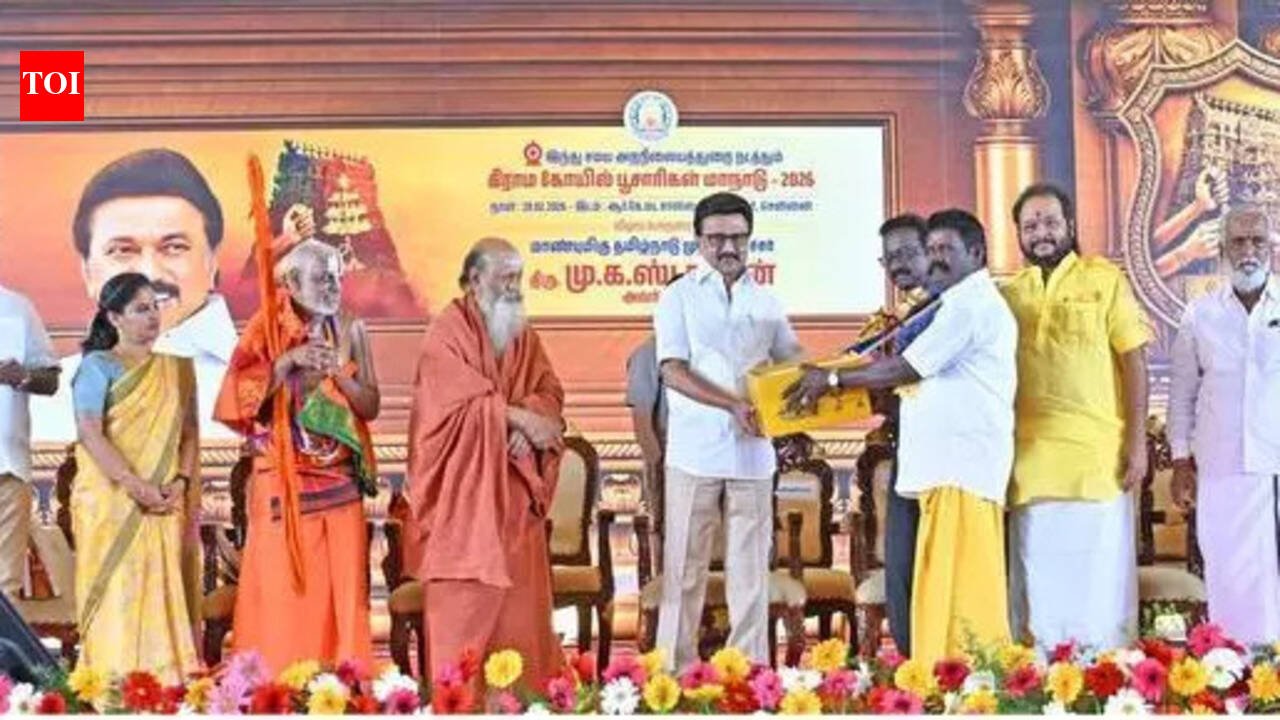
Chennai: Chief minister M K Stalin on Saturday said that true spiritualists and believers support a Dravidian model govt, one that follows the principle of “everything for everyone” and delivers it through schemes and programmes. He urged people to identify and reject divisive forces.“Seeing this conference, some may be astonished; a few may even be annoyed,” Stalin told a gathering of village temple priests at Kabaleeswarar Thidal in Chennai. The DMK govt’s objective, he said, is to celebrate equality and uphold everyone’s dignity and rights. This spirit, he added, should spread beyond Tamil Nadu to strengthen national unity. “Since we are doing this without compromise, spiritual leaders and believers continue to support this govt,” he said, stressing the need to reject those attempting to divide society. Recalling the widespread untouchability of earlier decades, Stalin said Tamil Nadu underwent a transformation where people from all sections can enter temples, become priests, and offer prayers in Tamil in the sanctum sanctorum. “This is true social transformation — and this is what true spiritualists wish for,” he said. On spirituality, Stalin said the DMK firmly follows party founder C N Annadurai’s principle, ‘Ondre Kulam, Oruvane Deivam’ (all are one; all gods are the same), and M Karunanidhi’s popular line that they were not against temples, but against turning them into havens for wrongdoers. “Guided by these principles, the Hindu Religious and Charitable Endowments department functioned to safeguard the rights and dignity of all,” he said. Taking a veiled dig at the previous AIADMK regime, he said people did not even know who the minister was then, adding that the situation is different now and praising HR&CE minister P K Sekarbabu. Listing the department’s achievements over the past five years, including consecration of 4,335 temples in 1,759 days, the appointment of 12 women Odhuvars, and 29 non-Brahmin priests, Stalin made 11 announcements for temple priests. These include new clothes for priests during Pongal, doubling compensation from 50,000 on a priest’s demise, and enhancing the annual salary ceiling to 1.25 lakh.
