


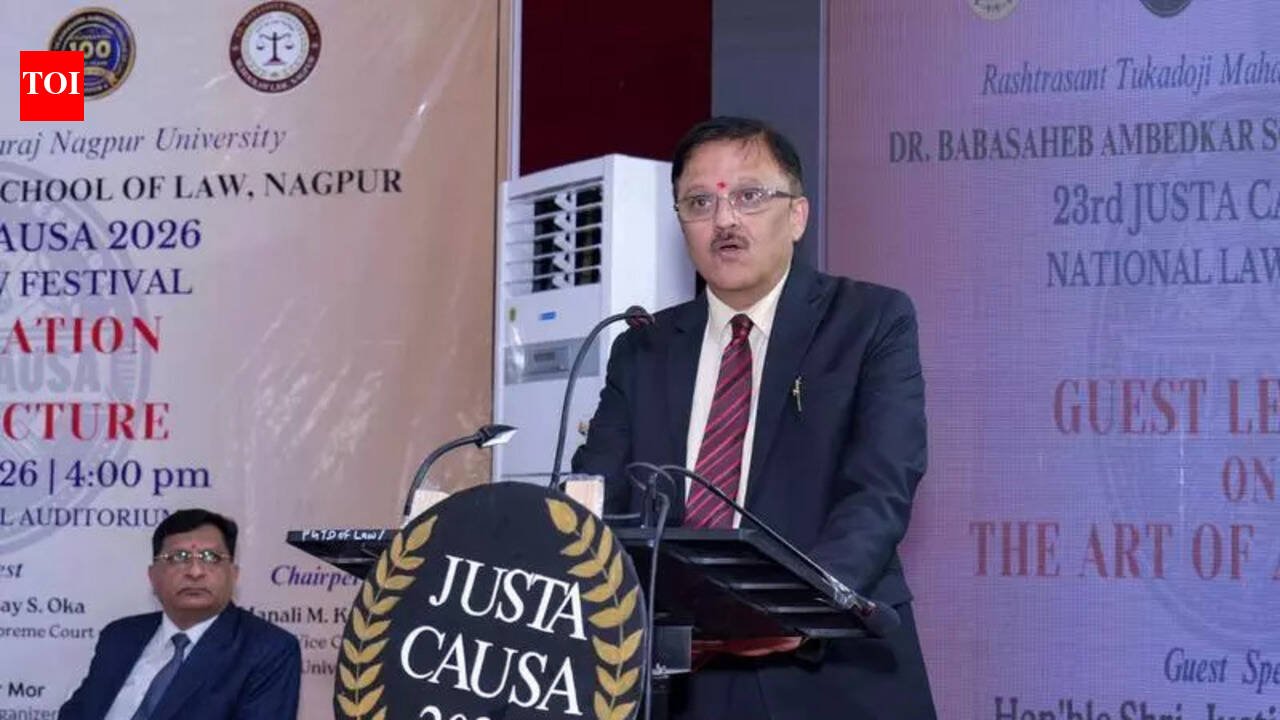
Nagpur: Justice Abhay Oka, a former Supreme Court judge, delivered a sharp message to young law students — the future of advocacy lies not in simulations or artificial intelligence, but in the lived reality of trial courts and human judgment. Addressing the National Justa Causa Law Festival and a centenary event of Nagpur University’s Dr Ambedkar Law College, Oka cautioned against what he described as a ‘misplaced perception’ that trial courts are inferior. “Trial and district courts are constitutional courts. They are the courts of the common man and the most important pillar of the justice system,” he said, stressing that these courts form the foundation of India’s judicial structure. Oka’s remarks come at a time when legal education globally is grappling with the growing role of technology and simulation-based learning. He warned that moot court competitions, while useful, often create an artificial sense of preparedness. “Advocacy is an art that can only be learnt through practice in actual courts,” he said, urging students to observe proceedings closely and train under experienced lawyers.He also underscored the ethical core of the profession. “A lawyer is first an officer of the court. The duty is to assist the court in arriving at the correct conclusion in accordance with law,” he said. On technology, Oka drew a clear boundary between assistance and substitution. “AI can help draft petitions or assist in legal research, but ultimately it is the application of the human mind that identifies new legal angles and doctrines,” he said. He also pointed to constitutional developments like the basic structure doctrine, noting that such ideas required human insight and could not have emerged from algorithmic processes. “AI may assist in drafting, but it cannot understand human behaviour or the complexities of individual cases,” he added. He further highlighted that effective advocacy requires an understanding of human psychology — of judges, clients, witnesses and even opposing counsel. “Every case has its own nuances. Standard arguments are not enough,” he said, advising lawyers to think carefully before responding. “Sometimes silence is the best advocacy.” Oka also placed the discussion in a broader democratic context, noting a decline in the number of legally trained lawmakers. Nearly 36% of members in India’s first Parliament were lawyers, he said, compared to around 4% today — a shift he suggested could affect institutional depth and legal understanding in governance.Echoing his views, Justice Anil Kilor, administrative judge at the Nagpur bench of the Bombay High Court, said moot courts often give students “a false sense of competence,” stressing that real skills are developed through courtroom exposure and client interaction.The event was attended by NU Vice-Chancellor Manali Kshirsagar, former SC judge Vikas Sirpurkar and other legal academics.
