


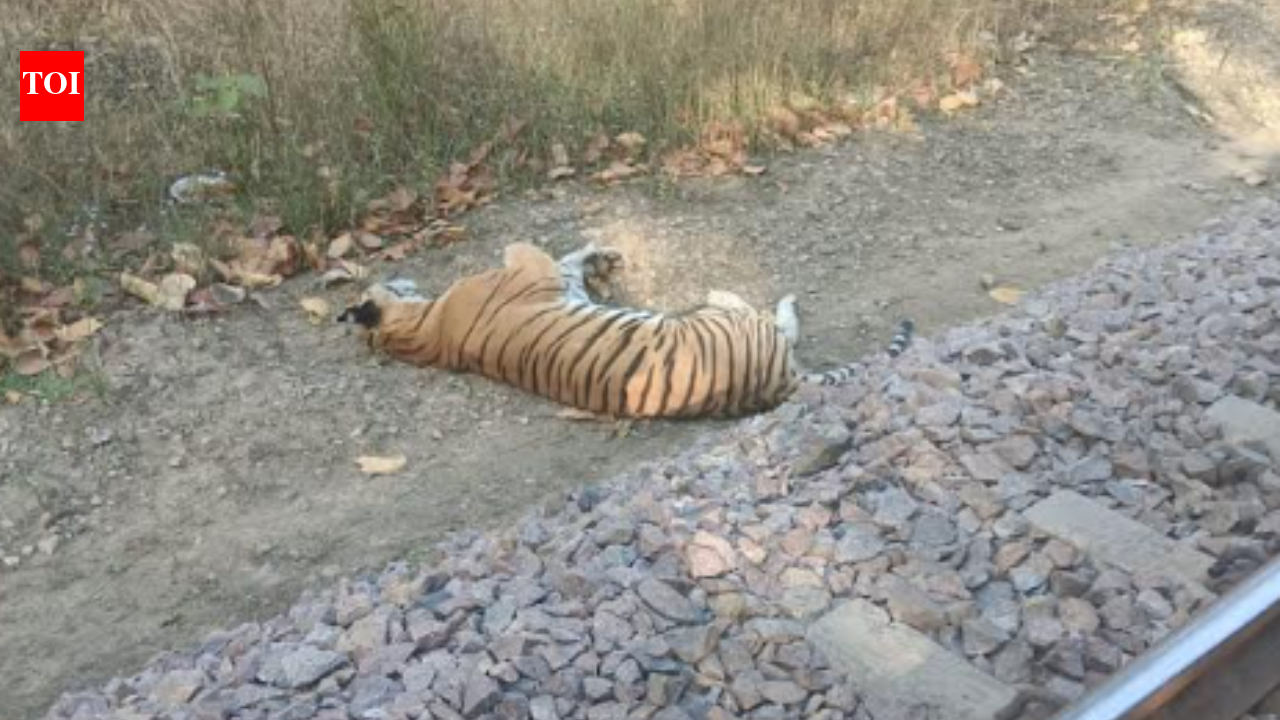
LUCKNOW: The death of a tigress near railway tracks in Uttar Pradesh’s Dudhwa buffer zone (DBZ) has triggered a sharp dispute between forest authorities and the Northeast Railway’s Lucknow division, with both sides presenting conflicting claims over the cause of the incident.The tigress was found dead Wed morning at around 8.50 am by railway staff near the Bhikhampur Halt on Mailani–Bankeganj railway section, in a dense forest stretch within the zone.According to the forest department, the carcass was discovered lying beside the track, prompting initial suspicion that the animal may have been hit by a speeding train. The body was recovered and sent for postmortem following national tiger conservation authority protocols.However, the railways have categorically denied any involvement of a train. In its initial probe report (copy with TOI), it stated that no physical evidence of a collision was found at the site.The preliminary assessment based on postmortem suggested the incident likely occurred late at night, between 10 pm and 11 pm, roughly 10 to 12 hours before the carcass was discovered.“On March 31, Pilibhit – Daliganj Passenger (55085) departed Bankeganj at 7.55 pm, Sitapur – Mailani Passenger (55082) reached Mailani Junction at 9.06 pm, Daliganj – Mailani Passenger (55088) arrived Mailani Junction at 11.33 pm. On April 1, at 12.25 am, a freight train departed from Mailani Junction, similarly at 5 am Mailani – Daliganj Passenger (55087) departed Mailani Junction at 5 am and at 7.20 am another freight train arrived at Mailani Junction. None of the train’s loco pilots reported any collision with the tigress, neither any of the trains had any signs of impact with tigress or damage were detected,” read the joint note prepared by four officials of different departments of railway.NER Lucknow divisional railway manager Gaurav Agarwal, pointed out the absence of drag marks, blood stains, or disturbance in the track ballast, all of which are typically seen in wildlife collisions.“Further statements from track staff and multiple loco pilots who operated trains along the route during the relevant hours also did not indicate any incident. Therefore, we assure that the tigress’s death was not linked to any train movement,” Agarwal informed TOI.Forest officials, however, have maintained that the possibility of a train hit cannot be ruled out.Dudhwa Buffer Zone deputy director Kirti Chaudhary said that preliminary assessment based on postmortem inputs suggested the incident likely occurred late at night. “Trains had passed through the section during that period, although the exact train involved has not yet been identified. We are deputing an investigation officer to probe the case while coordinating with the railway,” she told TOI.Chaudhary also responded to the railways’ claim of lack of physical evidence, stating that in high-speed impacts, especially involving large animals, the body can be thrown aside without leaving clear marks on the track. She emphasized that the postmortem findings point to a high-velocity impact.Details from the postmortem panel further strengthen this view. Dr Daya Shankar, a member of the panel, said the tigress suffered extensive internal injuries consistent with a powerful collision. “The force of impact displaced vital organs such as the heart and lungs into the abdominal cavity, while the trachea and esophagus were twisted. Stomach contents were found in the trachea, and severe muscle damage was observed in the neck and facial regions,” he informed TOI.According to him, such injuries indicate a strong high-speed impact.The postmortem was conducted about 14 to 16 hours after death by a team of veterinary experts, along with representatives from the NTCA and the chief Wildlife Warden’s office, under the supervision of senior forest officials.Chaudhary also raised concerns about train speeds in the sensitive forest corridor, stating that while the prescribed limit is around 30 km per hour, trains are often observed exceeding it. She added that similar wildlife incidents, including deaths of a nilgai and a bear, have been reported in the past along the same stretch.“In 2023, just a few meters away from the tigress carcass, we found an injured tiger cub who had been hit by a train. We had multiple times informed the railway about the violations of speed limit, but no action was taken,” she added.Countering the forest department’s claim, DRM Gaurav Agrawal said, “All our trains operate under the restricted speed limit in the sensitive DBZ.”Officials say further investigation and detailed forensic analysis will be crucial. Viscera samples were preserved and sent to the Indian Veterinary Research Institute (IVRI), Bareilly, for further forensic analysis, while the carcass was cremated as per protocol in the presence of officials and local witnesses.
