


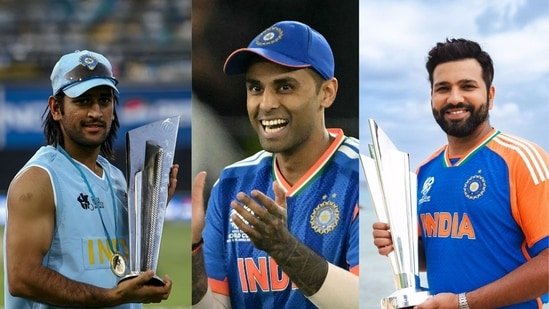
Less than 24 hours after India lifted the men’s T20 World Cup again, the immediate temptation is to stack the numbers, admire the symmetry and move on. Three titles now. First in 2007, then in 2024, and now, on March 8, 2026, another night of global coronation. But the true richness of this achievement lies not in the count alone. It lies in the contrast.
For these were not three variations of the same campaign. There were three different expressions of Indian T20 cricket across three eras: one born in volatility, one forged in pressure, and one delivered with the assurance of a side that has moved from chasing the format to commanding it. That is what makes the latest triumph such an inviting point of reflection. India did not merely win another World Cup in Ahmedabad on Sunday. In many ways, it completed a long arc.
2007: the campaign that ran on instinct
The first one will always have a certain youthful electricity that the others cannot replicate. India entered the inaugural World T20 without the burden of legacy in the format because there was no legacy yet. The tournament itself was still finding its rhythm, and India seemed to understand that before everybody else. They played as if T20 cricket was not something to be managed but something to be seized.
That campaign was not clean. It was not smooth. It was not built on the sort of all-phase control that defines champion sides in the modern game. India tied with Pakistan and survived the bowl-out. They lost to New Zealand in the Super Eight. They arrived at decisive moments with danger still circling them. And yet, perhaps because of that, the campaign acquired its edge.
It was a team powered by sudden surges. Yuvraj Singh’s assault on England was not merely a batting feat; it was a cultural detonation. Gautam Gambhir’s calm in the final gave the innings spine. Rohit Sharma, still a young man then, played one of those early knocks that hinted at a future nobody had fully seen yet. Even the last over of the final, all nerves and fractured breathing, gave the campaign its enduring image: India were not cruising through history, they were gripping it with trembling hands.
What made 2007 special was not perfection. It was courage in the unfamiliar. India won that World Cup before T20 cricket had fully settled into systems. There was instinct, audacity, and a willingness to keep swinging even when the tournament threatened to turn. It was the title of a team discovering both the format and itself.
2024: the campaign that closed every door
If 2007 was electric, 2024 was cold-blooded in the best possible sense. This was India not playing with the uncertainty of pioneers, but with the poise of a team that had carried enough heartbreak to understand exactly how little margin global tournaments offer. The years between 2007 and 2024 had given India many brilliant T20 players, but also many scars. The title in 2024 arrived carrying all of that weight.
This campaign was defined by control. India went unbeaten, and that matters beyond the statistic itself. It reflected a side that rarely allowed games to drift too far from its grasp. Their batting was not always hyper-explosive, but it was situationally intelligent. Their bowling, however, was the true emotional centre of the campaign. This was an attack that seemed to reduce even strong opponents into cramped, anxious versions of themselves.
There was also a maturity to the way India navigated the big moments. The win over Pakistan in a low-scoring contest showed nerve. The semi-final against England carried the sting of Adelaide 2022 in the background, and India answered that memory with a performance of complete control. Then came the final against South Africa, where the pressure became almost physical. India were pushed, stretched, and forced to confront the possibility of another cruel ending. Instead, they held.
That is why 2024 felt like release. It was not simply a title-winning campaign; it was the ending of a long, suffocating wait. The team did not just play good cricket. It carried the emotional burden of Indian cricket in global events and survived it. Where 2007 was spontaneous, 2024 was composed. Where 2007 thrived on ignition, 2024 thrived on discipline. It was the title of a side that knew how tournaments can slip away and decided, repeatedly, not to let go.
2026: the campaign that announced domination
And then came 2026, which may prove to be the most revealing of the three. Not because it was the first title. Not because it ended a drought. But because it suggested that India had moved beyond merely winning tournaments and into the territory of shaping them.
This campaign had a different temperature from the start. The batting carried more intent, more violence, more appetite. India were no longer merely trying to outlast opposition attacks; they were trying to bend games out of shape. Yet what makes the 2026 run particularly impressive is that it was not a serene march. There was a heavy defeat to South Africa in the Super Eight, the kind of loss that can shake the spine of a title defence.
Instead, it hardened India.
That response is central to understanding 2026. The team did not become cautious after being hit. It became more certain. The batting exploded. Big scores stopped feeling accidental and started feeling structural. By the time India reached the semi-final against England, there was an unmistakable sense that this was a side willing to win ugly, win wildly or win overwhelmingly. The final against New Zealand then became the fullest expression of that confidence: a crushing batting display, followed by a decisive bowling finish, with no room left for doubt.
That is why 2026 felt like authority. India were not sneaking through moments anymore. They were dictating them. They were not just champions again; they were defending champions who looked entirely comfortable with the status. That matters. Many teams win once. Far fewer learn how to win again when the whole tournament is built around stopping them.
Three trophies, one larger story
Seen together, these three campaigns read almost like chapters in the evolution of India’s T20 self-image.
-The 2007 side played like a team freed by the format’s newness.
-The 2024 side played like a team determined to suffocate old pain.
-The 2026 side played like a team that finally understood the extent of its own power.
India did not win these three World Cups by repeating a formula. They won them by adapting to the game, to the era, and to their accumulated memories. One title gave India belief. One gave India peace. The latest one has given India stature.
And perhaps that is the strongest line one can draw through all three: in 2007, India announced itself; in 2024, it redeemed itself; in 2026, it imposed itself.
