


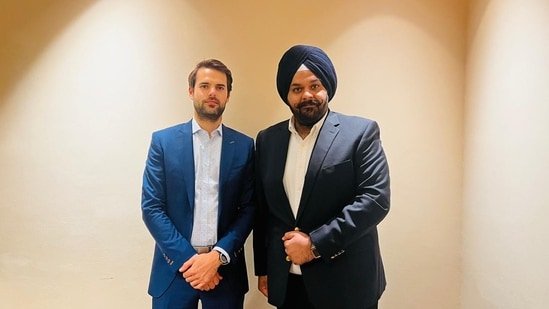
Thomson is expanding its presence in India with the launch of a new product category—refrigerators. The French brand, in partnership with Super Plastronics Pvt Ltd (SPPL), is betting on value-driven offerings tailored specifically for Indian households.
Thomson France with Avneet Singh Marwah, CEO SPPL, Exclusive Brand Licensee of THOMSON India. (Thomson)
Ahead of the launch, I, Aishwarya Faraswal (HT), spoke with Sebastien Crombez, Sales Account Director at Talisman Brands Inc (Thomson France) and Avneet Singh Marwah, CEO, SPPL, about the company’s strategy, target audience, and why it is avoiding the smart appliance race.
Edited excerpts from the conversation
Aishwarya Faraswal (HT): Thomson is entering a highly saturated refrigerator market in India, with brands —what gap did you identify that convinced you this is the right time to enter the refrigerator market.
Avneet Singh Marwah: We looked at where the real gaps are. About 95% of the market is concentrated between 175 and 195 litres. We saw opportunities in 100-litre mini refrigerators, which are ideal for bachelors and small households, and also in 190-litre models, where consumers can get more space at a slightly higher price.
We are also introducing 255-litre models, just below frost-free categories, for consumers who want larger capacity without paying a premium. Our focus is on identifying underserved segments rather than competing head-on.
Aishwarya (HT): What kind of consumer are you targeting with this launch—first-time buyers, families, or upgrade seekers?
Avneet Singh Marwah: Our focus is on bachelors, nuclear families, and first-time buyers, especially in tier 1, 2, and 3 cities. These are consumers looking for trusted brands that offer practical value.
Aishwarya (HT): When can we expect the launch, and what would the price range be?
Avneet Singh Marwah: We are planning the launch around April-end or early May in India. Pricing will be competitive, aligned with our value-first approach.
Aishwarya (HT): In India, usage is quite different—power cuts, high temperatures, and even the way we store leftovers or fresh food. So how have you adapted your refrigerators for these real-life conditions?
Avneet Singh Marwah: This is exactly where we’ve invested a lot of time. These refrigerators are not global designs brought into India—they are designed and manufactured here, keeping Indian usage at the centre.
We’ve created dedicated compartments based on how Indian households actually store food, curries, dairy, vegetables, leftovers, even items like chapatis. Storage behaviour here is very different from Europe or the US. We’ve also worked on temperature optimisation, hygiene, and cooling performance, especially considering high ambient temperatures and diverse food habits across regions.
Since India is so diverse in terms of food and climate, understanding that ecosystem was critical for us while designing the product.
Aishwarya (HT): Many brands are pushing smart features—are you betting on innovation, or simplicity that just works better?
Avneet Singh Marwah: We strongly believe in practical innovation over feature overload. If you look at trends, a few years ago, IoT was the big buzzword, much like AI is today. Many brands invested heavily in connected appliances. But the reality is, actual usage hasn’t scaled the way it was expected to.
Even today, for most appliances, whether it’s refrigerators, washing machines, or air conditioners, the consumer still uses them in a very basic way. The question we ask is: Does this feature genuinely save time or improve daily life?
If not, then it becomes more of a marketing feature than a real benefit. Our focus is on ease of use, reliability, and everyday practicality, because that’s what drives long-term satisfaction.
Sebastien Crombez: From a global perspective as well, we’ve seen that IoT adoption in large appliances has been slower than expected. It works in certain categories like heating, where there is a clear benefit.
But for refrigerators, the value is less obvious. Also, adding such features increases cost, dependency on components like chips, and overall pricing pressure. If consumers don’t use those features regularly, it doesn’t justify the added cost.
Aishwarya (HT): You’re entering a space dominated by brands with decades of trust. How do you plan to break that inertia among Indian consumers?
Avneet Singh Marwah: Trust is very important in this category, especially because refrigerators are long-term purchases.
Our biggest strength is that we’re not new to India. Thomson has already built a strong base through TVs and other appliances, with millions of customers and consistently high ratings online.
We are also exclusive to Flipkart, which has helped us build strong credibility through reviews, ratings, and repeat customers. In fact, our products typically have ratings above industry averages, and that plays a big role in purchase decisions.
On top of that, we have invested heavily in service infrastructure, with coverage across 19,000 pin codes and company-backed service support. That assurance is critical for consumers when trying a new category from an existing brand.
Aishwarya (HT): Are there plans for offline experience centres?
Avneet Singh Marwah: Not at the moment. We are an online-first brand, and we’ve seen that experience centres haven’t delivered strong returns in India, especially after COVID.
Aishwarya (HT): What’s one misconception Indian consumers might have about a “new entrant” like Thomson that you want to change?
Avneet Singh Marwah: The biggest concern is around service and long-term presence. But once consumers research us and see our track record, that concern usually goes away.
Aishwarya Faraswal (HT): What’s next for Thomson after refrigerators?
Avneet Singh Marwah: We are already working on new categories, but those will take time—around 18 months or more. We prefer to scale thoughtfully.
Sebastien Crombez: Globally, we are exploring categories like healthcare and emerging technologies. If they align with Indian consumer needs, we may bring them here in the future.
With its refrigerator debut, Thomson is stepping into one of India’s toughest appliance segments with a different playbook—focused on gaps, not gimmicks. Whether this value-first, no-frills approach can truly disrupt a market dominated by legacy brands is something the coming months will reveal.
