



When the Kremlin invaded Ukraine, French union activist Marie-Laetitia Garric found herself drawn to Russian anti-war activism as the country where she had spent time two decades ago triggered a full-scale war in Europe and plunged into deeper authoritarianism.
But it was the story of jailed Russian-Tatar mathematician Azat Miftakhov that turned her new interest into a political cause. Garric now leads Solidarité FreeAzat, a French organization campaigning for Miftakhov’s release globally.
“For my comrades and I, Azat is a clear example of a political prisoner, an innocent person arrested simply for disagreeing with the regime,” said Garric. “We took him as a symbol of our struggle for the liberation of all those imprisoned for their ideas.”
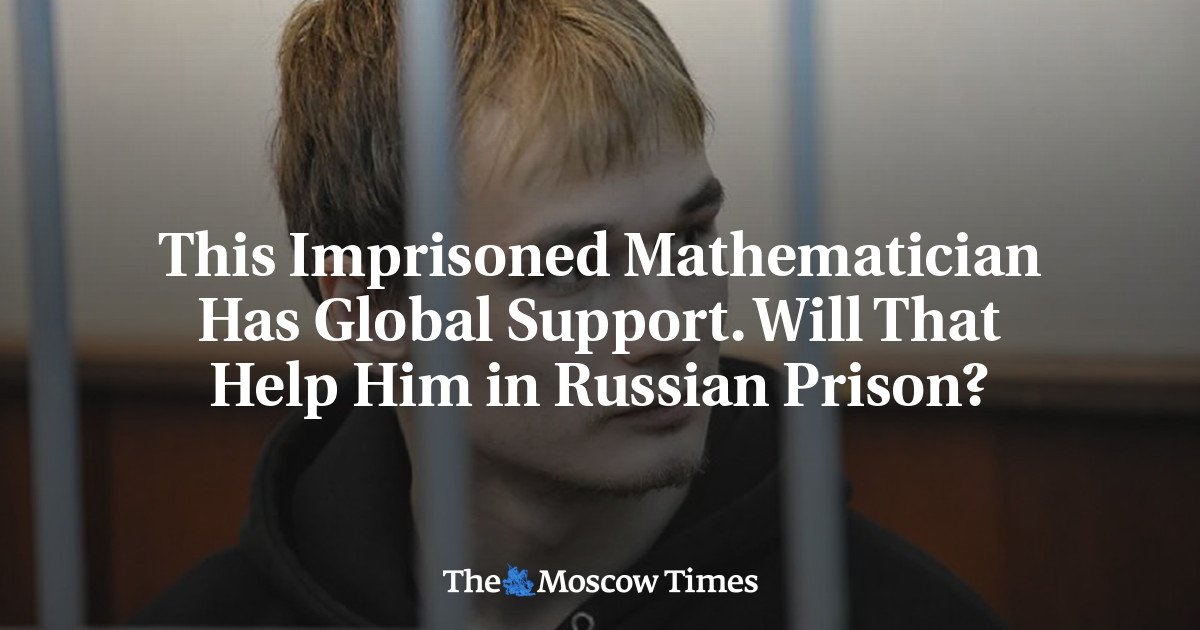
Garric is one of dozens of activists, fellow mathematicians and ordinary people around the world pushing for the release of Miftakhov, who is serving a prison sentence seen as a retaliation for his activism and outspokenness about the brutal treatment he has experienced behind bars.
Miftakhov’s recent transfer to a notorious Arctic prison — and his allegations that he was tortured there — have now left these supporters fearing for his life.
A man with ‘expressive eyebrows’
Miftakhov was 25 and in the fourth year of a prestigious graduate mathematics program at Moscow State University when he was detained in February 2019 on suspicion of manufacturing an explosive device.
He was arrested alongside 11 other students linked to the leftist and anarchist movements after police raided their dormitory.
Upon arriving at the police station, Miftakhov said he slit his wrists in hopes of avoiding abuse, but was nevertheless beaten and tortured with a screwdriver during questioning.
Though prosecutors failed to find evidence backing the explosives allegations, Miftakhov was immediately arrested on fresh charges after leaving the detention facility a week later. This time, he was accused of throwing a smoke bomb at the ruling United Russia party’s office in northern Moscow.
Prosecutors built their case on the testimony of an anonymous witness who claimed to have identified Miftakhov by his “expressive eyebrows.”
Miftakhov rejected the accusations as fabricated, saying they were retaliation for years of anarchist activism, which included protests and campaigns in support of political prisoners and workers’ rights.
In January 2021, he was sentenced to six years in prison on hooliganism charges..
After serving a shortened sentence, Miftakhov was detained for a third time in September 2023 just minutes after leaving a penal colony in the Kirov region.
The fresh charges against him were based on the testimonies of three fellow prisoners who claimed that he “justified” the actions of 17-year-old anarchist Mikhail Zhlobitsky, who committed a suicide bombing on a Federal Security Service (FSB) building in the northern city of Arkhangelsk in 2018.
That attack triggered a wave of repression against anarchist activists across Russia, including members of the People’s Self-Defense movement, which authorities linked to both Zhlobitsky and Miftakhov.
Russia later designated both People’s Self-Defense and Miftakhov as “terrorist and extremist.”
Though Miftakhov denied having any personal connection to Zhlobitsky or discussing the attack in prison, he was handed a new four-year sentence in a maximum-security prison in August 2024.
Memorial, Russia’s oldest human rights group, has designated Miftakhov a political prisoner.
Double pressure
“What’s striking about Azat Miftakhov’s case is the persistence with which the Russian repressive system seeks to punish him,” said Oleg Kozlovsky, a researcher at Amnesty International.
“It’s hard for me to say why security services have such a grudge [against him], but Miftakhov…bears all the trials heaped upon him stoically and with dignity. This cannot but command respect,” Kozlovsky told The Moscow Times.
Miftakhov has been subjected to additional pressure inside the prison walls.
While he was being held in pre-trial detention in 2019, FSB operatives leaked Miftakhov’s intimate photos to fellow inmates to out him as bisexual, the exiled news outlet DOXA reported.
This revelation meant that he was immediately pushed to the bottom of the informal hierarchy of Russian prisons, to the caste known as obizhennye (“the downtrodden”).
“This status … is one of the most severe social stigmas within the Russian penitentiary system,” said Olga Romanova, the head of the prisoners’ rights group Russia Behind Bars. “It means exclusion from normal camp communication, separate dishes, separate living space, a ban on physical contact with other prisoners and a constant threat of humiliation and violence.”
Miftakhov’s status as a political prisoner, meanwhile, “poses a problem for the prison administration due to the publicity, support and symbolic value” that comes with his case, Romanova said.
As a result, he lives under a “double status” that Romanova said leaves him vulnerable on multiple fronts.
“His political status makes him a target for the state. His prison caste status makes him a target in the joint,” Romanova said.
SOTAvision
Torture allegations
While many political prisoners in Russia keep a low profile in the hope of avoiding further punishment, Miftakhov has taken an unusually public approach to drum up publicity both inside and outside the prison walls.
“I’m not a fan of hiding my status as ‘the downtrodden.’ It’s not that I fear being exposed. I simply see nothing shameful in my status or the personal life that led to it,” Miftakhov wrote in an open letter from prison published by the exiled news site Mediazona.
“The main thing is that I don’t betray my principles and conduct myself with dignity. Not every ‘man’ could boast the same,” he wrote.
Miftakhov has been similarly outspoken about alleged mistreatment by prison authorities.
Last month, exiled outlet The Insider published testimony in which Miftakhov described torture he said he endured shortly after being transferred to a maximum-security prison in Kharp, the same Arctic settlement where Kremlin critic Alexei Navalny died in February 2024.
In the statement, Miftakhov said he was beaten on the soles of his feet with a wooden hammer, threatened with rape, dunked in a sewer and subjected to electric shock torture by inmates and prison employees identified as Mikhail Sobolev and Pavel Kiselyov.
“I experienced unbearable pain and wanted only one thing: to lose consciousness so as not to feel it,” Miftakhov’s lawyer Svetlana Sedorkina quoted him as saying during a recent meeting.
After the reports of torture surfaced in the media, prison officials offered Miftakhov to sign a testimony denouncing the allegations, but he refused.
The Prosecutor General’s Office in the Yamalo-Nenets autonomous district, where the prison is located, later dismissed Miftakhov’s complaints and claimed an investigation had found no evidence of torture.
“The torture had a profound effect on Azat at first. He was isolated for almost two weeks, digesting what happened without any contact with the outside world,” a source familiar with Miftakhov’s case told The Moscow Times on condition of anonymity.
“But he clearly cheered up during a later meeting with his lawyer and looked much better. He realized the worst was probably behind him. Plus, he was prescribed antidepressants,” the source said.
The cost of publicity
“Of course, there’s the endless question of whether it’s safe to talk about a political prisoner or not. I believe that speaking is always better than remaining silent,” said French campaigner Garric.
At the same time, she said she puts the “safety of Azat, his family and my team first.”
“Remember imprisoned pianist Pavel Kushnir? This man was brilliant but unknown. He died because no one wrote about him. People only started talking about him after his death,” said Garric.
People familiar with Miftakhov’s case told The Moscow Times that the international campaign for his release has been an important source of psychological support and that he regularly receives letters from supporters in Russia and abroad.
In March 2024, Garric’s Solidarité FreeAzat collected over 1,000 letters for Miftakhov from 65 countries.
The group’s petition calling for Miftakhov’s release was signed by prominent figures including French far-left leader Jean-Luc Mélenchon and American philosopher Noam Chomsky.
“After the 2024 prisoner exchange, we decided to do everything possible to include Azat in the next one, if it happens. We decided to do everything to make Azat famous all over the world,” said Garric.
With prospects for another major prisoner exchange between Russia and the U.S. uncertain, Miftakhov’s supporters have been focusing their efforts on Brazilian President Luiz Inácio Lula da Silva and France’s Emmanuel Macron.
Supporters say Miftakhov would have no problem finding academic and professional prospects if freed and swapped with another country.
The vocal support of the global mathematical community helped him receive an offer for Harvard University’s prestigious Scholars at Risk Fellowship in July 2022.
It is unclear whether Miftakhov was able to keep his place following his unexpected second imprisonment. The Scholars at Risk Program at Harvard did not respond to a request for comment.
“Many prominent mathematicians around the world are rooting for Azat wholeheartedly. If we imagine that Azat ends up somewhere in Europe or the U.S. tomorrow, they will certainly help him,” said the anonymous source close to the case.
Before his transfer to Kharp, Miftakhov received a letter from a French mathematician containing a modified version of an unsolved mathematical problem related to Chui’s conjecture. The reformulated problem was more tractable than the original, and he solved it in four months.
Miftakhov’s solution is due to be published in July in the French mathematics journal Revue des Mathématiques de l’Enseignement Supérieur (RMS).
“This situation truly inspired him and brought back confidence in his mathematical abilities,” Miftakhov’s wife Yelena Gorban, whom he married while in prison, told NO Media last month.
For Miftakhov’s family, keeping his case in the headlines also helps cover legal expenses that cost 30,000 rubles ($400) per week but which supporters say are essential for his safety.
“After Navalny’s death, Kharp has become an international symbol of Russia’s extreme form of penitentiary isolation,” said prisoners’ rights activist Romanova.
A settlement with a population of less than 5,000 people, Kharp has two maximum-security penal colonies located within its limits: Polar Wolf, where Navalny was killed, and Polar Owl, where Miftakhov is currently held.
Kharp’s harsh Arctic climate, dilapidated infrastructure and lack of transport connections make quick access to the two prisons nearly impossible for lawyers, doctors, relatives, journalists and human rights activists, she said.
While neither human rights activists nor lawyers have presented evidence that Miftakhov was transferred to Kharp with the intention of causing his death, Romanova warns that “serious illness, injury, psychological breakdown or death” could become “an almost natural consequence of the detention regime” in the Arctic prison.
“Strategically, international publicity remains vital for Miftakhov,” said Romanova. “It doesn’t guarantee safety, but it does increase the cost of violence.”
A Message from The Moscow Times:
Dear readers,
We are facing unprecedented challenges. Russia’s Prosecutor General’s Office has designated The Moscow Times as an “undesirable” organization, criminalizing our work and putting our staff at risk of prosecution. This follows our earlier unjust labeling as a “foreign agent.”
These actions are direct attempts to silence independent journalism in Russia. The authorities claim our work “discredits the decisions of the Russian leadership.” We see things differently: we strive to provide accurate, unbiased reporting on Russia.
We, the journalists of The Moscow Times, refuse to be silenced. But to continue our work, we need your help.
Your support, no matter how small, makes a world of difference. If you can, please support us monthly starting from just $2. It’s quick to set up, and every contribution makes a significant impact.
By supporting The Moscow Times, you’re defending open, independent journalism in the face of repression. Thank you for standing with us.
Continue
Not ready to support today?
Remind me later.
×
Remind me next month
Thank you! Your reminder is set.


