


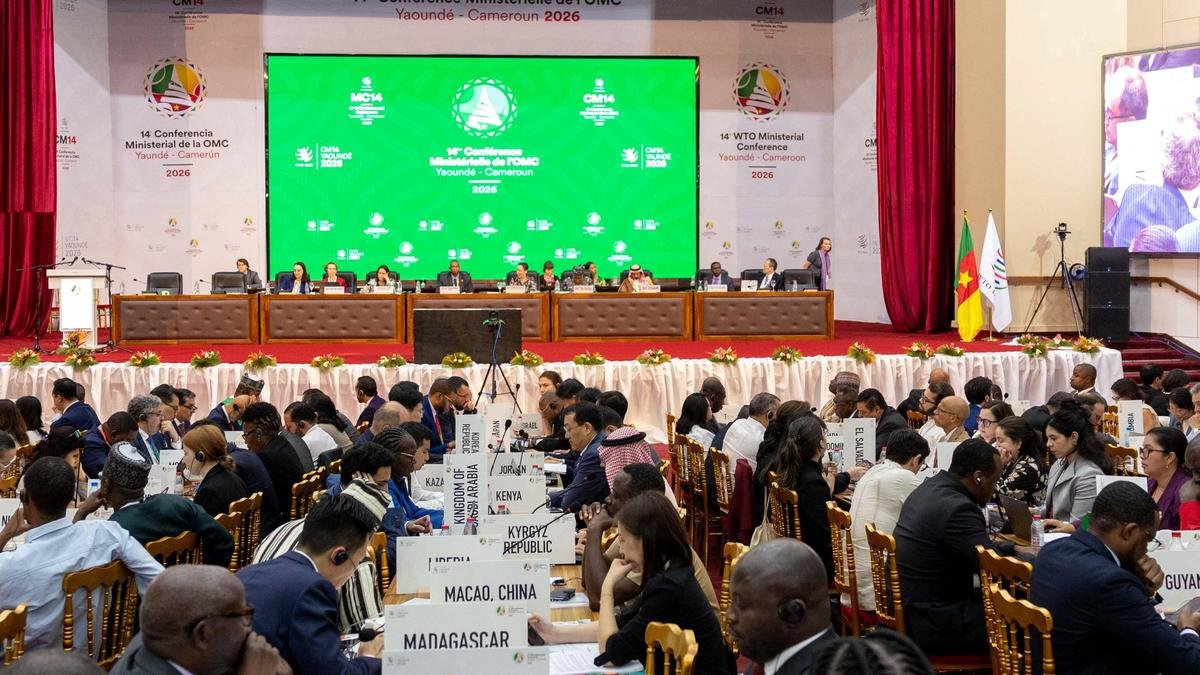
Trade multilateralism is facing its biggest stress test since the Second World War. The United States’ coercive unilateralism and attempts to dilute foundational rules such as the most-favoured nation (MFN) treatment threaten to hollow out the entire system. At such a critical juncture in history, the World Trade Organization (WTO)’s fourteenth Ministerial Conference (MC14), which recently concluded in Yaoundé, Cameroon (March 2026), was expected to reassure the global community about the importance of a rules-based global trading order, which limits hegemonic tendencies.
Regrettably, the MC14 failed to meet this challenge. While no one expected the MC14 to turn up trumps, the fact that the 166-member WTO failed to reach consensus on even issuing a ministerial declaration outlining future work is disconcerting. To paper over the cracks, the WTO’s Director General declared that the MC14 had produced a Yaoundé package comprising certain draft decisions, that is, decisions yet to be finalised, which will be discussed at Geneva in the months ahead.
Also Read | What is the World Trade Organization e-commerce moratorium?
Tale of two moratoriums
The MC14 will go down in history as the one that broke the long-standing consensus on moratoriums for two things. First, customs duties on electronic commerce transactions. Since 1998, WTO member-countries agreed not to impose customs duties on electronic commerce transactions to keep digital trade flows free. The moratorium has been extended every two years since its inception. However, at MC14, countries were unable to reach an agreement on extending the moratorium, which, thus, lapsed on March 31.
Today, countries are free to impose tariffs on digital trade flows, though it is expected that the WTO’s General Council will deliberate on this issue again in the months ahead. While this may provide developing countries with an opportunity to augment their revenue, it will burden consumers and businesses. A significant development that accompanied the end of the e-commerce moratorium was the signing of an e-commerce agreement (ECA) by 66 WTO members, which prohibits customs duties on digital trade.
Although not yet part of the WTO rulebook and binding only for the signatories, this agreement will establish two separate legal frameworks: the WTO, which allows tariffs on digital trade, and the ECA, which does not.
The second moratorium, in force since 1995, barred non-violation complaints under the WTO’s TRIPS Agreement. The WTO allows countries to file claims not only for legal violations but also when a country’s measures nullify another country’s anticipated benefits, even if those measures are legal.
This raises concerns for developing nations that their laws to promote public health could provoke complaints from developed countries alleging that they nullify the benefits of their intellectual property. Although such complaints are possible, history suggests they are unlikely to succeed, as evidenced by the failure of all 10 non-violation complaints related to trade in goods at the WTO.
COMMENT | Is the World Trade Organization still relevant?
Plurilateral innovation
A so-called low-hanging fruit at the MC14 was the incorporation of the plurilateral Investment Facilitation for Development (IFD) agreement into Annex 4 of the WTO Agreement, with support from 129 of 166 countries. However, it did not materialise due to India’s opposition. New Delhi opposed the IFD’s inclusion for multiple reasons, including the absence of legal safeguards to incorporate plurilateral agreements into the WTO acquis.
Plurilateral agreements to be incorporated into the WTO should be open and inclusive rather than exclusive. The failure to include the IFD Agreement has deepened the WTO’s legislative crisis, as the organisation struggles to establish rules for 21st century challenges.
EXPLAINED | What is at stake at the WTO’s MC14?
No road map for the future
The MC14 failed to provide a clear road map for WTO reforms. Critical issues such as reviving the stalled appellate function of the WTO’s dispute settlement system have been postponed. Any attempts by the developed world, especially the U.S., to undermine key principles, such as MFN and the special and differential treatment, must be strongly resisted.
It is often said that those who do not learn from history are doomed to repeat it. The history of trade multilateralism demonstrates that whenever trade multilateralism slows, American unilateralism tends to rise. This occurred in the early 1970s when the General Agreement on Tariffs and Trade (GATT) negotiations floundered, leading to the enactment of strict measures such as Section 301 of the U.S. Trade Act of 1974. This provision empowers the U.S. President to take unilateral action against perceived unfair trade practices. We are currently witnessing a similar situation, but this time without Congressional approval and with far greater vengeance. A setback at the MC14 will exacerbate these trends.
Additionally, the failure of the MC14 will accelerate the trend of countries creating new trade rules outside the WTO. To keep the WTO relevant, innovative solutions must be found, such as plurilateralising the WTO. India should take the lead in developing the legal guardrails needed for the development and adoption of plurilateral agreements within the WTO. Achieving this will require a novel approach and unflinching political commitment to trade multilateralism.
Prabhash Ranjan is Professor and Vice Dean (Research), Jindal Global Law School, O.P. Jindal Global University. The views expressed are personal
Published – April 06, 2026 12:48 am IST
