


By Purna Chandra Pradhan, Sushanta Mahapatra & Madan Meher
India’s digital boom counts every click, kilometre and customer rating as value. Platforms use this data to sharpen pricing, target customers, and attract investors, but the riders and drivers who generate these streams of information see little of the benefit. The labour questions of the twentieth century, involving wages, hours and social protection, now have a digital counterpart: who owns, controls and benefits from workers’ data? If policy focuses only on traditional concerns, India risks building a high-growth digital economy on a foundation that leaves workers at a disadvantage.
The stakes are clear. India’s growth story is increasingly digital. As per MeitY, Government of India, the digital economy accounted for 11.74 per cent of national income in 2022–23, valued at about ₹29 lakh crore, and is projected to rise to 13.42 per cent by 2024–25. A significant portion of this expansion is driven by platform-mediated work such as deliveries, ride-hailing and home services, where workers’ phones act as sensors feeding corporate intelligence.
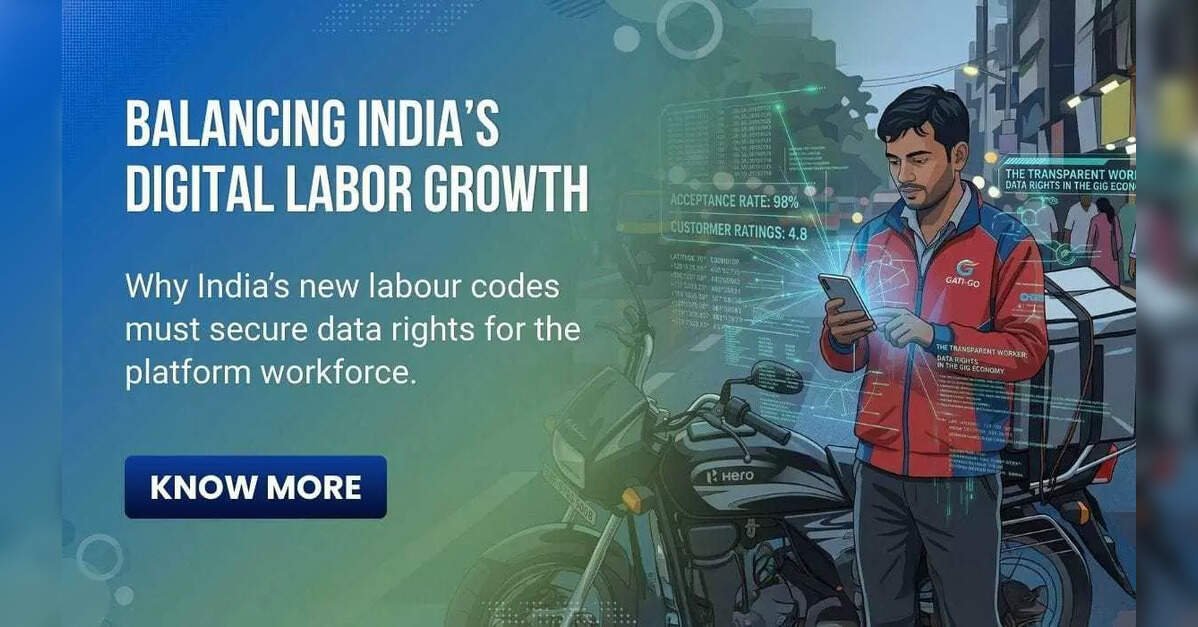
This creates a mismatch. Data flows upward while pay and protections remain limited. Workers face low and volatile earnings, long hours, and minimal benefits. Beneath these challenges lies a quieter extraction. Every route, acceptance rate, cancellation and customer rating feeds algorithms that assign tasks, calculate incentives, and determine suspensions. These systems also gamify work and show peer comparisons, encouraging longer hours and higher risk. What appears as flexibility can become dependence, producing informational and bargaining imbalances that shape worker decisions long before negotiations.
Indian policymakers have begun to respond. Several states have taken early steps to provide recognition and welfare support for platform workers. Rajasthan’s Platform-Based Gig Workers (Registration and Welfare) Act 2023 established a welfare board and registration framework. Karnataka has introduced a cess-funded social security ordinance, while Telangana and Maharashtra are developing boards, databases, and mapping initiatives. These measures represent an important shift, acknowledging that platform work requires institutional protection.
At the national level, India’s new labour codes mark the most comprehensive overhaul of labour law in decades. The Code on Social Security recognises gig and platform workers as distinct categories eligible for social security schemes. For the first time, these workers are acknowledged in formal statutory law. This inclusion provides a foundation for building broader protections.
Recognition alone is not sufficient. To be truly future-ready, the labour codes must also consider the digital realities that shape modern work. Platform work is inseparable from data production and automated decision-making. Labour regulation should integrate data governance as part of worker protection, alongside wages and benefits.
Fairness can be strengthened through three key measures. Workers should have access to clear records of trips, ratings, incentives, and the signals used in automated decisions. Platforms should provide summary explanations of key algorithms and allow independent audits of systems that determine pay and suspensions. Policymakers may also explore data dividends to channel a portion of platform-generated profits into welfare funds or direct support for registered workers. These measures are practical, politically feasible, and increasingly relevant as data becomes central to economic value.
The new labour codes present an opportunity to embed transparency, data rights, and grievance mechanisms within the legal framework. App-based workers could gain safeguards for collective voice, including protection against unfair deactivation, support for sectoral bargaining, and recognition of worker organisations adapted to dispersed digital work. They could also have rights to algorithmic impact assessments and appeals against adverse automated decisions. Such protections would make accountability meaningful.
Some critics argue that stricter rules could limit innovation. Evidence from state experiments suggests otherwise. Unchecked data extraction can weaken trust, fuel disputes, and invite heavier regulation, which ultimately affects platforms. Fair, well-designed rules can make platform work sustainable, enabling workers to share in the value they create while supporting platform growth.
India’s labour codes arrive at a pivotal moment. They offer the chance to modernise worker protection while recognising the realities of the digital economy. By extending social security and addressing the value of worker data, the codes can create a framework that balances flexibility with fairness, supporting both workers and platforms. For millions of riders, drivers, and service workers who keep India’s cities moving, such measures can provide protection, dignity, and equitable participation in the growth of the digital economy.
The author Purna Chandra Pradhan is the professor of Economics Area at XLRI Jamshedpur, Sushanta Mahapatra is the Associate Professor of Economics Area at IFHE Deemed University, Hyderabad, and Madan Meher is the Assistant Professor of Economics Area at Amity University, Raipur.
DISCLAIMER: The views expressed are solely of the author and ETEDUCATION does not necessarily subscribe to it. ETEDUCATION will not be responsible for any damage caused to any person or organisation directly or indirectly.
