
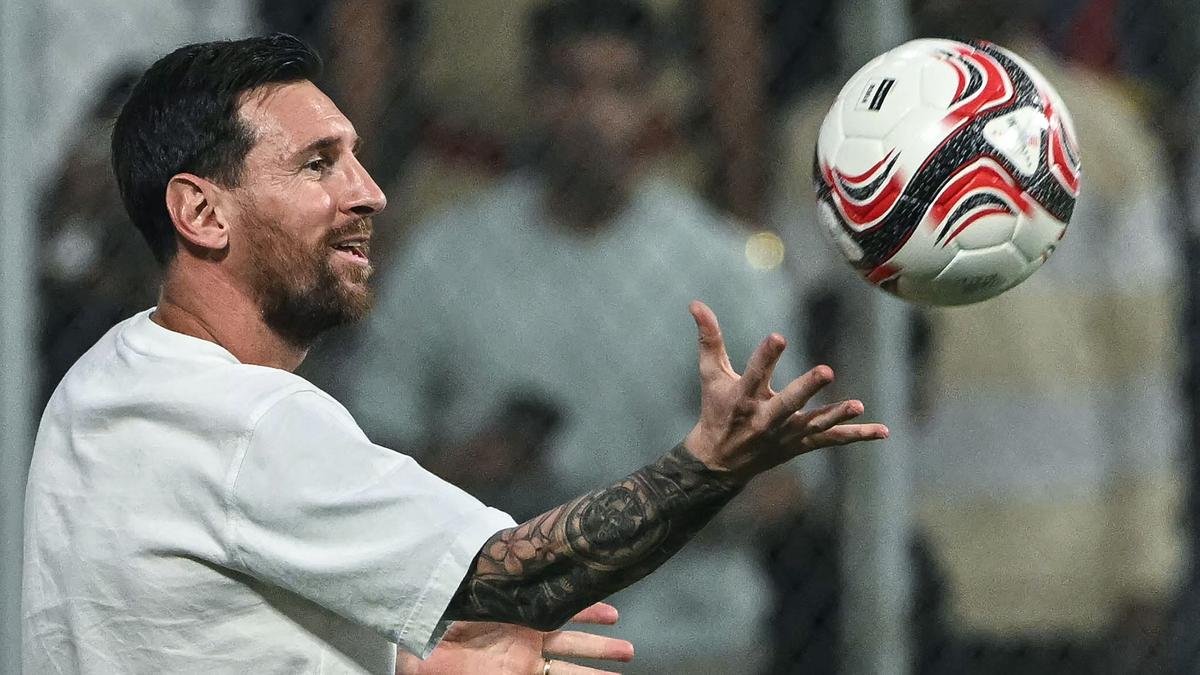
Four cities. Three days. Two close friends. One punishing itinerary.
That, in essence, was Lionel Messi’s GOAT India Tour, a whirlwind that delivered all the adulation the Argentine icon deserved, along with a measure of chaos he could have done without.
Kolkata, where football borders on religion, was the tour’s natural starting point. Mumbai and New Delhi, with their blend of glamour and power, were equally inevitable. The fourth and final stop, however, remained open, triggering a quiet contest among several States eager to host the world’s most recognisable footballer.
While Messi’s visit to India had been billed and advertised as a private event, there is no event in the country, especially one this high profile, that goes by without one, if not all, of the three industries having a hand in it: politics, films, and cricket.
And it is one part of that Venn diagram that ended up clinching Hyderabad’s spot on the tour.
“We had competition from Gujarat and Rajasthan. Even Karnataka was trying. Some states were trying very, very hard to take him,” Parvathi Reddy, Chief Patron and advisor for the Hyderabad leg of the GOAT Tour, told The Hindu.
“However, I had a trump card, and that was (Telangana Chief Minister) Revanth Reddy. Coincidentally, you know, he plays the sport and is passionate about it as well. Why not bring that in on the table?”
If anticipation surrounded Messi’s arrival in Hyderabad, so did anxiety, largely because of what had unfolded earlier in Kolkata. The scenes there, widely documented by national and international media, prompted alarm bells in the City of Pearls. Security was tightened, protocols revisited, and nerves stretched.
Calmed nerves
When Messi landed in Hyderabad alongside Inter Miami teammates Luis Suárez and Rodrigo De Paul, there was little spectacle. Any concerns about the trio’s mood after Kolkata, however, dissipated quickly.
“When we were in the car on our way from the stadium, I was telling De Paul that I have a son who is his age and is just as naughty as him. Then he began to joke about his age; he said he was 30 and was trying to play the fool. The other guys immediately chimed in and caught his lie. They were pulling each other’s leg with age; they were adding two years to each other’s ages and laughing about it. The vibe was very good.”
“I think Hyderabad made them relax; we gave them the comfort for them to be themselves. It was not overwhelming for them, in spite of what happened in Kolkata. They landed with some fear, understandably, maybe thinking, ‘What is going to happen?’ But we didn’t invade their personal spaces.
Messi was mobbed in the City of Joy, not by the masses but by bureaucrats, all wanting a piece of the legendary pie. Fans could barely spot their idol, and the hallowed turf of the Salt Lake Stadium, for once, left all fans, irrespective of their club or national allegiances, equally betrayed and seething with anger.
That episode shaped Hyderabad’s approach.
“I did have a conversation with Messi when they all landed, and we were in the car. The first thing I told them and the whole team was that everything in Hyderabad was in control. We also told them we will not have anybody on the field at the stadium. Only the children and four photographers, no one else to mob them,” she said.
Further proof of their ease came as soon as they reached Falaknuma Palace.
“There was this band playing as soon as we entered Falaknuma. The hotel arranged it, it is a regular thing they do. Bouquets were given, and then they had these dancers dancing to some music. I saw De Paul shake a leg and I was like ‘okay, let’s move a little bit.’ He’s such a wonderful character! They were all very chilled out.”
Recouping investment
Messi’s time in Hyderabad began with a meet-and-greet session at the Falaknuma Palace. The private event, for which tickets were sold to the crème de la crème of society for ₹10 lakh each, generated a lot of debate online.
Parvathi, however, vehemently defended the model.
“In theatres, why do we have 500 rupee tickets and then cheaper ones? Why do you segregate? It’s as simple as that. Why do you have a business class ticket and a normal economy class ticket? Why don’t you question that? In the end, you have to generate money to have an event like this and also make it ‘normal’ for regular people who wouldn’t otherwise fly to Argentina or the US or somewhere to see Messi.”
The demand ultimately fell short of expectations.
“We had 100 slots that we wanted to sell, but we barely sold 20 to 25. People were hardly willing to spend that kind of money. Meaning, they’re still not mentally prepared, even the ones who can afford it. The response to that event was definitely very, very minimal,” she said.
“Sponsors got to take a picture for free. Some we had sent as a courtesy, especially to people who have helped us put it together. There were some that were purchased and there were some that went to sponsors as a deliverable. So all of these categories of people were there.”
The players moved along, insulated from these logistical elements. Their mood also got a boost when they could switch back to a more familiar tongue – Spanish – during a brief chat with Congress leader Rahul Gandhi.
“Rahul ji, Revanth Reddy, myself, Messi, Suarez, De Paul, all of us were there and had a chat for a few minutes around the courtyard garden. He (Rahul) had a conversation with them in Spanish, and they felt very comfortable with that.”
Wants, and hard lines
The tour then moved to Uppal, where a section of the cricket stadium had been converted into a makeshift football pitch. Images of Messi, Suarez, and De Paul casually striking footballs into the stands soon flooded social media – a rare moment of ease amid a relentless schedule.
They spent less than an hour at the venue, but left behind memories that fans will carry for a lifetime. With Mumbai and Delhi still to come, the rest was the priority, though not before dinner.
“The players asked for grilled chicken and fish. De Paul told me that he loves eating sweet potatoes and requested me to ensure he gets that.”
There was one unanimous instruction, however.
“They didn’t want spice. The line ‘We don’t want spice,’ was said about 10 times.”
Officially, Messi’s Hyderabad visit ended that night. For fans, it didn’t.
“I saw a kid who had come from Mumbai. He wanted to see Messi, and at around 11:30 p.m. or so, when I was leaving the hotel, he asked me, “Aunty, will he not come out?” I said no, he’s retired for the night. The next morning, I saw him waiting in the courtyard again.”
And he was not the only kid at the hotel who was eager to get a brush with greatness, pushing Parvathi to improvise.
“There were a lot of children in Falaknuma who wanted a picture. I knew it would be chaotic; there were at least 20 to 30 children. Since individual pictures were not possible, I made them sit together, in three levels.”
“One standing, one kneeling, and one sitting down. And I told them to leave space for three people in the center. One of Messi’s personal security was unsure if a picture would happen. But I fought back and said it will happen.”
“Then Messi walked out, and then all three of them went straight to the children and took a picture. They saw those kids beautifully in three levels, and I didn’t have to tell them anything. They just walked straight to them and took a picture. I felt very good that I could give that picture for free to 20 children who I thought would go home happy.”
Quiet regrets
While Hyderabad delivered the hospitality India prides itself on, Parvathi was left with a few personal regrets.
“My entire team couldn’t get a picture with them, nor did anyone from Hyderabad Talkies (the company managing the event),” she said, adding, “But when you host something, you have to be very responsible. Our focus was fully on that, and in the end, we couldn’t get a picture with the team.”
Even she missed out.
“In fact, I spent a lot of time with them in the car, and I do not have a single selfie with all three of them. I still cannot believe I forgot that! Thankfully, De Paul was kind enough to suggest I take one with him when we were in the stadium.”
While she couldn’t get her family to also have a picture with the three players, she is glad to have gotten their autographs for her daughter-in-law.
“My daughter-in-law is pregnant, and we didn’t want to take her to public spaces. And because there was so much happening, you can’t steal their time for yourself. Unfortunately, she couldn’t get a picture with Messi, but we managed to get her his autograph, that too on her handbag! So she’s very happy about it.”
“When I told Messi that my daughter-in-law wants his signature on her bag, he paused and then asked me if I was sure. I told him that the memory that he will give her will be priceless.”
In a tour dominated by flash and fanfare, and beyond the stadiums and cameras, it was the human connections that left the deepest marks. The small gestures and the fleeting smiles were a reminder that Messi is more than a footballer; he’s a moment-maker.
For Hyderabad, and for the fans lucky enough to witness it, it was less about chaos and more about character. Messi’s boots may have left the city, but his footprint is now permanent.
