


We are all feeling the shift. The familiar corporate ladder that we were told to climb is being dismantled and replaced by flat, fast-moving networks where titles mean less and agility means everything. Today, a manager sitting in Mumbai might lead a team spread across three different continents, all while trying to figure out if Artificial Intelligence (AI) is there to help them or replace them. The reality is that leadership is being reshaped faster than we can print the manuals for it.
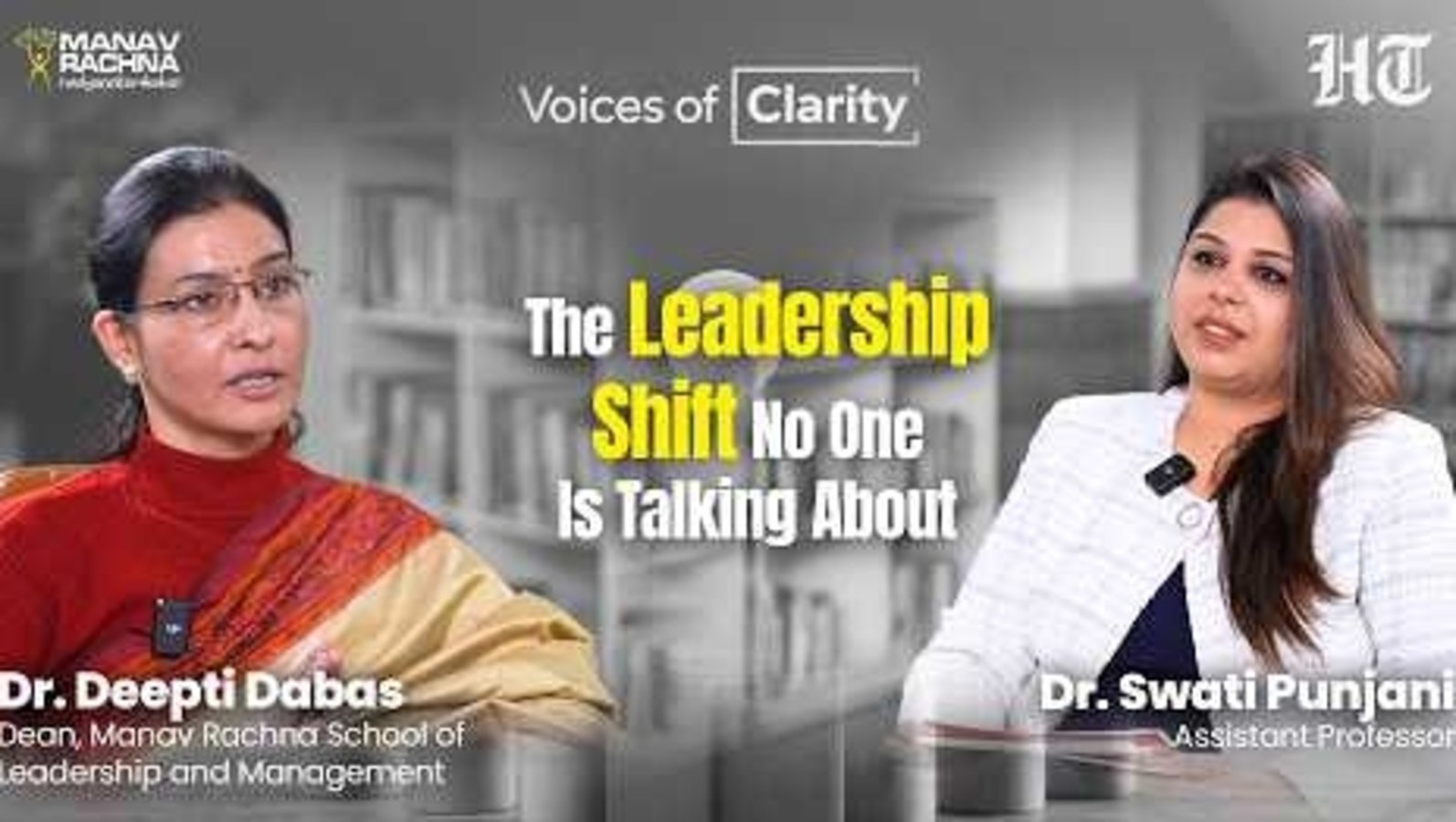
The question is how can we stay grounded in such an environment. In a special interaction, Dr Deepti Dabas Hazarika, Dean of the School of Leadership and Management at Manav Rachna, spoke about how our leadership must become more intelligent and more human as our tools deploy more AI.
The human centre in a digital storm
While tech transformation dominates boardroom discussions, Dr Dabas felt that the core of successful leadership remains to be the people. Drawing inspiration from Henry Ford’s philosophy that people are the ultimate strength of any enterprise, she views the leader not as a mere manager of processes, but as a lighthouse in a storm of digital disruption.
Whether it is navigating geopolitical shifts or managing intergenerational cohorts like Gen Z, the leader’s role has transitioned into that of a friend, philosopher and guide. “The role of a leader remains the centrepiece of driving through this entire change… as the mentor, and as the one person the team looks at as the face, the centrepiece of culture, building trust for everybody around,” she said.
Taking a closer look at the flattening structures
One of the most significant structural shifts in Indian industry, both for established giants or start-ups , is the move toward “flatter” organisations. Traditionally, career paths looked like multi-layered hierarchies where “power distance” defined the relationship between a boss and their team. Today, those layers are thinning.
Dr Dabas saw this not as a loss of control, but as an opportunity for mentorship. In a flat structure, a leader acts as a fulcrum with a wider span of control, tasked with identifying what she called “process owners” rather than just subordinates. This shift demands a move toward clearly defined Key Result Areas (KRAs) to ensure that despite the lack of layers, the mission remains focused.
“What it requires is to identify process owners, identify functional leaders… that purpose should be very clear, from a vision of a leader towards a broader team of further leaders,” she said.
Psychological safety in the hybrid world
The pandemic served as a kind of global masterclass in the importance of human connection. While remote work was not new to sales or distribution networks, the sudden lack of face-to-face interaction for entire organisations created a disconnect that leaders are still working to bridge so many years later.
Dr Dabas highlighted that the modern leader must prioritise psychological safety. This involves moving beyond functional check-ins to genuine engagement which focused on non-defensive communication.
“Leaders quickly understood like never before post-pandemic that they need to keep that connection going with their people, even if it is a personalised message on the date of joining or on somebody’s birthday,” she said.
Leadership for the Gen Z workforce
Perhaps the most discussed cohort in the workforce today is Gen Z. Often labelled as “difficult to handle”, Dr Dabas offered a different perspective. Representing nearly 25 per cent of the Indian workforce, Gen Z is tech-native and values independence. However, she noted a common expectation mismatch when they hit the realities of the professional world.
To lead Gen Z effectively, she suggested a trade-off where you provide them with absolute clarity and freedom, and in return, benefit from their creativity. “They need to be told about the legacy systems, but they need to be given a free hand. The creativity and out-of-box thinking which you get from Gen Z is wonderful,” Dr Dabas said.
Her advice is simple for Gen Z professionals entering management roles for the first time. “They need to remain grounded… accept, appreciate and respect that they are working with senior cohorts as well and accept them as mentors,” she said.
The role of AI as an enabler
AI is frequently called the “elephant in the room”, but Dr Dabas disagrees with the framing of AI as a threat. Instead, she views it as a “mammoth enabler” that handles the heavy lifting of number crunching, freeing humans to focus on higher-level intelligence.
As AI takes over tasks, the value of Emotional Intelligence (EI) and even Spiritual Intelligence (SI) is expected to skyrocket. “There has to be a trustworthiness there which will not be there in a software… the human centricity, the empathy quotient, and the ‘yes, I have somebody to talk to’ that AI will never be able to curb,” she further said.
Using AI to transform education
The proliferation of information at the click of a button has rendered traditional “chalk and talk” methods obsolete. Dr Dabas spoke about a shift toward “Bloom’s Taxonomy”, which focussed on Higher Order Thinking Skills (HOTS) like synthesis and creation rather than simple rote memorisation.
Modern education must be an experiential package. This includes flipped classrooms where students teach their peers, use cloud-based simulations and reverse internships where faculty spend time in the industry to stay updated with market requirements.
“If I see I forget, but if I, hands-on, get into an exercise, then I imbibe it… the probability that I’m likely to replicate that or improvise upon that experience increases manifold,” she said.
The new skills of resilience and networking
Beyond technical domain knowledge, which remains the necessary foundation, the future belongs to those with strong social skills. Dr Dabas said traditional teamwork is collaboration and friend-making is networking. These form the new definition of social net worth.
The ability to be resilient in the face of burnout and to embrace change as a constant are now non-negotiable traits for both students and educators. “To embrace change, to be resilient, to collaborate with people, not to consider geographical boundaries as boundaries any longer, and to be grounded… these are the skills which we should imbibe,” she said.
