


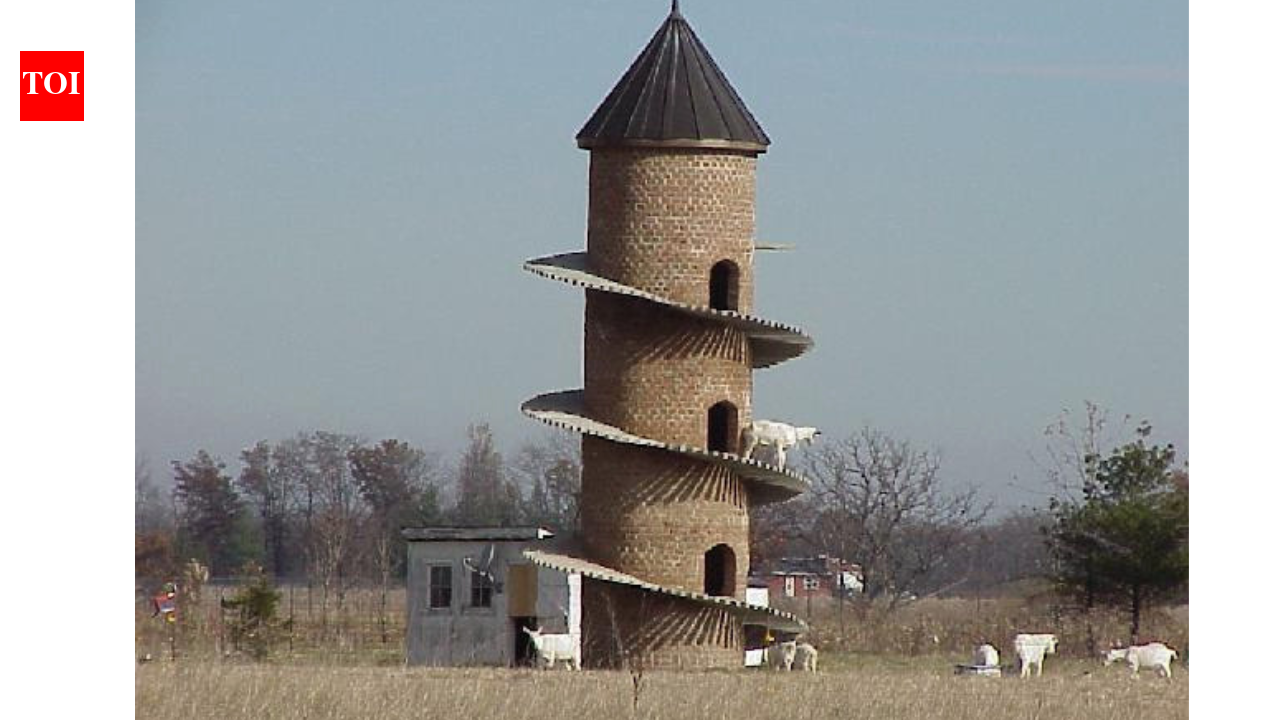
A 31-foot brick tower built just for goats stands in rural Illinois, and yes, it is completely real. Wrapped in a spiral of narrow ramps, the structure lets goats climb, rest, and look out over the surrounding farmland. What might seem like a quirky or even absurd idea at first has actually gained widespread attention online. But beyond its unusual design lies a practical purpose, combining animal behaviour, farm innovation, and a touch of creativity to transform an ordinary dairy setup into something far more distinctive.
What is the ‘goat tower ’
The structure, often referred to as the “Tower of Baa-Goat,” is located in Windsor, Illinois and was built by farmers David and Marcia Johnson. Rising roughly 31 feet high, the tower is constructed from around 5,000 handmade bricks and features a continuous spiral pathway made up of hundreds of steps.Inside, the tower is divided into multiple compartments where goats can rest, while the outer spiral allows them to climb to the top. The design is both functional and visually striking, resembling a miniature fortress built not for humans, but for livestock.At first glance, the idea seems purely eccentric. But goats are natural climbers. In the wild, they instinctively seek elevated terrain to monitor their surroundings and stay active. Flat farmland does not offer that stimulation.By creating a vertical environment, the tower allows goats to express these natural behaviours. Animal welfare research suggests that such enrichment can reduce stress, prevent boredom, and limit repetitive behaviours often seen in confined livestock. What appears quirky is, in practice, a thoughtful adaptation to the animals’ instincts.
More than a novelty: Function meets design
While the tower serves a practical purpose, it also stands out as a piece of unconventional architecture. Its spiral design and compact height evoke comparisons to famous landmarks, giving it a distinct visual identity.Over time, it has evolved into a local attraction. Visitors often stop by to watch goats navigate the ramps, turning a simple farm feature into a point of curiosity. In this way, the structure blends utility with tourism, helping the farm gain attention far beyond its immediate surroundings.Despite recent social media posts suggesting it is a new construction, the goat tower is not a 2024 creation. It was originally conceived in the late 1990s, with goats introduced shortly after completion.Its resurgence online reflects how easily older, unusual structures can find new life in the age of viral content. Stripped of context, the tower appears almost fictional, which is precisely what fuels its popularity today.
The bigger picture: Rethinking farm spaces
The goat tower highlights a broader shift in how farms approach animal care. Rather than purely focusing on efficiency, some farmers are experimenting with environments that encourage natural behaviour.Structures like this challenge the assumption that livestock spaces must be purely utilitarian. Instead, they show how creativity and science can intersect, resulting in designs that benefit both animals and farmers while capturing public imagination.
From curiosity to symbol
What began as a practical idea has become something more symbolic. The tower represents a blend of ingenuity, humour, and care, proving that even in traditional industries like farming, unconventional thinking can thrive.In the end, the “GOAT Tower” lives up to its name not just because it houses goats, but because it stands as a greatest-of-all-time example of how the unexpected can work beautifully in the real world.
