


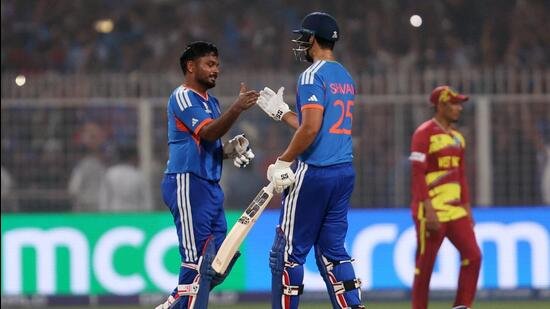
Kolkata: In the long arc of T20 cricket, batting almost always used to gravitate towards a single, central star. Australia once orbited around David Warner. England’s white-ball revolution was inseparable from Jos Buttler. Even India, for much of the last decade, found its T20 identity braided tightly with the genius of Virat Kohli in the middle and Rohit Sharma at the start. Over the past two years, however, India systematically dismantled and democratised that reliance. The result is what you see today.
From Abhishek Sharma’s uninhibited powerplay assaults to Ishan Kishan’s elastic strokeplay, from Tilak Varma’s middle-overs poise to Suryakumar Yadav’s angle-defying audacity, from Shivam Dube’s matchup-based muscle to Hardik Pandya’s dual-role flexibility and Sanju Samson’s high-variance elegance, India’s T20 batting has morphed into a constellation of high-performance generators. Samson’s calm, collected and match-winning 97 on Sunday once again underlines how India have created an effective and aesthetic structural reliance under Gautam Gambhir’s supervision.
Not just Samson. Had it not been for Dube’s two quick, pressure-releasing boundaries in the 19th over after Pandya’s dismissal, the asking rate could have been different. Suryakumar’s strike rate was only 112.5, but paramount was the 58-run stand he helped stitch with Samson. Ditto for Varma, whose 15-ball 27 helped add another 42 runs. All these contributions compounded together into a win that couldn’t have come easy.
“For too many years, we’ve only spoken about certain contributions. This is a team sport, and this will always remain a team sport,” said Gambhir, whose 97 in the 2011 World Cup final has never been serenaded the way it deserved. “For me, I think Shivam’s two boundaries are as important as Sanju’s ninety. Because if he wouldn’t have been able to hit those two boundaries, probably that 95, you won’t have even spoken about.
“So it’s not only about 95–yes he played a special innings, but those small contributions actually help you win games as well. The big contribution makes headlines. The small contribution, the contribution that can help the team win, cross that line, is going to be very important. And that’s why I say that this is going to be the philosophy going forward till I am there.”
For years, India’s T20 batting model leaned on an anchor—someone who could bat deep, manage volatility and provide a psychological safety net. That approach, effective in bilateral series, often left the team short in world tournaments where pitches weren’t always easy. Left-right batting combinations were slowly introduced, and quickly that was binned for left-handed top-order domination. Who knows, this approach too might not find favour in a few months. Point is, India refused to be stereotyped, making it impossible for opponent teams to get an actionable read on them.
Gambhir believes their power batting allows for that flexibility. “When you’ve got power, you’re never away from the chase. You’re never away out of the game as well,” he said. “You’ve got people like Tilak, who has batted really well in both the innings. He’s batted out of his position. He batted at number three initially. But now when we pushed him at number five six see how he’s batted. So you’ve got that talent you need to have that talent where you can bat out of positions.”
The recalibration hasn’t been subtle. But it has worked so far. Rather than asking one batter to absorb pressure, this team works as a unit to engineer pressure back onto the opposition. That in turn has changed the emotional tempo of India’s innings. Instead of waiting for a designated finisher, the team now seeks multiple inflection points across different junctures.
Samson embodies the new tolerance for volatility. There was a time when inconsistency might have cost him extended runs. But now India have adopted a more layered wait-and-watch policy. So when Samson didn’t do well against New Zealand, he was allowed to take his mind off the failures. “Obviously he had a tough series against New Zealand, so sometimes it’s important to give him a break as well, because you want to get the guy off that pressure situation as well,” said Gambhir. “And we always knew that whenever we need him in the World Cup game, he’ll come and deliver it for us. And against Zimbabwe, he delivered it for us. We got a start that we wanted in the first three overs (48/1 in 3.4 overs when he was dismissed). And today, again, from where he had left against Zimbabwe, he showcased his talent.”
This approach reflects an acceptance of net positive mathematics in a format that rewards bursts over averages. Perhaps that’s the most significant shift in India’s philosophical approach too. In ensuring such a high-performing flexible batting depth, India have effectively rendered opposition planning more probabilistic than targeted. There is no single wicket that unlocks relief for them anymore. Remove one aggressor and another arrives, often with a different scoring pattern. This multiplicity has also allowed India to tailor lineups to conditions, to distribute responsibility. WIth success no longer monopolised, India’s batting has effectively been democratised.
The defeat to South Africa showed this evolution is not without peril. On difficult surfaces, a cascade of dismissals can expose the absence of a traditional stabiliser. Yet India appear comfortable with that trade-off, choosing plurality over singularity and raising their ceiling in the process. The names change—Abhishek one night, Suryakumar the next, Dube or Samson after that—but the template endures. India’s T20 batting is no longer a story about rescue acts. It’s about recurring surges. For a cricket culture long accustomed to lionizing individual heroes, this collective turn marks a quiet revolution.
