


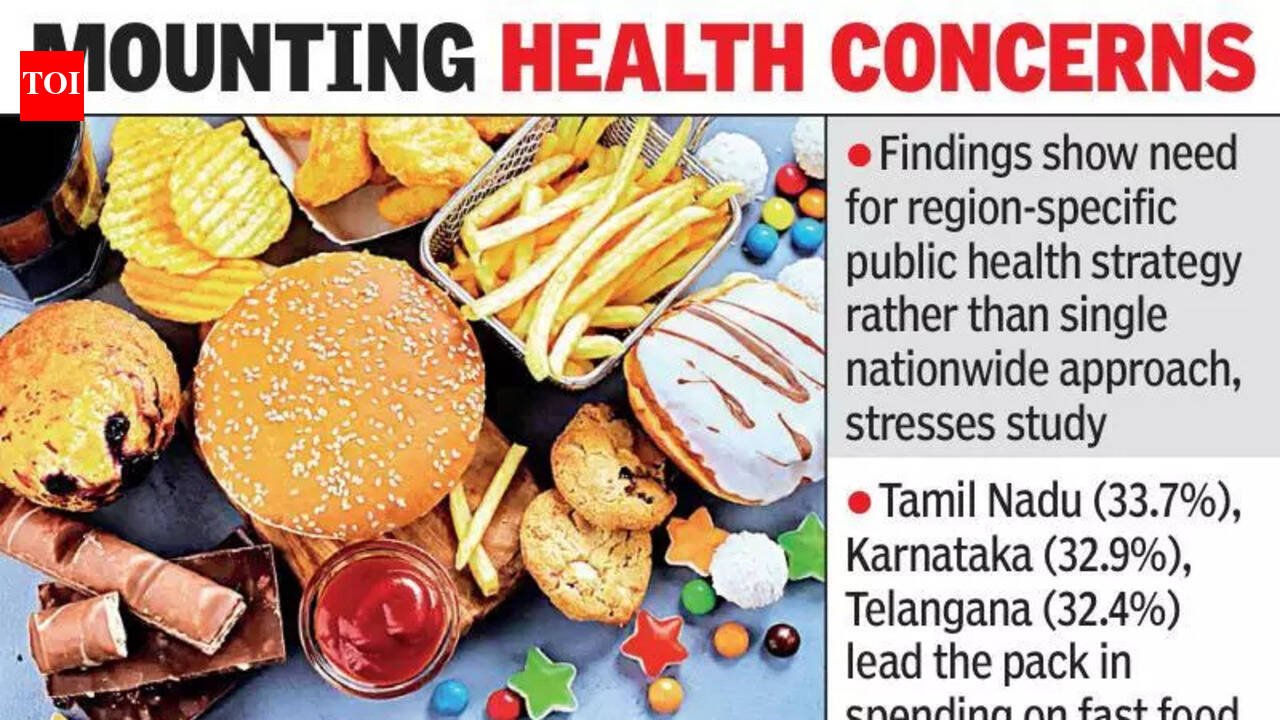
Hyderabad: People in Hyderabad and other urban hubs of Telangana, as well as in the southern states of the country, are spending a third of their monthly food budget on fast food, leading to a sharp rise in type-2 diabetes in the region.This has been brought out in a recent study ‘FADIS (Fast-food Attributed Diabetes Index Study)’ published in the Indian Journal of Medical Research (IJMR) of the Indian Council of Medical Research (ICMR). It was taken up by doctors from Mayo Clinic, USA, and the Siddhartha Medical College, Vijayawada.The growing spend on fast food has led to a massive rise in consumption of ultra-processed foods (UPFs) in Telangana, Tamil Nadu, Karnataka, Kerala and Andhra Pradesh, the authors say.For both urban men and women, the study has found a significant link between spending on fast food and diabetes rates. In rural areas, however, the correlation was weaker, which doctors attributed to lower access to junk food outlets and different lifestyle patterns.To break it down, on average an individual spends between Rs 1,000 and Rs 1,450 per person monthly on UPFs from the total Rs 4,120. It includes industrially prepared, ready-to-eat or ready-to-heat meals, snacks and beverages that are typically high in refined carbohydrates, added sugars, unhealthy fats and salt.The study warns that these states are at the forefront of a ‘nutritional transition’ where traditional diets are being replaced by energy-dense and processed foods. Tamil Nadu tops chart, Telangana thirdAmong the 18 states analysed for per capita spending on fast food, all southern states ranked at the top. Tamil Nadu recorded the highest share of spending on fast food, followed by Karnataka and Telangana. In comparison, several northern and northeastern states reported UPF consumption rates below 15%.Identifying Telangana as a high-risk zone, the study says Hyderabad and other urban areas are already seeing health impacts, with diabetes prevalence reaching 3.8% among urban men, one of the higher rates recorded in the study.Among women, the study identifies excess weight and obesity as the single most significant risk factor for diabetes. In fact, obesity levels among women in the southern states were found to be much higher than the current prevalence, indicating that a large population could be at risk of developing diabetes in the future.The study stressed that the findings highlight the need for gender-focused and region-specific public health strategies, rather than a single nationwide approach. With fast-food spending in Telangana nearly three times higher than in some northern states, the researchers recommended targeted nutrition awareness campaigns, urban food policy reforms and community-level interventions to reduce the consumption of ultra-processed foods.
