


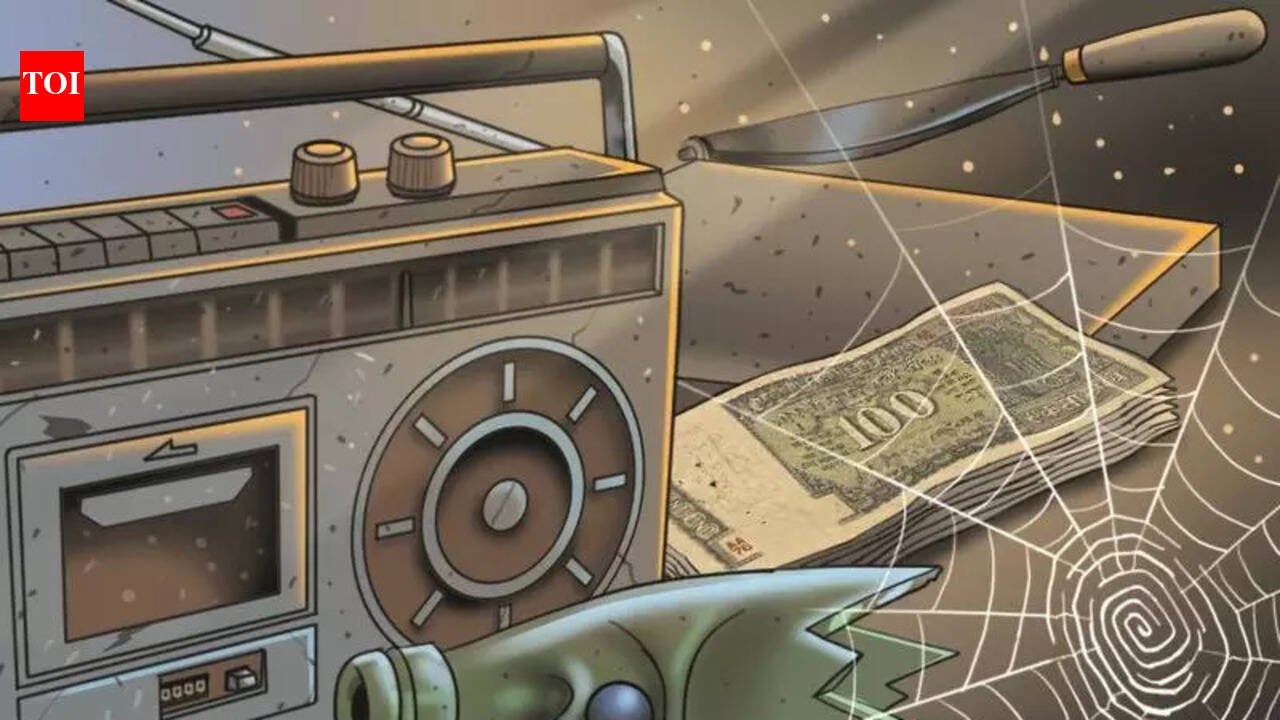
Mumbai: Four-decade-old tape recorders, obsolete currency notes now prized mainly by collectors, and physical glass slides, blocks and paper-cutting machines once allegedly used to counterfeit money are finally set to leave the muddemal rooms of the city sessions court. Their exit follows the recent disposal of several criminal cases from the 1980s and 1990s, most of which ended in acquittal. Muddemal refers to material evidence in a case.Additional Sessions Judge Satyanarayan R Navander cleared nearly 20 men across four, 40-year-old trials.Taken together, the cases trace a city’s shift from the analog world of the 1980s and 1990s to today’s digital age. They also show how extreme delay, in some instances stretching beyond 40 years, steadily eroded the prosecution’s ability to prove guilt. The evidence belonged to another era: counterfeit Rs 100 notes, then a high-value denomination, allegedly produced using glass slides, blocks and paper-cutting tools, long before scanners and digital printers became common.Other cases reflected the crimes of their time. In one, broken soda-water bottles were used as weapons, from a period before illegal firearms became widespread. In another, the theft of Rs 300 in cash and gold chains worth Rs 5,500 amounted to a major robbery in 1985. A 1992 Colaba case centred on a car tape recorder, then an expensive removable device with a thriving black-market demand.The common thread in these collapses was the disappearance of witnesses. Key witnesses and even accused persons died, moved away or simply lost memory of the events, making proof beyond reasonable doubt impossible. In a counterfeit currency case, the trial lasted 40 years and 11 days. It began with a single Rs 100 note passed at a South Mumbai fruit stall in 1985. Much of the delay was attributed to the accused remaining absconding for years. By the time judgment was delivered in Feb 2026, some of the original nine accused had died and others had already been acquitted.A notable feature of these recent acquittals is that several trials proceeded under the Bharatiya Nagarik Suraksha Sanhita, which allows courts to continue in the absence of accused who have long been absconding. But while the law enabled proceedings to move ahead, the evidence, both human and material, had not survived the passage of time. In each case, the court found that nothing incriminating remained on record.Eyewitness testimony, still important today, was even more central in the pre-CCTV era. In a 1985 robbery in Bhandup, the court acquitted the remaining accused in March 2026 after nearly 40 years of proceedings. A group armed with broken soda-water bottles stormed Sushila Masala Stores and Dada General Stores, robbing Rs 300 from the counter and snatching gold chains from the victims. The stolen property was then valued at Rs 5,500. Two accused had already been acquitted in 2004 and 2009, while two others remained untraceable. Since they had jumped bail and absconded, the court eventually tried them in absentia under the BNSS. But when witnesses were called to identify the attackers, the case collapsed. One witness told the court, “I haven’t seen these men before.”In a 1992 Colaba case, the prosecution alleged that three accused entered the parking area of Sangeet Co-operative Housing Society in the early hours of Sept 24 to steal a car tape recorder. When confronted by the watchman, they allegedly stabbed him with a knife and fled with the device. One co-accused died during the pendency of the case and another was acquitted in 2004. The trial against the third continued in his absence. But the watchman, the prosecution’s main witness, deposed that although a theft had occurred, he had not actually seen the thieves.The counterfeit currency case exposed another weakness: physical possession alone does not establish legal guilt without scientific proof. Police had seized printing blocks, glass slides and paper-cutting machines. But the investigating officer never sent the seized Rs 100 notes to a govt mint or forensic laboratory for expert examination. Without that, the court said, there was no legal basis to declare the notes fake. A layperson’s suspicion, whether that of a fruit seller or a police officer, could not substitute for forensic evidence, the judge noted. After 40 years, the equipment was ordered destroyed as worthless because its connection to any crime had never been scientifically established.Procedural lapses also proved fatal. In a 1990 dacoity and murder conspiracy case, six men were acquitted. The prosecution stemmed from a July 1990 robbery at Mahavir Traders on P D’Mello Road, where armed men allegedly stole Rs 97,000, a gold chain and a wristwatch. With no digital or DNA evidence, the case depended on a test identification parade. But the victim admitted the police had shown him the suspects beforehand, rendering the identification legally unreliable. The special executive magistrate who conducted the parade was not examined, and the victim could not identify the seized cash. The court ordered the money forfeited to the state and directed disposal of the remaining material evidence.
