


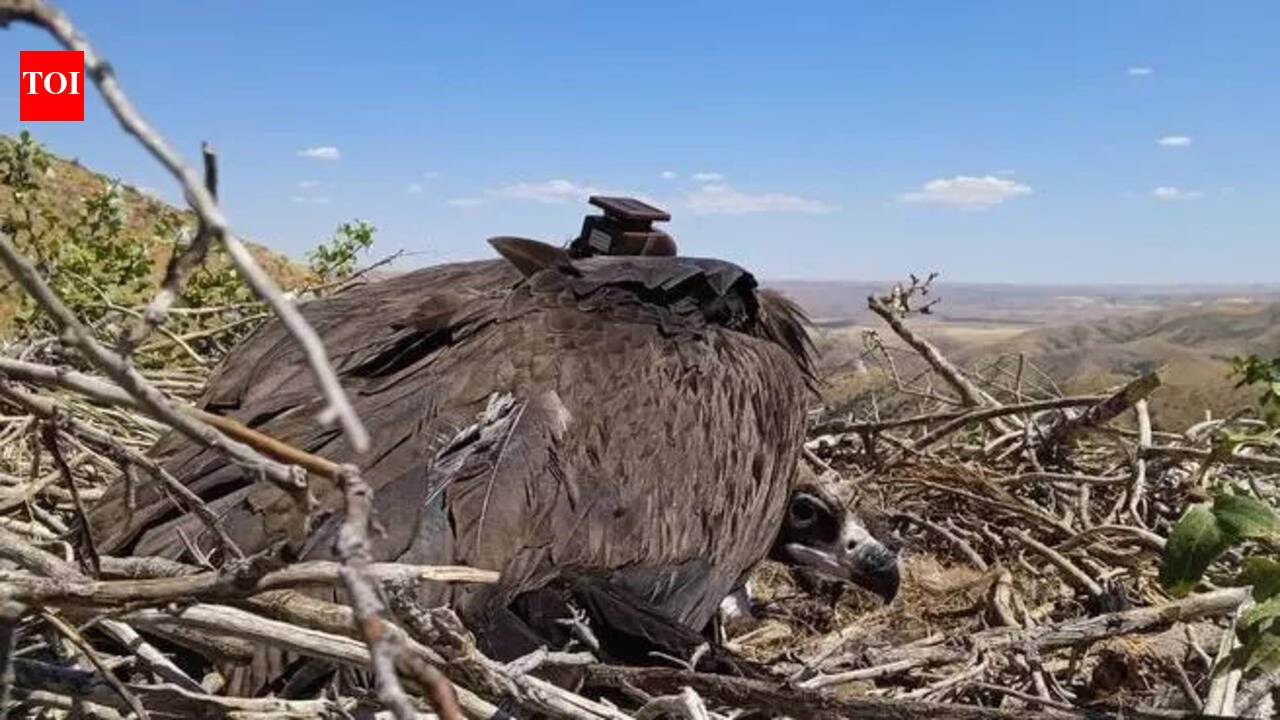
Jaipur: The first Cinereous Vulture tagged in Kazakhstan under an international raptor tracking programme and later migrating to Rajasthan during the winter season was found dead in Judiya village in Jodhpur during a routine field survey.The juvenile vulture was fitted with a satellite tag on July 24-2024 to monitor long distance migration routes between Central Asia and the Indian subcontinent. It successfully completed its two back and froth journey, but died on third winter surjourn.Preliminary assessments by conservationists suggested the raptor may have died after feeding on the carcass of a livestock animal that had allegedly been administered a banned veterinary painkiller before death, a threat long linked to vulture mortality across South Asia.A member of the Raptor Conservation Society said, “The tag number of the bird is KA5105. Two times it successfully completed the back and forth journey and this time it was found dead.”The bird was fitted with a satellite transmitter and identification ring under the Raptor Research and Conservation Network by scientists Igor Karyakin and Alyona Kaptyonkina, who studied migratory raptor movements across Eurasia.During the survey, conservationists recovered bird’s identification ring, which confirmed its identity, but the satellite tag could not be located. “It appears the bird died almost a week ago and the body had already decomposed significantly, with most of the remains consumed by feral animals,” a conservationist said. Rajasthan hosts major carcass dumping grounds that supported one of the highest concentrations of wintering raptors in Asia, attracting several migratory species from Central Asia every year. However, conservationists warned that the continued use of toxic veterinary drugs remained a serious threat to these birds.Recently, the Centre prohibited the production, sale and distribution of all formulations of Nimesulide, a drug widely used as a painkiller for livestock. The decision followed research conducted by the Indian Veterinary Research Institute in Bareilly, which confirmed the drug’s lethal impact on vultures that consume contaminated carcasses. Despite the ban, conservationists alleged the drug continued to be easily available in parts of Rajasthan.Environmentalists said a large number of raptors migrating from Central Asia relied on carcass dumping sites in Rajasthan for food during winter, and exposure to toxic veterinary drugs increasingly affected the survival of younger birds. “Nimesulide was widely used as a painkiller for animals including cattle, pigs and horses. When such animals die and are dumped in carcass yards, vultures feed on them and ingest the toxic residue, which often proves fatal, particularly for young birds,” said researcher Dau Lal Bohra.Another environmentalist said that while several harmful veterinary drugs were banned in India over the years, enforcement on the ground remained weak. “To protect the vulture population, a number of veterinary drugs have been prohibited. The most significant among them is Diclofenac, which was banned for veterinary use in 2006. More recently, Aceclofenac and Ketoprofen were also banned in 2023–24, but effective implementation of these restrictions is still lacking,” the environmentalist said.
