


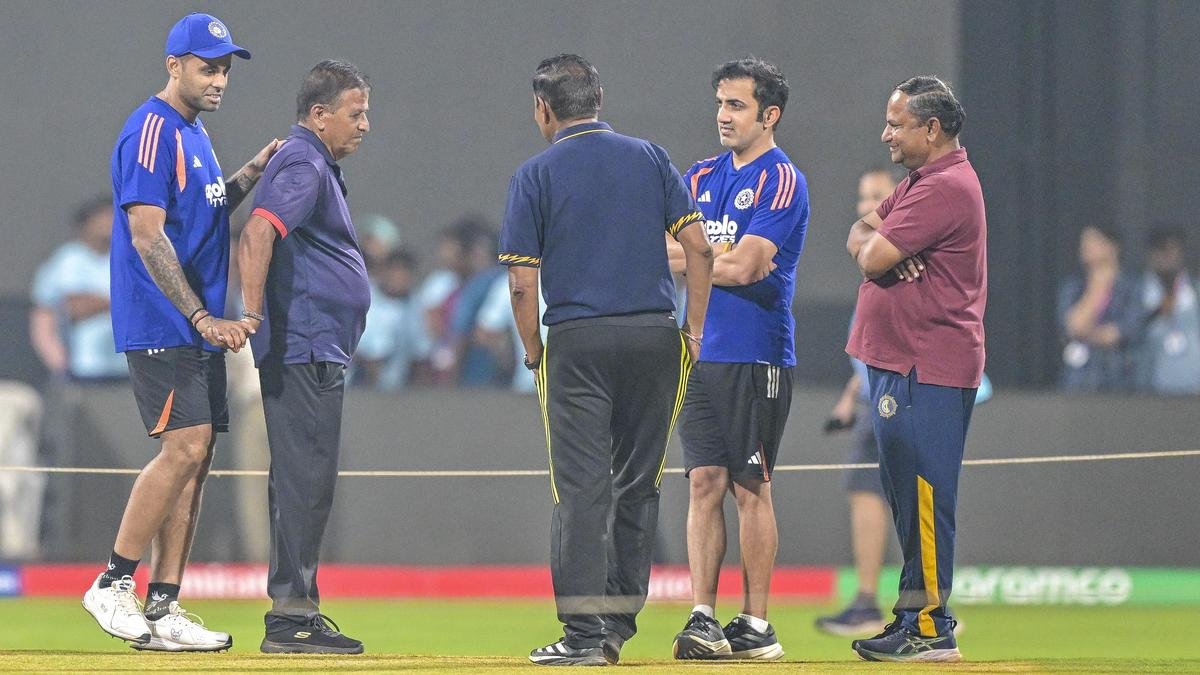
India’s captain Suryakumar Yadav, head coach Gautam Gambhir and Ramesh Mhamunkar, chief curator of Wankhede Stadium, near the playing surface on Tuesday, March 3, 2026.
| Photo Credit: EMMANUAL YOGINI
Twenty-four days after launching its Men’s T20 World Cup title defence with a scratchy win over the United States, Suryakumar Yadav’s men returned to the Wankhede Stadium on Tuesday night — this time with a semifinal against England looming large.
As the Indian squad went through its fielding drills under lights, the curators quietly covered the 22-yard strip that will dictate fortunes on Thursday. Two days out, the surface wore a greener look than is customary at the Wankhede — even by First-Class standards, let alone a T20 International.
With temperatures climbing steadily over the past fortnight, the decision to retain a healthy grass cover was understandable, a protective measure to prevent the pitch from drying out and breaking up. The pertinent question now is how much of that grass will be shaved off before match time.
Interestingly, while head coach Gautam Gambhir took a close look at the strip before it was covered, none of the Indian players ambled across to inspect it. Perhaps they are content to wait until match day, drawing cues from the two fixtures already played on this surface earlier in the tournament.
The red-soiled surface slated for Thursday’s semifinal was used for England’s clash against West Indies on February 11 and the Italy-Nepal game the following day. On both occasions, it offered assistance to spinners, particularly as the games progressed. Yet, much has changed since then — not least the weather and the stakes.
India’s preference for truer, flatter decks has been indulged through the Super Eights. Whether that pattern continues at the semifinal stage remains to be seen. For now, beneath the covers and the coastal humidity, the Wankhede strip holds its secrets close — waiting to reveal them on the biggest night of India’s campaign.
Published – March 03, 2026 09:06 pm IST
