
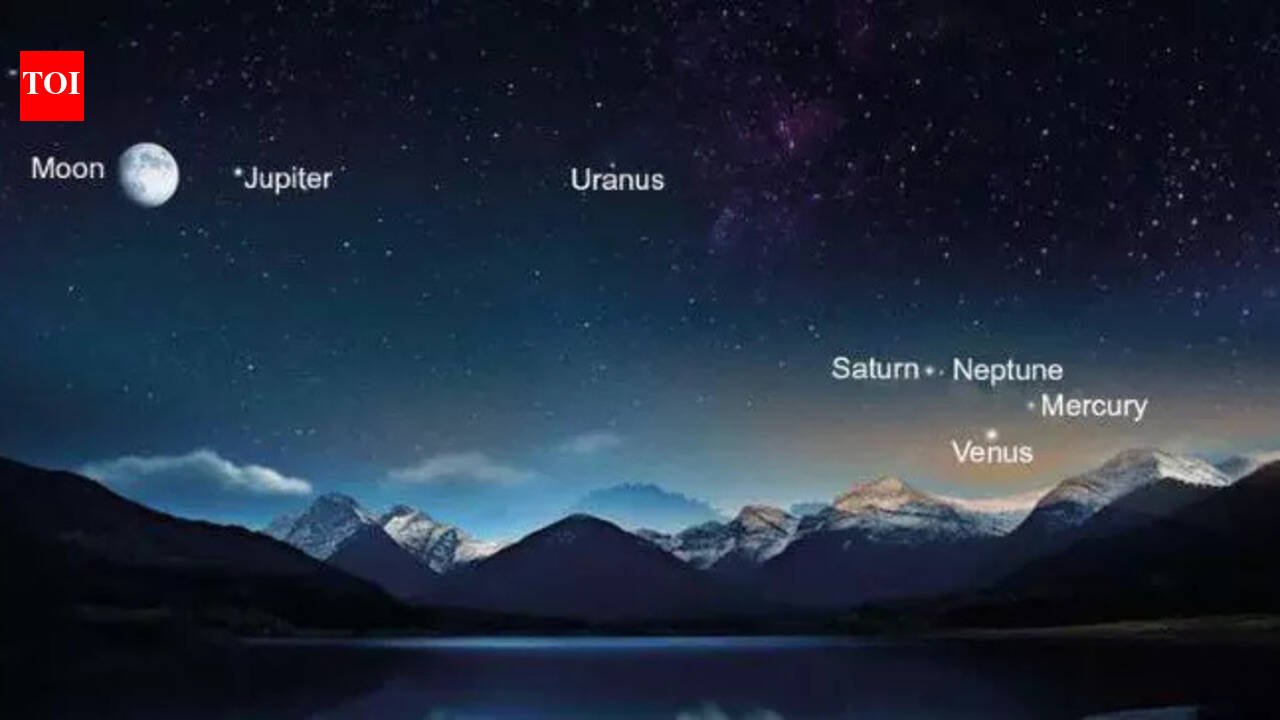
Chennai: If you have a telescope and are lucky, you might be able to catch six planets and the Moon in the night sky on Feb 28. The planets — Mercury, Venus, Saturn, Neptune, Uranus and Jupiter will be parading in the sky shortly after sunset.Experts said the planets may, however, not be in a straight line. While Mercury, Venus, Saturn, Uranus and Neptune may be low on the western horizon, Jupiter will be accompanied by the Moon high on the eastern side. Hence, the planets may be visible only for about 30 minutes after sunset, provided the sky is clear. According to NASA, the planets will be visible soon after sunset throughout the month of Feb, but they will be lined up best towards the end of the month. Four of those planets will be visible to the unaided eye, weather permitting, but only those with optical assistance will be able to view Uranus and Neptune. S Soundararaja Perumal, former executive director, Birla Planetarium, said stargazers may have very little time to catch a glimpse of planets such as Mercury, as they may move below the horizon by around 7 pm. “Light pollution could make it difficult to view them. If the sky is clear, we may be able to see the partial phase for a few minutes after moonrise,” he said. “Jupiter may be the brightest of them all.” A powerful telescope may be needed to view Neptune and Uranus, as they may be too small in the sky. “The planets’ visual magnitude would be 8, which is not visible to the naked eye, as it will be fainter than the typical human limit of 6,” Perumal said. In Jan 2025, six planets —Venus, Saturn, Jupiter, Mars, Uranus and Neptune — made a rare parade in the night sky. Mercury, which takes 88 days to orbit the Sun, joined the planets in Feb 2025.
