
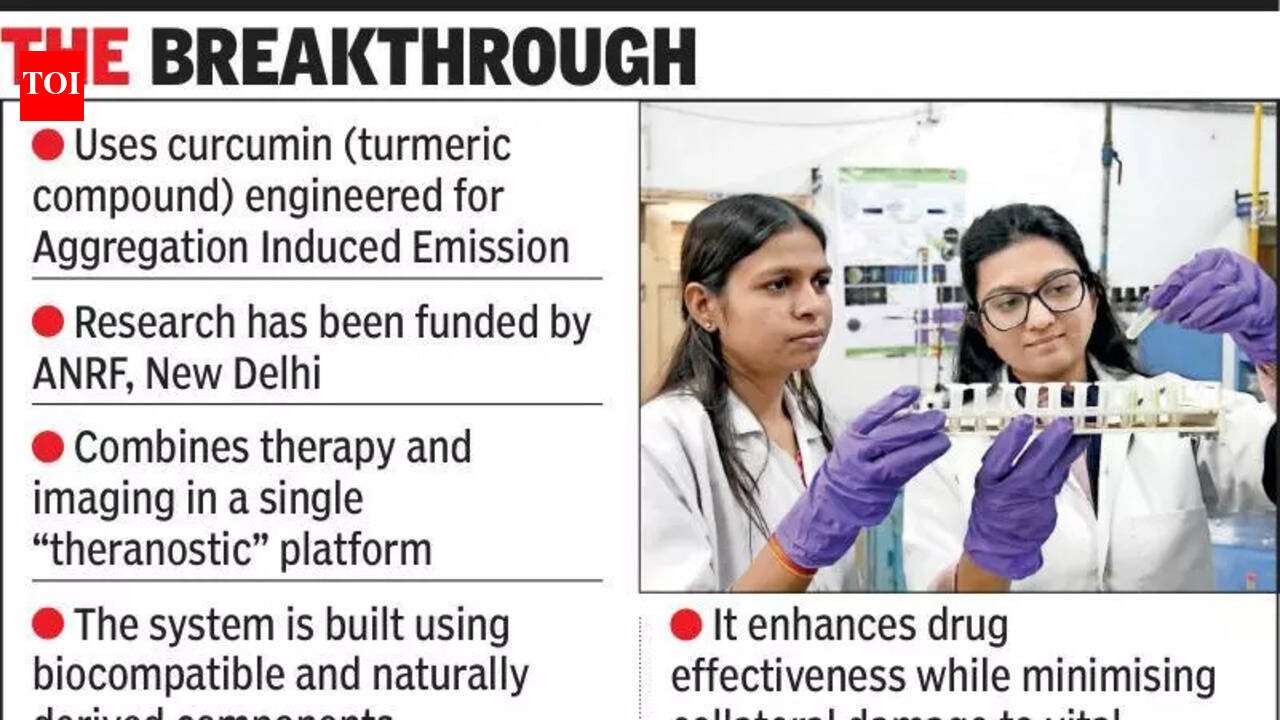
Vadodara: A compound found in one of the most common kitchen spices could help transform the way cancer is treated. Scientists at Maharaja Sayajirao University (MSU) have developed a novel “smart” drug delivery system using curcumin — the active ingredient in turmeric — that can precisely target tumours, illuminate them for real-time monitoring, and significantly reduce damage to healthy tissues.The research, led by prof Sonal Thakore of the Department of Chemistry, Faculty of Science, along with researchers Twara Kikani and Krutika Patel, addressed one of chemotherapy’s biggest limitations — its inability to distinguish between cancerous and normal cells, often resulting in severe side effects.The study, funded by the Anusandhan National Research Foundation (ANRF), New Delhi, has been published in the peer-reviewed journal Biomacromolecules of the American Chemical Society (ACS). It was included in vivo studies on mice conducted in collaboration with Nirma University, Ahmedabad. Tests on breast and liver cancer cell lines and animal models demonstrated improved drug efficacy with minimal impact on critical organs such as the heart.The findings point towards a future where cancer treatment may no longer be a trade-off between destroying tumours and enduring toxic side effects.“Conventional chemotherapy works, but it does not differentiate between healthy and cancer cells, which leads to toxicity,” said Thakore. “We wanted to design a system that not only delivers the drug precisely to the tumour site but also helps us see and monitor the treatment process.”To achieve this, the team chemically engineered curcumin into a specialised molecule that glows brightly once it aggregates inside tumour tissue — a phenomenon known as Aggregation-Induced Emission (AIE). When the modified curcumin reaches the tumour, it emits a fluorescent signal, effectively acting as a spotlight that helps doctors visually locate cancer cells and track tumour shrinkage in real time.“It is a theranostic platform — therapy combined with diagnostics,” Thakore explained. “The same system that delivers the drug also helps in imaging. This reduces dependence on repeated invasive biopsies or multiple scanning procedures.”The chemotherapy drug is packed inside tiny carriers called nanomicelles, which function like a GPS-guided delivery system. These nanomicelles remain stable while circulating in the bloodstream but respond to the acidic microenvironment unique to tumour tissue. Once they detect this environment, they release the drug precisely at the cancer site, along with the fluorescent curcumin molecules.“In simple terms, the nanomicelles travel safely through the body and ‘pop open’ only when they reach the tumour,” said Thakore. “This enhances drug effectiveness while minimising collateral damage to vital organs.”“Because the system is built using biocompatible and naturally derived components, it has the potential to be safer and more affordable,” Thakore added. “Our next step is to conduct expanded studies and explore industry collaboration for clinical translation.”If successfully scaled, the innovation could pave the way for precise, patient-friendly, and cost-effective cancer care.Head: The BreakthroughUses curcumin (turmeric compound) engineered for Aggregation Induced Emission Research has been funded by ANRF, New DelhiCombines therapy and imaging in a single “theranostic” platformThe system is built using biocompatible and naturally derived componentsNanomicelles release chemotherapy drugs only in the tumour’s acidic environmentIt enhances drug effectiveness while minimising collateral damage to vital organsIt has the potential to be safer and more affordable
