


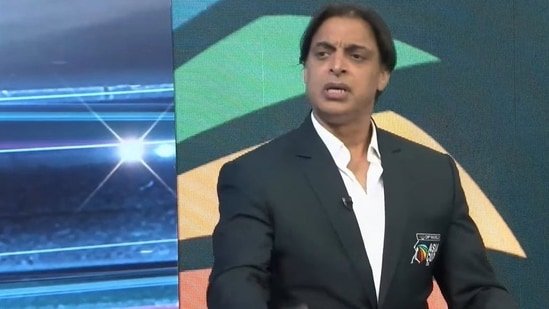
Shoaib Akhtar’s reaction to Pakistan’s defeat by England in the T20 World Cup Super 8s went viral not just because it was angry, but because it exposed how quickly fan-and-pundit narratives can swing in a high-pressure tournament. Before the game, his focus was openly emotional and rivalry-driven. After the game, the tone shifted sharply to leadership, accountability and selection judgment.
That contrast is what has made the clip travel so widely.
Before the match, Akhtar had framed the contest in blunt, fan-first terms, saying, “England insalla itnah burah khel jaye, hum khushi khushi do point bhi le jaye. Aur phir India bhi bahir ho jaye. Humari khushi ka thikana nahi rahega agar India bahir ho jaye.” (I pray to God that England plays very bad cricket, and then we happily take the two points. After that, India will also get eliminated, our happiness will hold no bounds if India are eliminated.)
It was the language of hope, rivalry and possibility. Pakistan still had a live route in the competition at that stage, and the emotional energy around permutations often brings out this kind of rhetoric. England, however, beat Pakistan in Pallekele, with Harry Brook’s hundred proving decisive in the chase, a result that left Pakistan’s semi-final chances under severe pressure.
From external rivalry to internal blame
What followed after the loss was a complete change in target and tone.
Akhtar moved from discussing England and India to questioning Pakistan’s internal decision-making, especially regarding captain Salman Ali Agha. His most striking line was direct and unambiguous: “He is not a captain material.”
He went further and tied that criticism to Pakistan’s planning and the broader structure around the team. Among the lines from the viral reaction were, “I don’t think that he is cut for this job when he is called a captain”, and “He was forced to be a captain in the makeshift.”
Whether one agrees with the assessment or not, the shift is revealing. Before the game, the emotional narrative was built around what Pakistan wanted to happen. After the game, the narrative became about why Pakistan are where they are.
That is often how knockout-pressure tournaments work in South Asian cricket ecosystems. Hope gets personalised quickly, and so does blame. Akhtar’s comments captured that full arc in less than two minutes: from dreaming about outcomes, to dissecting leadership, to questioning the system that created the situation in the first place.
