


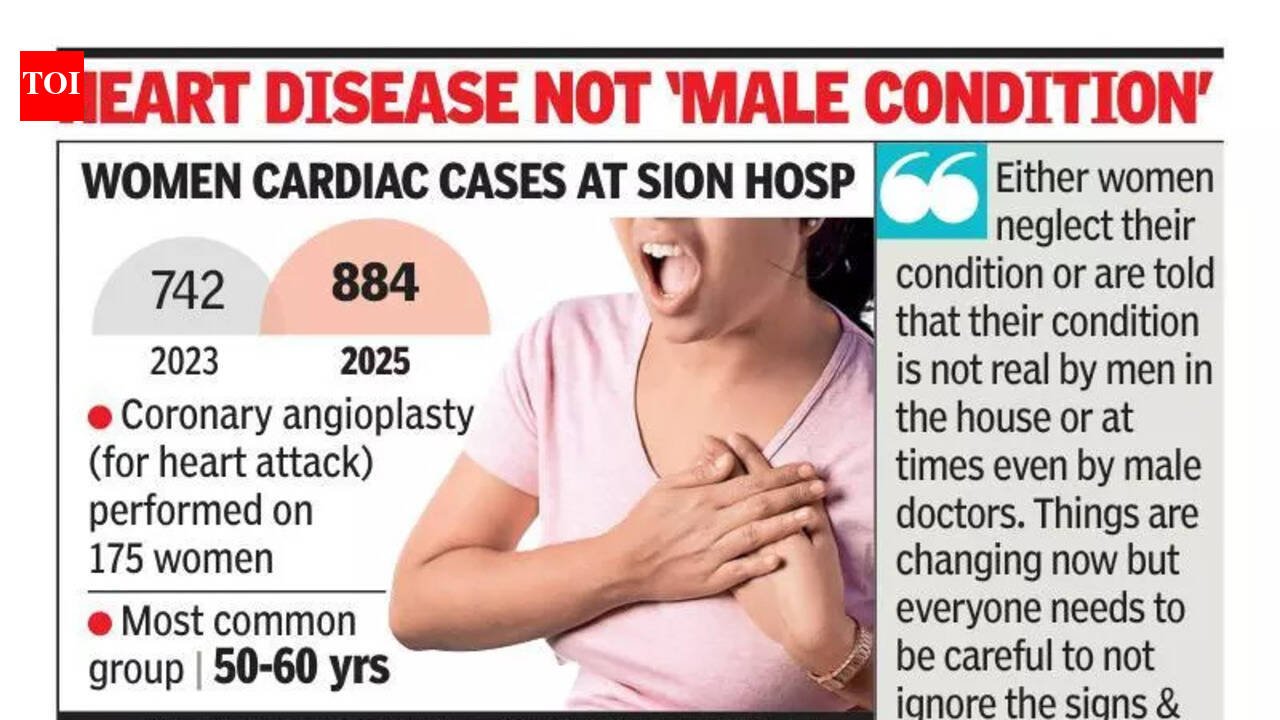
Mumbai: Medical literature has long held that heart disease primarily affects men and that women have a natural biological “shield” to a certain extent owing to the presence of oestrogen, but recent data from the civic-run Sion Hospital indicates that that protection is breaking down.Cardiac procedures among women at the hospital surged nearly 20% in two years—from 742 cases in 2023 to 884 in 2025. Even those in the age group of 20-40 underwent such procedures; the most common age group impacted was 50-60. Moreover, coronary angioplasty, which is performed in instances of heart attack, accounted for 20% of all cardiac procedures performed in women. Diabetes, tobacco and hypertension remain the primary risk factors. Dr Pratap Nathani, head of the department of cardiology at Sion Hospital, said what is more concerning is that these are women who were referred to them through various OPDs and departments. “It never happens that they reach us because they believe it is a heart attack. It is common for women to neglect all types of illness. On top of that, symptoms of heart attack in women are not classic. So, the ones we can save are just by luck.” He said the crisis in women is masked by “atypical symptoms” like acidity or fatigue, back pain, abdominal pain, jaw or neck pain, nausea, flu-like symptoms and even anxiety. “These could be mistaken for a wide range of ailments.” Such is the case with a patient Dr Vidya Suratkal has been treating at Lilavati Hospital for the last four years: A 28-year-old woman walked in with gastrointestinal issues but walked out with an angioplasty after an angiography detected blockages. “She came back multiple times with different arteries each time. She also underwent a bypass now. There is no clear identifying factor or cause in her case.” While doctors at Sion Hospital found stress to be a contributing factor in 16% of the cases—which ranged from financial to domestic—the cause in 1% of the cases every year is unknown. Both Dr Nathani and Dr Suratkal said factors like pollution have a correlation with heart issues, but more data is needed for a clearer link. Dr Nathani said women are naturally protected because of oestrogen, “but urban life, stress, lack of proper sleep, and even the increasing incidence of smoking among women is tearing apart that protective layer”. Dr Charan Lanjewar, cardiologist at civic-run KEM Hospital, is more cautious about drawing many conclusions from the uptick. “There are multiple factors. Diagnostic services have improved over the last few years. Besides, at BMC or govt hospitals, schemes like MJPJAY (Mahatma Jyotirao Phule Jan Arogya Yojana) have started covering more procedures, which could also play a role in the increase in cases.”
