


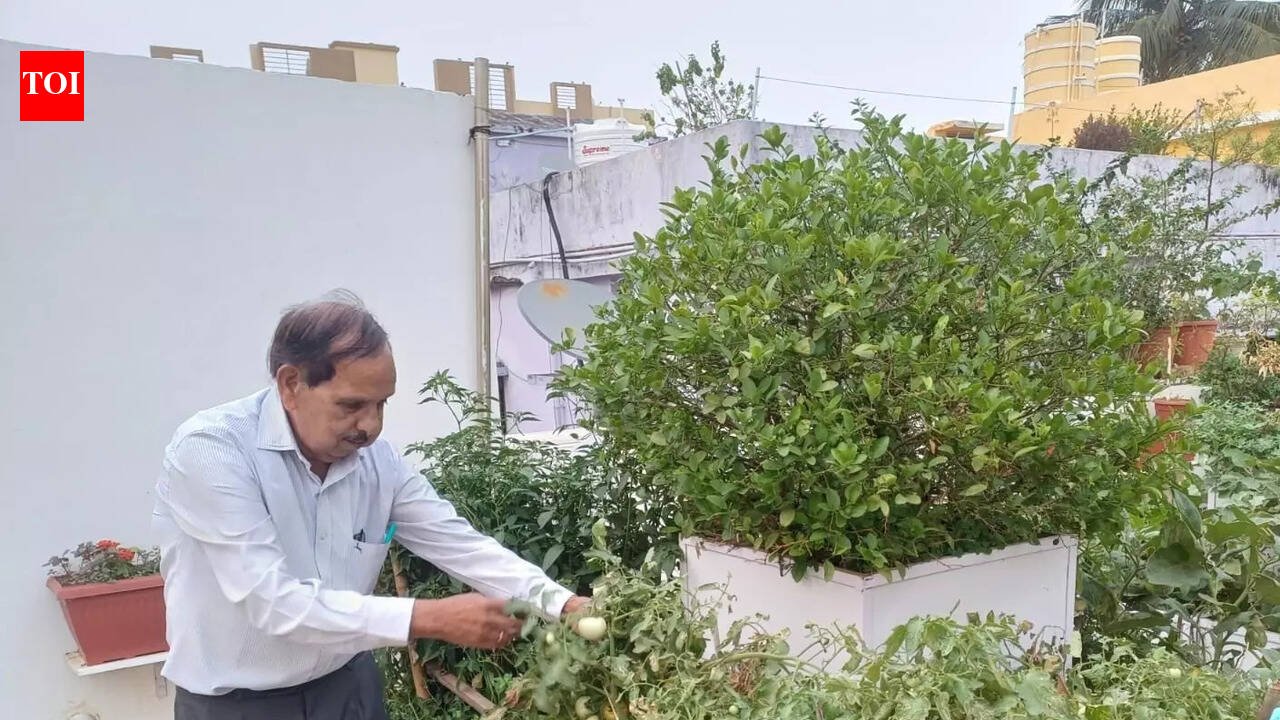
Bhubaneswar: At 76, Sabhapati Khadanga begins his day tending to a rooftop garden at Jagamara, which he calls a ‘laboratory of natural farming’. The garden, spread across his terrace, is home to flowers, fruits and vegetables grown without chemical fertilisers or pesticides.Khadanga said he relies on kitchen waste and locally available natural inputs to prepare biofertilisers and biopesticides. His preparations include vermicompost, azolla, eggshells, fish extracts, mohua flowers, aloe vera fermentation and other organic ingredients. He also uses formulations such as jeevamruta to improve soil health, multi-grain extracts to support plant growth, banana-peel fermentation, neem-based fertiliser and a fish tonic to prevent leaf withering in fruit plants.To deter monkeys, he developed a mixture he calls ‘Monkey’s Puzzle’, made from cow urine, garlic and neem leaves. He says the pungent smell from the fermented solution keeps monkeys away.The rooftop garden has 22 varieties of plants, including maize, pumpkin, chilli, brinjal, tomato, radish, leafy vegetables, bitter gourd, yam, beans, onion, lemon and amla, along with scented and flowering plants. Khadanga said he does not buy seeds from the market, instead collecting indigenous varieties and saving seeds from each harvest for the next crop.An MSc in agriculture from Odisha University of Agriculture and Technology in 1972, Khadanga worked in the private sector before completing a diploma in rural development in the UK in 1984. He says his exposure to the UK’s emphasis on natural farming shaped his long-term focus. In 1991, he received a UK fellowship on natural farming, which he credits with deepening his work on developing organic formulations and field-testing them in his own garden.“When I worked on natural farming, the whole country entered a different era of using chemical fertiliser and pesticide to increase crop yields manifold. Now, we are in the web of pesticides, and it will be difficult to come out of it easily. Everybody should create their kitchen gardens in their backyard or rooftop and start natural farming,” he added.A native of Bhanjanagar in Ganjam district, Khadanga now lives in Bhubaneswar with his family. His son, Col Manas Khadanga, serves in the Indian Army, while his daughters work as a banker and a teacher.Khadanga is a national resource person with the National Institute of Rural Development and Panchayati Raj, Hyderabad, and advises organisations and farmers on adopting natural farming practices. He regularly travels across Odisha, urging cultivators to reduce dependence on chemical fertilisers and pesticides and move towards pesticide-free food production.
