


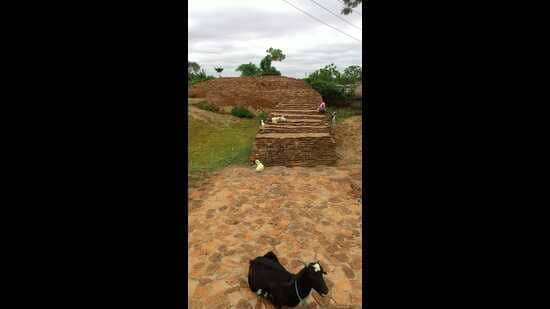
The Archaeological Survey of India (ASI) has granted fresh approval for excavation at the ancient fort site of Balirajgarh in Madhubani district, rekindling hopes that the buried layers of Mithila’s early urban civilisation will finally be explored in depth.
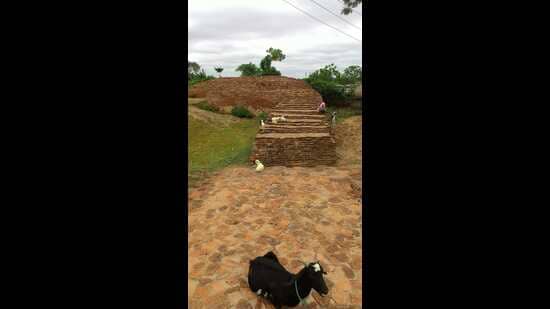
The approval, issued by the ASI headquarters in New Delhi on February 26, is valid for one year and authorises the ASI’s Patna Circle to undertake excavation at the centrally protected site, officially listed as the “Remains of Ancient Fort of Garh, locally known as Raja Bali Ka Garh, at Balirajgarh.”
According to official records from the ASI and the ministry of tourism the centrally protected area of the monument, spread over 122.31 acres in Babubarhi block, was declared a site of national importance in 1938 under the Ancient Monuments Preservation Act, 1904.
Located in Bhupatti panchayat of Babubarhi block, about 35 kilometres from the Madhubani district headquarters, Balirajgarh is regarded as one of Bihar’s most significant archaeological sites. Archaeological findings from earlier excavations suggest continuous habitation from around the 2nd century BCE through the Pala period. The massive fortification wall, constructed with baked bricks on the exterior and mud bricks in the core, measures up to 8.18 metres in width at certain points.
Earlier excavation campaigns at the site — carried out by the ASI in 1962-63 and 2013-14, and by the Bihar state archaeology directorate in 1972-73 — had revealed significant structural and cultural remains. However, the digging was discontinued before reaching deeper cultural layers, with officials citing environmental constraints, particularly a high water table that made further excavation difficult.
The question of whether previous efforts were pursued with adequate depth and continuity has since been raised in public discourse. Critics have argued that only a fraction of the fortified settlement has been scientifically explored, leaving substantial portions of the site untouched.
Taking a strong stand, Rajya Sabha MP Sanjay Kumar Jha, who is also chairman of the Parliamentary Standing Committee on Transport, Tourism and Culture, said that he would ensure that the excavation this time is carried through to its “logical conclusion.”
“Balirajgarh holds immense historical significance for Mithila and the country. The excavation must be scientific, systematic and comprehensive, Jha said, adding that he has taken up the matter with the Union ministry of culture and senior ASI officials.
“Sanction alone is not enough. Attempts were made earlier as well, but they did not yield any results. The excavation must reach its full depth this time,” he said ,adding that around 20 trenches are proposed to be dug.
Jha asserted that he would personally monitor the progress to ensure that the work is not abandoned midway. Describing the approval as a major step for the region, he said a sustained excavation could unearth significant historical evidence, potentially establishing Balirajgarh as a landmark site in the study of ancient Mithila, not unlike Nalanda and Vikramshila universities
Archaeological findings from earlier digs point to a five-fold cultural sequence at the site, beginning with the Northern Black Polished Ware phase (circa 700–200 BCE) and continuing through the Sunga, Kushan, Gupta and Pala periods. This suggests continuous habitation from early historic to early medieval times.
Excavations have brought to light massive mud-brick ramparts constructed in multiple phases, along with burnt-brick structural remains believed to be part of residential or other built complexes. Antiquities, including terracotta human and animal figurines, semi-precious stone beads, copper coins, iron objects and terracotta sealings, have been reported from past phases.
The scale of the fortification and the variety of artefacts indicate that Balirajgarh was once a significant fortified urban centre with possible trade and administrative importance in the Gangetic plains, experts believe.
Under the fresh approval, the ASI has directed that due financial sanctions be obtained and that a detailed field report, along with a comprehensive list of antiquities recovered, be submitted to its headquarters after completion of the excavation.
Jha hope that this phase of excavation will move beyond earlier limitations and provide a clearer, deeper account of the ancient settlement that still lies buried beneath the huge mounds of Balirajgarh.
