



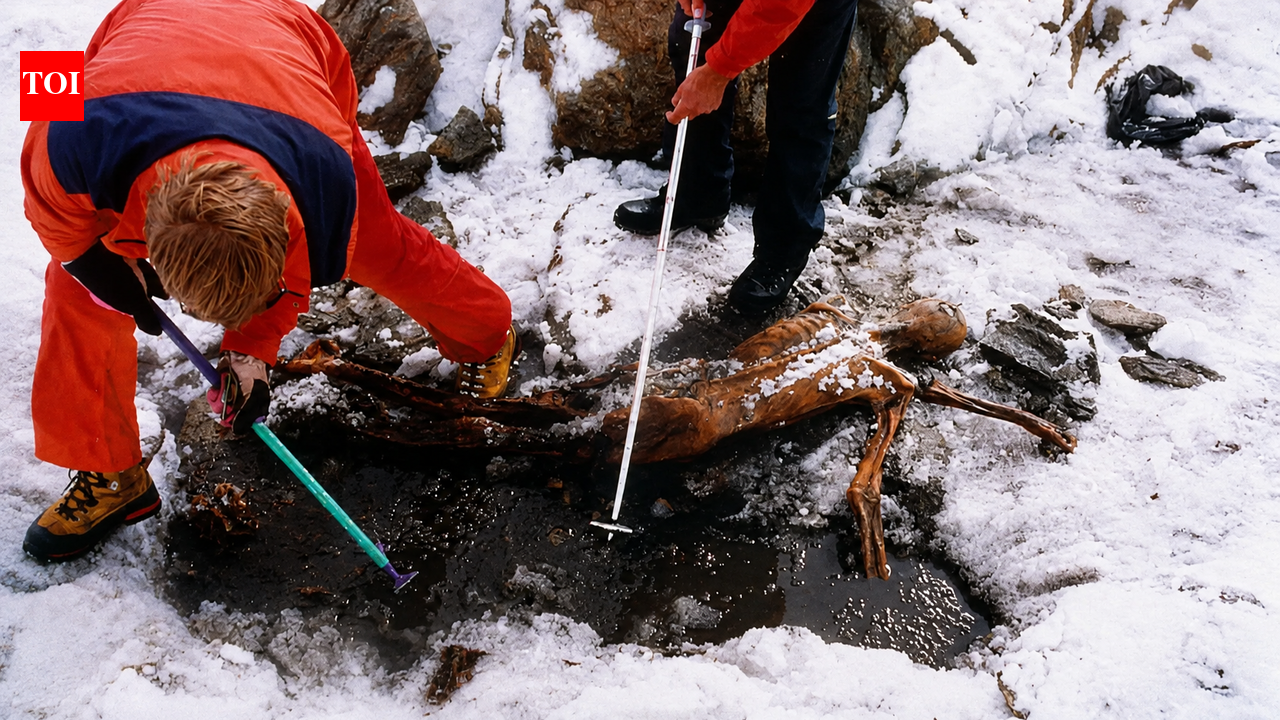
The microscopic yeast that could survive in association with a 5,300-year-old body feels unlikely, almost speculative. Yet the frozen remains of Ötzi, the Copper Age “Iceman” preserved in the Alps and housed in a controlled museum chamber in northern Italy, have provided scientists with an unexpected testing ground for that possibility. Over decades of study, attention gradually shifted beyond bones, tools, and clothing to the invisible biological traces embedded in and around the mummy itself. In particular, researchers began examining microbial DNA recovered from tissue, surrounding meltwater, and the conservation environment, asking whether any of these organisms could still reflect ancient ecological states rather than modern contamination.
Inside the glacier chamber: How Ötzi’s frozen environment became a living laboratory
Ötzi has been kept in a deliberately cold chamber since his discovery in the Alps in the early 1990s, a setting designed to imitate the glacier that originally froze him. That environment has become as much a laboratory as a display. Over time, scientists began sampling not just the mummy itself but everything around it: melted water that trickled during handling, air drifting through the conservation rooms, even material from the site where he was first uncovered.As reported in the Springer Nature Link study, titled, ‘The Iceman’s microbiome: unveiling millennia of microbial diversity and continuity’, a body that old, preserved in ice, is unlikely to be biologically sterile. What was less obvious was how to separate ancient microbial remnants from the modern contamination that inevitably arrives with decades of human contact. DNA sequencing helped split the picture into fragments that looked genuinely old and others that clearly belonged to the modern world. The distinction was messy rather than clean, as these things usually are.
Frozen clues or modern intruders: The yeast evidence around Ötzi
Among the microbial traces, a group of cold-loving yeasts stood out. These organisms are not the kind that thrive in kitchens or warm soils. They are more often associated with frozen lakes, polar ice sheets, and high-altitude environments where biological activity slows to a crawl. Four genera were identified, each adapted to conditions that mirror the kind of deep freeze Ötzi has spent millennia in.Their presence was not entirely shocking in itself, given the environment, but what drew attention was where they were found. Some traces came from skin, others from internal material, and a portion from what remained of stomach contents. That mix made interpretation awkward. It was not immediately clear whether these organisms had been part of a post-mortem colonisation event shortly after death, or whether they represented something more persistent that had endured in a frozen state.
Signs of life in the frozen past: Scientists reveal ancient yeast findings
Microbes are not bones. They do not fossilise in the same way, and under the right conditions they can remain metabolically inactive for long stretches before waking again. That possibility sits at the centre of the discussion here. One of the yeast groups showed signs that suggested ongoing change over time, or at least something that looked like it. Samples taken years apart from the mummy’s tissue showed shifts in abundance, with one genus appearing more prominent in later tests. The genetic material from those later samples also appeared less broken down. Whether that means slow replication in a stable cold environment or simply differences in sampling and preservation is where interpretation starts to split.
Scientists revive ancient yeast and use it to bake sourdough bread
One of the isolated yeasts was cultured under laboratory conditions. The process was not immediate. Early attempts failed to produce anything usable, and it took repeated adjustments before the organism began to behave predictably. Once it did, the team used it in dough preparation. The result was not treated as a culinary breakthrough in any modern sense, but as a test of whether the organism retained basic fermenting ability. It did. The dough rose, and a loaf of sourdough was eventually produced using yeast traced back to the ancient remains.


