



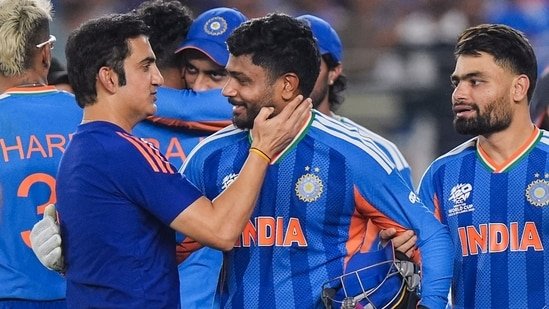
India’s T20 World Cup success rode on the team finding form and clicking at just the right time, when they had no other option. After a slow start for the batters in particular through the first five games leading up to the loss to South Africa, the batting unit exploded upon the inclusion of Sanju Samson back at the top of the order.
With three sterling performances to close out the tournament, Samson’s impact awarded him the Player of the Tournament despite only playing five matches; an average of 80 and strike-rate of 200 were essential for India to get their hands on the trophy. The key element was Samson’s mental strength, able to come in out of the blue and drag his team forward by the straps.
Speaking to Sportstar, Indian batting coach Sitanshu Kotak revealed exactly what enabled this to be the case.
“While the best eleven were playing, our plan allowed the others to remain confident,” asserted Kotak, who is part of Gautam Gambhir’s staff. “For instance, when Sanju was not playing, he was still confident. I spoke to him that every other day things change, there could be injuries or poor form, and that he had to be prepared.”
Samson played early on in Abhishek Sharma’s absence, but was brought back in later on to introduce variety at the top of the order. He had belief in his own abilities, and that was key. “And he used to say, ‘Kotak bhai, aap chinta mat karo, main always prepared hoon, jab aap kahoge main kar dunga (Don’t worry, I am always prepared. Whenever you tell me to go and perform, I will do it).’ So all that actually came true. That was great.”
‘Ek toh hundred karna hai…’
Samson’s best was saved for the must-win game against the West Indies, where he scored 97*, before following it up with near-identical knocks of 89 in the semifinal and final against England and New Zealand. Samson often looked untouchable, but never quite got to his century – something he didn’t let bother him at all.
“Sanju kept batting in the semifinal and kept the team’s motto intact that the team’s interests are bigger than individual milestones,” praised Kotak. “That was evident from the fact that despite being close to a hundred, he did not push for it.”
In fact, even the batting coach urged Samson to gun for the century, only to be rebuffed: “I told Sanju, ‘Ek toh hundred karna hai,’ (you have to score one hundred). He replied with a smile: ‘On one hand you say it’s not about personal milestones, and on another you say score a hundred. How are two things possible?’”
Kotak believed that this kind of mentality taken forward by Samson – a player who now can boast of plenty of experience at the highest level – bled into the team and became the guiding hand for the unit as a whole.
“Obviously, he was joking, but it spoke volumes about the mindset of the team. Players never thought about their personal runs and always put the team first. That made the difference,” said Kotak.
India’s third T20 World Cup title was a win by committee, one which shed any pretence of fear – and Sanju Samson is certainly the greatest example of that.


