


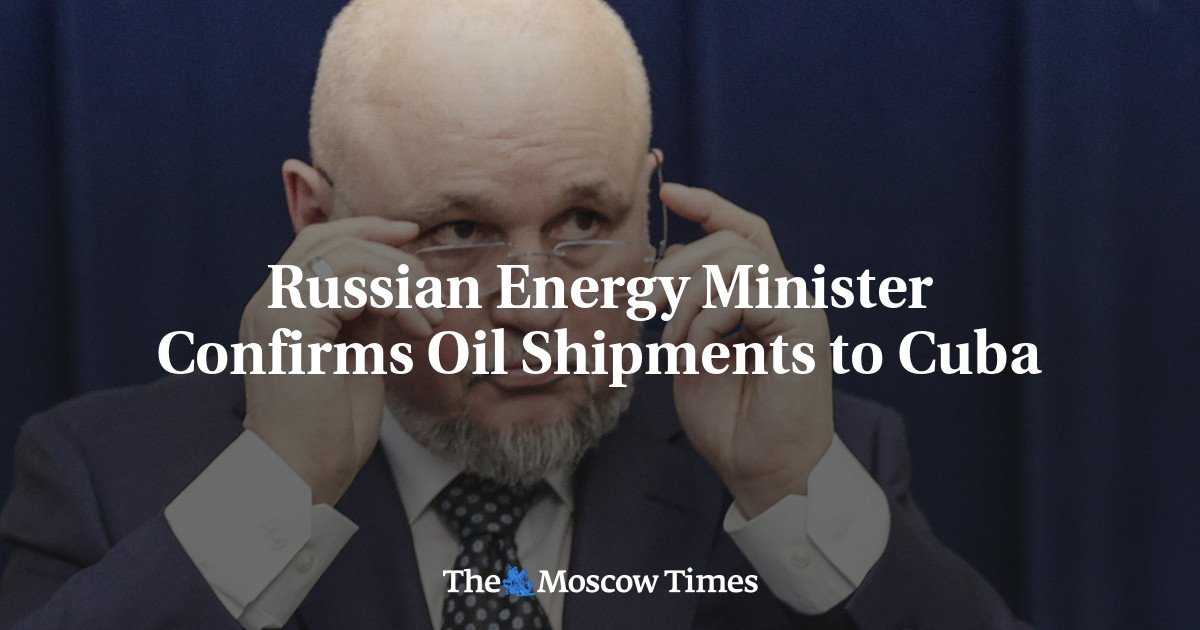
Energy Minister Sergei Tsivilev confirmed Wednesday that Russia is sending “humanitarian” shipments of oil to Cuba after ship-tracking data earlier appeared to show that at least one tanker had unloaded Russian crude in Havana.
Cuba, which imports around 60% of its energy supply, previously relied on oil sold by Venezuela. Those shipments ended after then-President Nicolás Maduro was captured in a U.S. military raid.
An energy embargo imposed by U.S. President Donald Trump to bring pressure for a change in the island’s political system has compounded years of deep economic crisis and led to more frequent blackouts across the Caribbean nation.
“We are sending humanitarian aid. We are providing humanitarian support,” Tsivilev told reporters.
“Cuba has found itself in a difficult situation as a result of sanctions pressure. That is why we are currently sending humanitarian supplies to Cuba,” he added.
The Financial Times reported last week that a Russian tanker delivered gasoline to the island earlier this month. In response to that reported shipment, the U.S. Treasury Department amended a sanctions waiver for Russian oil tankers, barring transactions that include Cuba.
Several aid vessels carrying solar panels, bicycles, food and medicine have also been dispatched to Cuba in recent days. Those humanitarian deliveries have been organized by groups of politicians, activists and other public figures from dozens of countries.
Trump has said that he is prepared to “take” Cuba. Authorities from both countries acknowledged that they are holding talks, although they have not disclosed details.
Amid the U.S. pressure campaign, the Kremlin has reaffirmed its support for Cuba and has expressed concern over the growing humanitarian crisis on the island.
A Message from The Moscow Times:
Dear readers,
We are facing unprecedented challenges. Russia’s Prosecutor General’s Office has designated The Moscow Times as an “undesirable” organization, criminalizing our work and putting our staff at risk of prosecution. This follows our earlier unjust labeling as a “foreign agent.”
These actions are direct attempts to silence independent journalism in Russia. The authorities claim our work “discredits the decisions of the Russian leadership.” We see things differently: we strive to provide accurate, unbiased reporting on Russia.
We, the journalists of The Moscow Times, refuse to be silenced. But to continue our work, we need your help.
Your support, no matter how small, makes a world of difference. If you can, please support us monthly starting from just $2. It’s quick to set up, and every contribution makes a significant impact.
By supporting The Moscow Times, you’re defending open, independent journalism in the face of repression. Thank you for standing with us.
Continue
Not ready to support today?
Remind me later.
×
Remind me next month
Thank you! Your reminder is set.
