


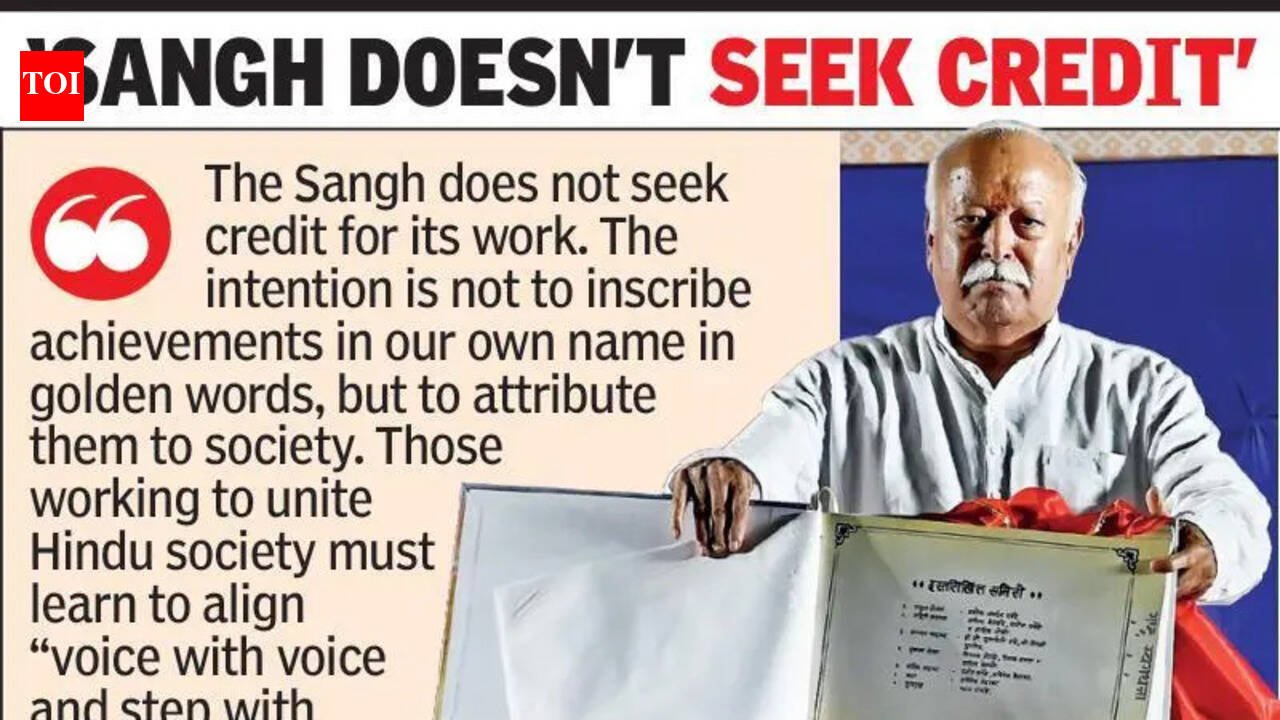
Nagpur: Emphasising the Rashtriya Swayamsevak Sangh‘s (RSS) growth over the past century, RSS chief Mohan Bhagwat on Wednesday said, “The organisation stood because of the swayamsevaks, not due to anyone else’s ‘krupa’ (grace). Neither did it stopped because of someone’s disfavour.”He was speaking at the unveiling of the book ‘Rashtra Swaradhana’, written and compiled by Ashok Dawande, at Dr Hedgewar Smruti Mandir, a volume documenting the history and evolution of the Sangh’s ‘Nagpur Mahanagar Ghosh’ (musical band) tradition.Bhagwat also clarified that the Sangh does not seek credit for its work. “The intention is not to inscribe achievements in our own name in golden words, but to attribute them to society,” he said, adding that those working to unite Hindu society must learn to align “voice with voice and step with step”. Referring to a Sanskrit phrase — “Deva bhagam yatha purve…” — he underlined the importance of working in unison, saying that just as the gods achieved their goals through coordinated effort, society too must move forward “in one voice and one direction”.The RSS chief said, “Swayamsevaks collectively invested their strength to build the organisation, which today represents a force capable of shaping the nation’s direction.” Calling the Sangh’s 100-year journey both ‘romanchkari’ (thrilling) and ‘udbodhak’ (enlightening), he noted that its history offers lessons for future work.Highlighting the role of ‘ghosh’ within the Sangh’s organisational structure, Bhagwat said all its divisions exist to inculcate ‘sanskar’ (values). The musical wing, he said, adds an element of discipline and aesthetic appeal to physical training (sharirik), ensuring that public presentations by swayamsevaks are both coordinated and engaging.He stressed that maintaining quality standards in such activities is essential. “It is important to reflect on what we have done and what needs to be done ahead,” he said, calling for continuous self-assessment.On role of training, he said physical exercises help shape the mind and foster coordination, which becomes a natural tendency through such programmes. He cited examples from sports like kabaddi, noting that while swayamsevaks often excel due to their training, the Sangh’s objective is not to produce professional athletes.On the artistic aspect of ‘ghosh’, Bhagwat said precision alone is not enough. “The act must be flawless, but it must also carry ‘bhav’ (emotion), which comes from within,” he said, adding that Indian art traditions aim at creating “satyam, shivam, sundaram” and to ensure that is what RSS is working for.He called for introspection on whether present efforts match the dedication of earlier generations. The centenary, he said, is not merely a celebration but an opportunity to expand the organisation’s reach and deepen its work.
