


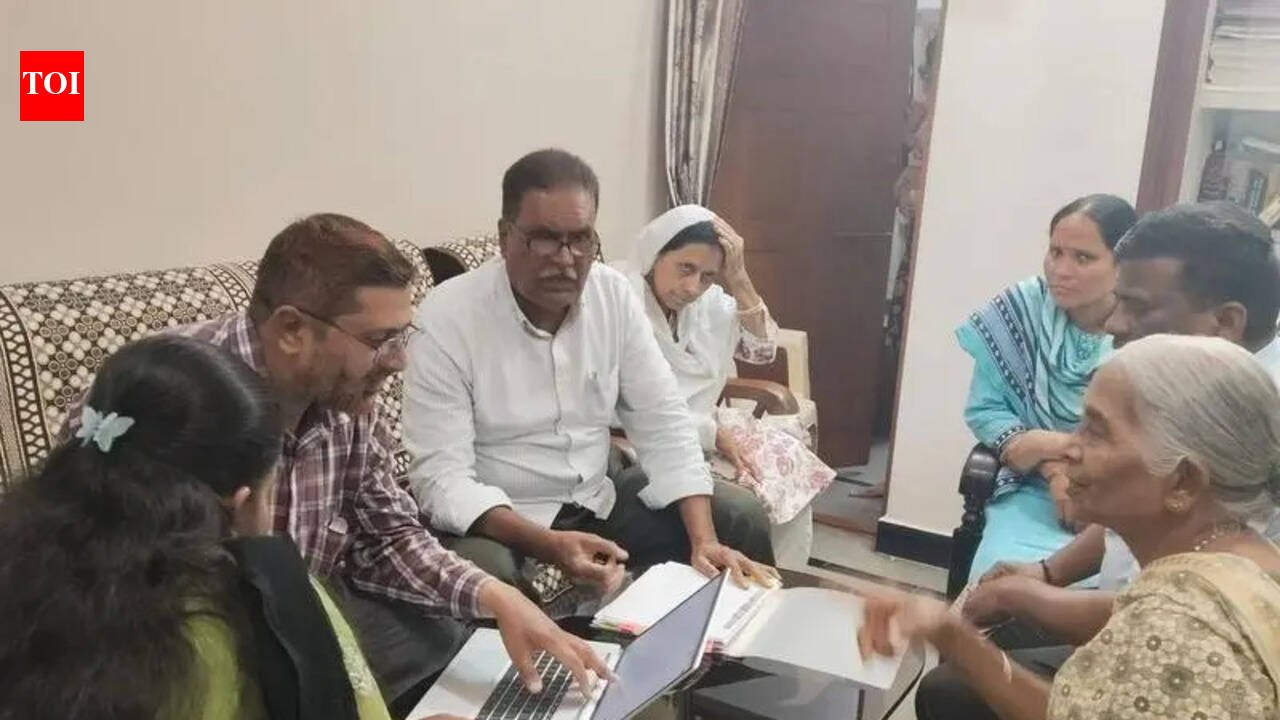
Hyderabad: With the Election Commission of India’s special intensive revision (SIR) of electoral rolls scheduled to begin in the state soon, a practising Telangana high court advocate and a multinational company employee from Malkajgiri have stepped in to help citizens navigate the exercise with clarity and ease.Mohd Osman, an advocate, and Syed Ghouse, an MNC professional—both in their 50s—have been conducting awareness and assistance camps across the twin cities, helping residents understand the SIR process and trace their names in the 2002 voter list, the benchmark document for the revision. So far, the duo has organised 26 such camps at housing societies and mosques spread over 10 assembly constituencies till April 4.”We will be conducting more such camps as the SIR process is now likely to begin in May,” Osman tells TOI.Equipped with printouts of voter lists from various polling stations in Secunderabad assembly constituency and soft copies stored on their laptops, Osman and Ghouse patiently guide residents in locating their own entries as well as those of family members. The SIR process involves mapping details from the 2002 electoral rolls with the 2025 rolls.At a housing society in Mirjalguda, 65-year-old Srinivas Rao arrives at the helpdesk carrying a soiled and faded voter ID issued in 2005. The EPIC number, house number and serial number are barely legible. With just the polling station number, Osman quickly traces the family’s details and locates entries for both Srinivas and his son, who is currently employed in Bengaluru.At another camp held at the Jama Masjid in Chilkalguda, residents queued up with visible confusion. Many were unsure about the purpose of the SIR and feared that missing names in the 2002 voter list could affect their voting rights.Osman, who is also an advocate with central administrative tribunal (CAT), was quick to dispel such concerns. “SIR is a regular electoral exercise conducted under the provisions of the Representation of the People Act. The purpose of our awareness camps is to help residents find out their details in the electoral rolls so that people can easily trace their details when the booth level officer (BLO) visits them during the SIR process. People need not worry. Missing names in the 2002 voter list does not mean loss of rights. If individuals have valid documents for themselves and their families, the revision process will be smooth,” Osman explained, while tracing voter details of individuals who turned up in dozens.Ghouse, who was assisting a group of elderly residents, said recalling old house numbers and polling booth details from 2002 has been the biggest challenge. “Many people have relocated or seen their wards reorganised. We help them trace old entries step by step,” he said.Over the past few weeks, the camps have seen steady footfall, with many residents expressing relief after understanding the requirements of the SIR. While distributing self-explanatory charts outlining the step-by-step SIR process and the documents required, Ghouse told TOI: “While the youth are generally able to figure out the procedure on their own, people above 50 are finding it difficult to trace family details from the 2002 voter list—especially when families have shifted homes within an assembly constituency or moved to another constituency.“The duo has also explained the SIR process to members of the Chilkalguda Jama Masjid committee. Committee vice-president Mohammad Hussain Munna said the mosque has begun assisting residents in the pre-SIR process by setting up a helpdesk with volunteers.On Saturday, the duo conducted an awareness camp in association with a local NGO in Housing Board Colony in Moula Ali, which was exclusive for women. The camp saw a good turnout, prompting Osman to promise to conduct more such camps exclusively for women. “We are training 10-15 volunteers at each camp on the SIR procedure, who in turn will help people in their localities when BLOs visit house-to-house for the SIR exercise beginning in May,” he said.
