


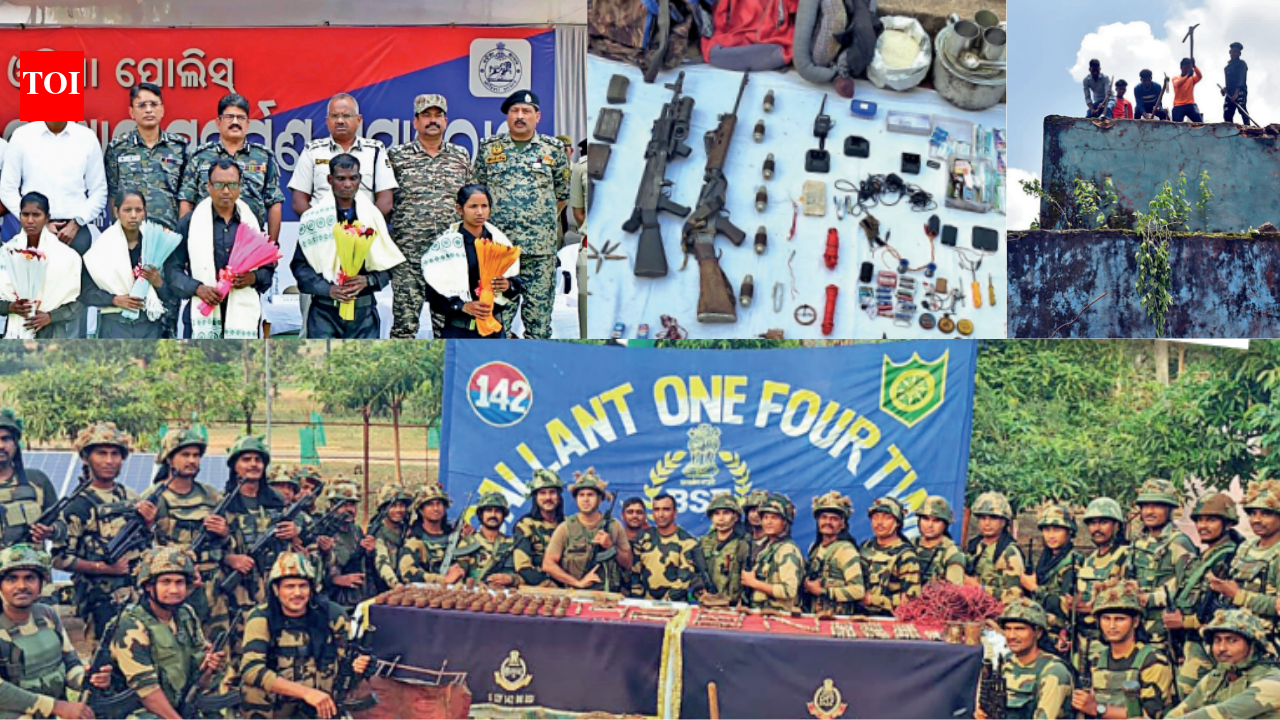
Ahead of the March 31 deadline to make India Maoist-free, many rebels are laying down arms and returning to mainstream. In the second segment of its three-part series, TOI examines how sops and more security helped Odisha overcome Maoist violence.For 62-year-old Sanguru Madkami of Malkangiri, memories of gunshots, landmine blasts, abductions and relentless Maoist violence are etched deep. Decades of fear defined his childhood and adulthood. But a lot has happened since then and now, he, and thousands like him, stand on the cusp of a new era.
With the Centre’s ambitious goal of ending Naxalism in the country by March 31 within touching distance, Odisha is witnessing a transformation that once seemed unimaginable. “Nobody other than us can truly understand this change. We lived through the worst of Maoist terror, and today, the atmosphere of safety means everything,” Madkami said, as he and his villagers pulled down a memorial built by the rebels in Kalimela area in the past, summing up the collapse of Maoist fort and the culmination of fear.Once synonymous with Maoist violence since the 1980s, the state has steadily reclaimed ground. Decades of bloodshed and insurgency are giving way to stability. With the long-drawn battle nearing an end in Odisha, the transformation is evident from chief minister Mohan Charan Majhi’s reply during the budget discussion of home department in the assembly on March 25 where he informed that Kandhamal is the lone Naxal-affected district left in the state with the presence of 8 or 9 rebels.
Past NightmaresOdisha experienced the height of Maoist violence between 2004 and 2012. At least 21 out of 30 districts in the state were then affected by LWE activities. On Feb 15, 2008, a series of attacks by Maoists took place on several police establishments, including the armoury in Nayagarh district. At least 14 people, including 13 security personnel, were killed in the brazen attack that took place barely 80 km from Bhubaneswar.On July 16, 2008, CPI-Maoist cadres killed 17 personnel of Odisha police in a landmine blast in the MV-126 area in Malkangiri district. On June 29, 2008, at least 38 security personnel, including 36 belonging to the elite anti-Maoist Greyhounds from Andhra Pradesh, were killed in the Chitrakonda reservoir of Malkangiri district, close to the Andhra Pradesh border.
The murder of Swami Laxamanananda Saraswati at his ashram at Jaleshpata in Kandhamal district on Aug 23, 2008, had triggered ethno-religious conflict in the district.Another deadly Maoist attack was reported on April 12, 2009 at Nalco’s bauxite mine at Panchpatmali, Damanjodi in Koraput district, killing 11 CISF personnel.
The state govt had to pay a heavy price following abductions of many high profile persons in the state by Maoists. Former Malkangiri district collector R Vineel Krishna, along with two engineers, was kidnapped by Maoists on Feb 16, 2011, in Kudumulu Gumma block. The three were released on Feb 24. Two Italian tourists – Bosusco Paolo and Claudio Colangelo – were kidnapped by Maoists in Kandhamal district on March 14, 2012. Colangelo was released on March 25 and Bosusco on April 12. Former BJD MLA Jhina Hikaka was kidnapped by Naxals on March 24, 2012 when he was returning home to Laxmipur from Koraput town and was released on April 26. TurnaroundThe arrest of top Odia cadre, Sabyasachi Panda, from Berhampur on July 17, 2014, dealt a blow to the Naxals in the state. Panda is still in judicial custody. The state govt’s revised surrender and rehabilitation policy for Maoists significantly contributed to the improved LWE situation in Odisha. Notified on Nov 27, 2025, the state govt’s hike in the reward payout for Maoists is 10% more than what Chhattisgarh offers, making the former’s rehabilitation package more lucrative.
Momentum In 2025 Odisha’s anti-Maoist campaign gained momentum last year with successive blows to the CPI (Maoist). On Sept 11, central committee member and Odisha secretary (in-charge), Modem Balakrishna, was killed in Chhattisgarh, while a joint Odisha–Chhattisgarh–CRPF operation in Chhattisgarh eliminated top commander Chalapathi and 13 cadres on Jan 21. On May 21, Basavaraju, CPI (Maoist) general secretary and key architect of its Odisha expansion, was killed, along with 27 others, in Chhattisgarh. Final Assault“Odisha police made the most significant achievement by gunning down central committee member Ganesh Uike and five others during a two-day operation in Kandhamal on Dec 24–25, last year. Surrender of top Maoist leaders like Nikhil and Sukru recently caused significant erosion of Maoist organisation in the state,” ADG (anti-Naxal operations) Sanjeeb Panda said.
