


Hello and welcome to Regions Calling, your guide to news beyond the Russian capital from The Moscow Times.
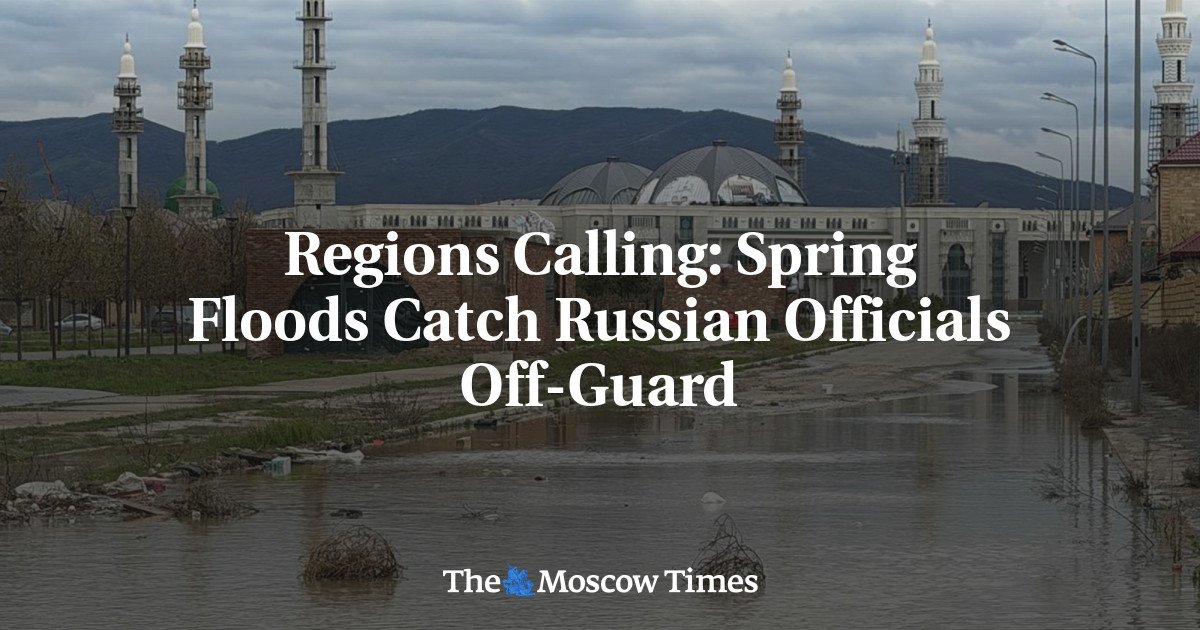
This week, we zoom in on the North Caucasus, where two republics are grappling with catastrophic floods after experiencing their heaviest rainfall in decades.
People in dozens of other regions have been closely watching this situation unfold, knowing that their battle with spring floods is also imminent.
But first, here is what else happened in the regions:
The Headlines
More than 20 people were detained across Russia last weekend for staging unauthorized one-person protests against tightening internet restrictions, according to a tally by human rights watchdog OVD-Info.
In addition to 14 people in the Russian capital, protesters and organizers were also detained in the republic of Sakha, St. Petersburg and the Kaluga, Voronezh and Tomsk regions.
Activists across 28 regions had filed at least 46 requests to hold rallies against internet restrictions since Feb. 22, but the authorities rejected all of them.
Although the widely popular Telegram messaging app was expected to be fully blocked starting Wednesday, reports indicate that users in some regions can still access it.
Regional officials, who have long relied on their Telegram channels for public communication, also continued posting on the platform as of Thursday.
In Siberia’s Novosibirsk region, dozens of farmers and their supporters gathered in the regional capital on Sunday to protest the mass culling of livestock under vaguely defined disease control measures.
Though no arrests were reported at the rally, its organizer, leftist activist Sergei Krupenko, was taken into custody en route.
At least two agricultural businesses have since filed lawsuits against veterinary services and the Novosibirsk region government to challenge the legality of the livestock seizures.
Separately, farmers from several regions traveled to Moscow on Tuesday to submit a petition against the cull to President Vladimir Putin’s reception office.
The group, which is linked to supporters of the occult healer Svetlana Lada-Rus, also called for Russia’s exit from the World Trade Organization, blaming WTO rules for the mass livestock killings and the overall decline of Russia’s agricultural sector.
Read more about the Siberian farmers’ stand against government orders to cull thousands of animals in previous editions of Regions Calling here and here.
The Spotlight
‘Negotiating With Water’: Spring Floods Catch Russian Officials Off-Guard
Russians in the vast majority of regions are bracing for a spring of severe floods following a winter of record-breaking snowfalls.
Flooding of varying intensity has been recorded in at least 32 regions, according to the Emergency Situations Ministry.
Despite early warnings from state weather agency Rosgidromet, many regions appeared either unprepared or slow to deal with the problem.
Over the weekend, the North Caucasus republics of Dagestan and Chechnya experienced some of their worst flooding in more than a century.
In Dagestan, a republic on the shores of the Caspian Sea with a population of more than 3 million, authorities declared a state of emergency in three districts and five major cities, including the capital Makhachkala.
Caused by a record-breaking rainfall, the floods triggered landslides, rockfalls and the collapse of at least one major bridge in the mountainous region.
More than 3,300 people were forced to evacuate their homes, the Emergency Ministry said. As many as 800 houses across the region remained inundated as of Wednesday, more than four days since the flooding began.
People in Makhachkala reported prolonged power outages, water shortages and mobile service disruptions.
“There has been no power…since Saturday morning. My elderly parents have an electric stove, so we can’t cook. Relatives bring us food,” Makhachakala resident Zemfira told independent news outlet Caucasian Knot.
Russian Emergency Situations Ministry
The situation is much the same in neighboring Chechnya, where flooding damaged more than 1,800 homes and partially destroyed a dam in the eastern part of the republic, prompting a regional state of emergency.
People in both republics complained to independent media that officials were slow to come to their aid, with local volunteers stepping in to evacuate people and provide shelter.
“People were taken to the central square in Grozny, where locals were waiting in their cars to take the victims home. That night, no one was left on the streets,” Usman, a resident of Chechnya’s capital, told Kavkaz.Realii, the local affiliate of the U.S.-funded Radio Free Europe/Radio Liberty news outlet.
“I admire our people. They don’t sit idly by, waiting for the emergency services to arrive or for the authorities to take action,” he said.
Though Chechen leader Ramzan Kadyrov said new housing for flood victims was already under construction, many flood victims in both Dagestan and Chechnya said they expected to rely primarily on their own resources and community support.
“We will have to get back on our feet on our own and with the help of our relatives. It’s good that at least people here are normal, ordinary,” Kavkaz.Realii quoted a resident of Makhachkala as saying.
Nadezhda, a local charity in Dagestan, said Tuesday that it raised more than 50 million rubles ($620,000) to help affected families.
Meanwhile, the local government said it would cap individual one-time payments to victims at 16,000 rubles ($200) — less than the regional monthly minimum wage — with an additional 157,000 rubles ($1,950) offered to families who lost all property.
Federal officials allocated over 9 billion rubles ($112 million) for flood prevention this year, but environmental experts and activists say that meaningful mitigation would require vastly higher investment.
Experts note that long-term resolution of the issue calls for more stringent urban planning regulations to limit the erratic building of houses and entire neighborhoods in flood-prone areas.
“We have had problems [with flooding] since the colonization of Siberia and the [subsequent] loss of the local population’s ability to adapt to their environment,” said environmental expert Yevgeny Simonov.
“Our ancestors either didn’t build homes in the floodplains or were willing to sacrifice them for access to water. People love living near water, and as territories become colonized and urbanized, their understanding of the consequences becomes less and less clear,” Simonov told independent news outlet Veter.
Social media
With spring flooding already underway and government resources limited, some officials are calling on constituents to submit to the forces of nature instead of trying to fight them.
One official taking a creative approach is Pavel Romanenko, the mayor of Olyokminsk, a town in the republic of Sakha.
Located in a valley on the shores of the Lena River, Olekminsk risks being submerged as soon as snow from its seven-month winter begins to melt in May.
“In previous years, we transported the snow out [of the city], but it yielded no effects. I think the best solution would be to allocate these funds to cleaning and fixing the drainage ditches in the summer,” local news outlet Olekma Info quoted Romanenko as saying.
“We need to negotiate with water, not fight it!”
Photo of the week
Adam Kadyrov, the heir apparent of Chechen leader Ramzan Kadyrov, made his first public appearance last week since exiled media reported that he was involved in a “massive fatal car crash” in January.
The 18-year-old’s appearance at a regional government meeting came amid rumors that he fell out of favor with his father after the incident, making his older brother Akhmad the new favorite to succeed their father as the leader of Chechnya.
Culture & Entertainment
- The Moscow Times is hosting “Back to the USSR: When Russia Took a Wrong Turn,” an exhibition of photographs from our archive, from April 17 to June 10 in Amsterdam. Entrance is free. Location: Localie Hub, Rudi van Dantzigstraat 3, 1095 PK Amsterdam.
- France-based Russian artist Igor OST’s exhibition NOWHERE is currently on display at Localie Hub. The exhibition’s grand closing on April 15 will be accompanied by a lecture and presentation of the artist’s ex libris collection. More information is available here.
- Reforum Space Paris will host a screening of “A Shaman’s Tale,” a documentary by Yakutsk-born director Beata Bubenets about Yakutian shaman Alexander Gabyshev, on April 10. The screening will be followed by a presentation of Mikhail Bashkirov’s book “Lightning Strike,” which examines Russian society through the lens of Gabyshev’s story. More information about the event is available here.
A Message from The Moscow Times:
Dear readers,
We are facing unprecedented challenges. Russia’s Prosecutor General’s Office has designated The Moscow Times as an “undesirable” organization, criminalizing our work and putting our staff at risk of prosecution. This follows our earlier unjust labeling as a “foreign agent.”
These actions are direct attempts to silence independent journalism in Russia. The authorities claim our work “discredits the decisions of the Russian leadership.” We see things differently: we strive to provide accurate, unbiased reporting on Russia.
We, the journalists of The Moscow Times, refuse to be silenced. But to continue our work, we need your help.
Your support, no matter how small, makes a world of difference. If you can, please support us monthly starting from just $2. It’s quick to set up, and every contribution makes a significant impact.
By supporting The Moscow Times, you’re defending open, independent journalism in the face of repression. Thank you for standing with us.
Continue
Not ready to support today?
Remind me later.
×
Remind me next month
Thank you! Your reminder is set.
