
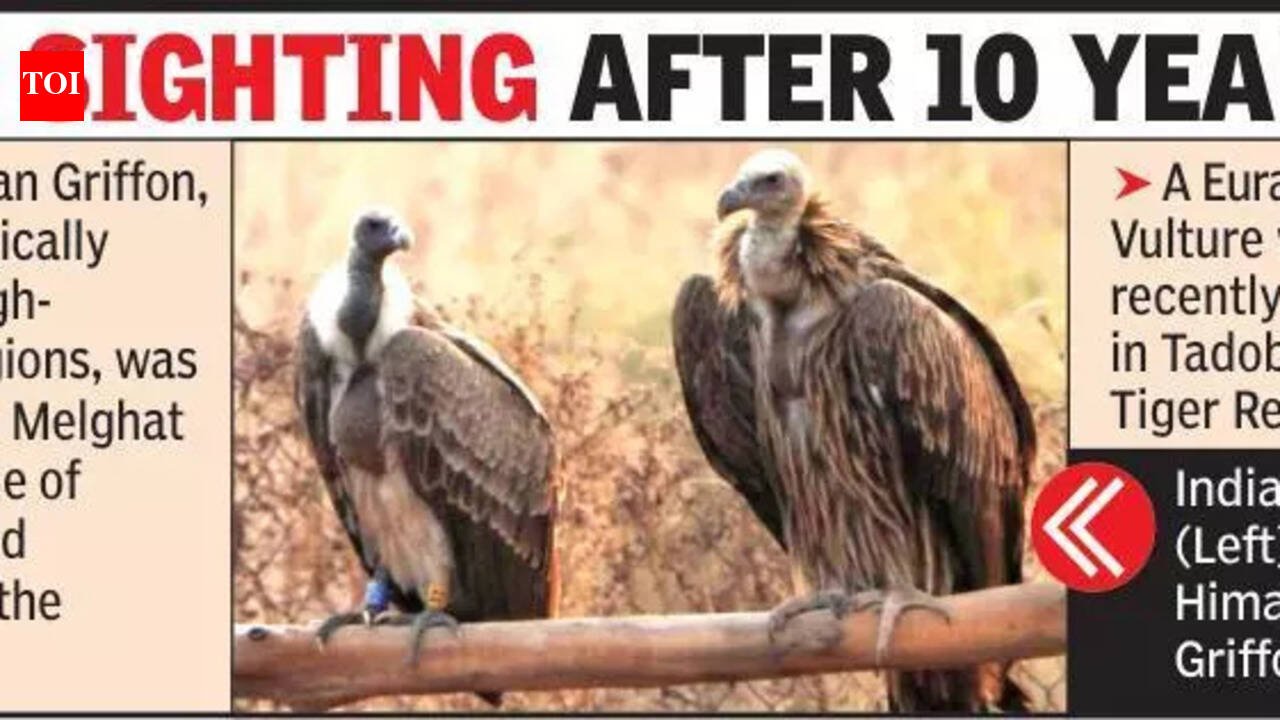
Nagpur: Conservation efforts led by Bombay Natural History Society (BNHS) began yielding visible ecological results in Maharashtra with a wild Himalayan Griffon Vulture spotted in Melghat Tiger Reserve (MTR) after 10 years — a rare sighting that conservationists say signals improving habitat acceptance following vulture rewilding initiatives.Bhaskar Das, conservation biologist at BNHS, said, “The fact that vultures released in Melghat are drawing wild vultures is a big achievement. The Himalayan Griffon mixing with captive-released vultures and feeding alongside them indicates growing ecological acceptance of MTR area.”
According to BNHS, the Himalayan Griffon, a species typically found in high-altitude regions and known to migrate seasonally across India, was recorded in Melghat after release of captive-bred vultures in the reserve. Shortly after, a Eurasian Griffon Vulture was also observed in Tadoba Andhari Tiger Reserve, strengthening indications that released vultures are helping re-establish ecological cues for wild populations. Vultures became locally extinct in Melghat and Tadoba nearly a decade ago.BNHS director Kishor Rithe said, “Melghat has historically been a stronghold for vultures. We hope the birds relearn to thrive. Their continued presence and proper exploration of the MTR area for the last month shows positive signs. Also, their socialising with a wild Himalayan Griffon for almost a week is remarkable.”By 2004, vulture populations across Maharashtra declined sharply due to widespread veterinary use of non-steroidal anti-inflammatory drugs such as diclofenac, aceclofenac, ketoprofen and nimesulide, which proved fatal to vultures. In response, the state forest department partnered with BNHS to revive vulture populations through breeding, release and habitat management programmes.As part of the latest phase, 15 critically endangered long-billed vultures were translocated from the vulture conservation breeding centre at Pinjore to the Somthana range of Melghat Tiger Reserve on April 23.
