


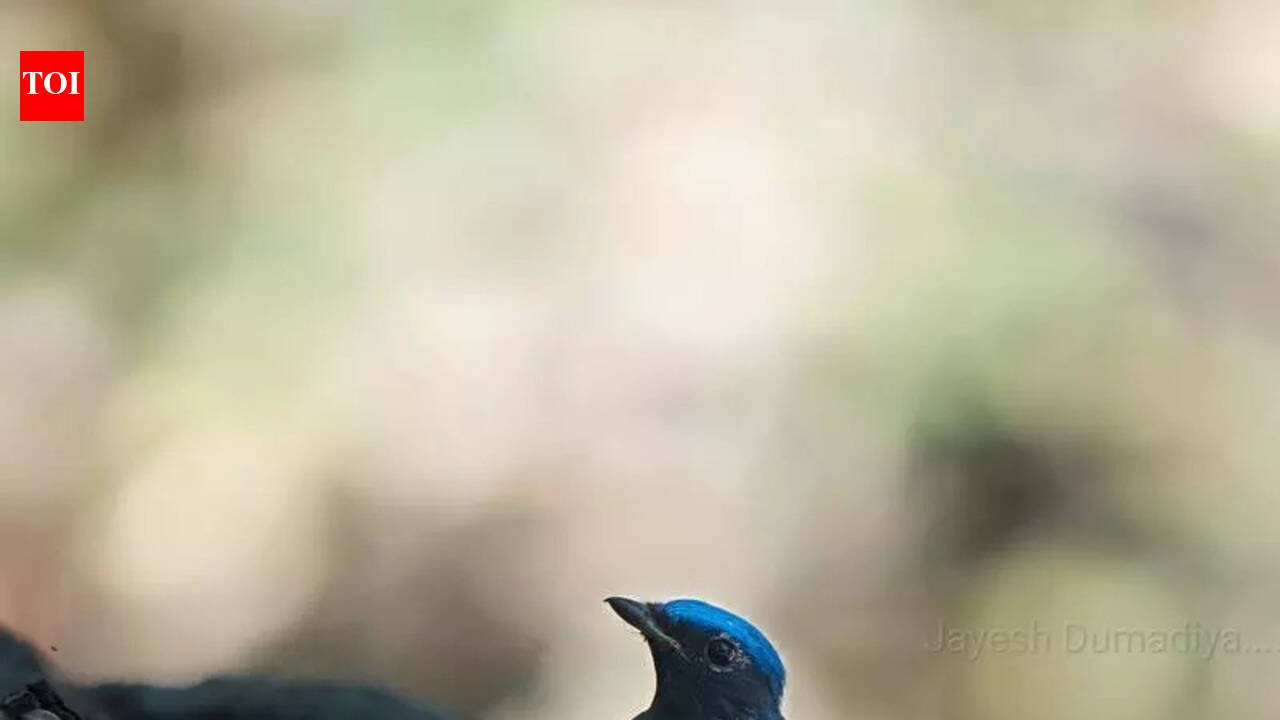
Vadodara: A male blue-and-white flycatcher, a small and striking migratory bird rarely seen in India and identified by its royal blue upperparts, black face and breast, and white belly, was recently spotted on Pavagadh Hill, forest officials said.The bird was sighted accidentally by a team of forest officials who had gone to the hill on March 8 to collect seeds of trees growing in the forest. The team, along with a botany expert, was working near Maachi around 2pm when they noticed the bird and managed to photograph it.Jayesh Dumadiya, range forest officer (Ghoghamba social forestry), said he had moved to an isolated spot during the visit to observe birds in the area. “I saw a blue-and-white bird come to drink water there. It continued drinking water even in my presence, allowing me to click photographs and record videos before it flew away into the dense forest,” he said.Dumadiya said native species such as the black-naped monarch and Tickell’s blue flycatcher appear similar to the blue-and-white flycatcher but are usually wary of human presence. “These birds generally fly away when they see humans, but this one remained calm even when I was nearby,” he said.After examining the photographs and videos, Dumadiya noticed that the bird looked different from the native species. “We checked online resources and books to confirm that it was a blue-and-white flycatcher. We also shared the visuals with experts who confirmed the identification,” he added.According to Dumadiya, India does not fall along the usual migration route of the species, and the bird has been recorded only about 149 times in the country.Officials said a female bird of the species was spotted in Kheda district in Nov this year. Unlike the male, female blue-and-white flycatchers are brownish in colour and resemble other female birds of the flycatcher family.The species breeds in Japan, Korea and parts of China and Russia between May and July. From Aug, it migrates to countries such as Vietnam, Thailand, Malaysia, Indonesia and the Philippines, where it remains until Jan, before returning to its breeding grounds between Feb and May.
