


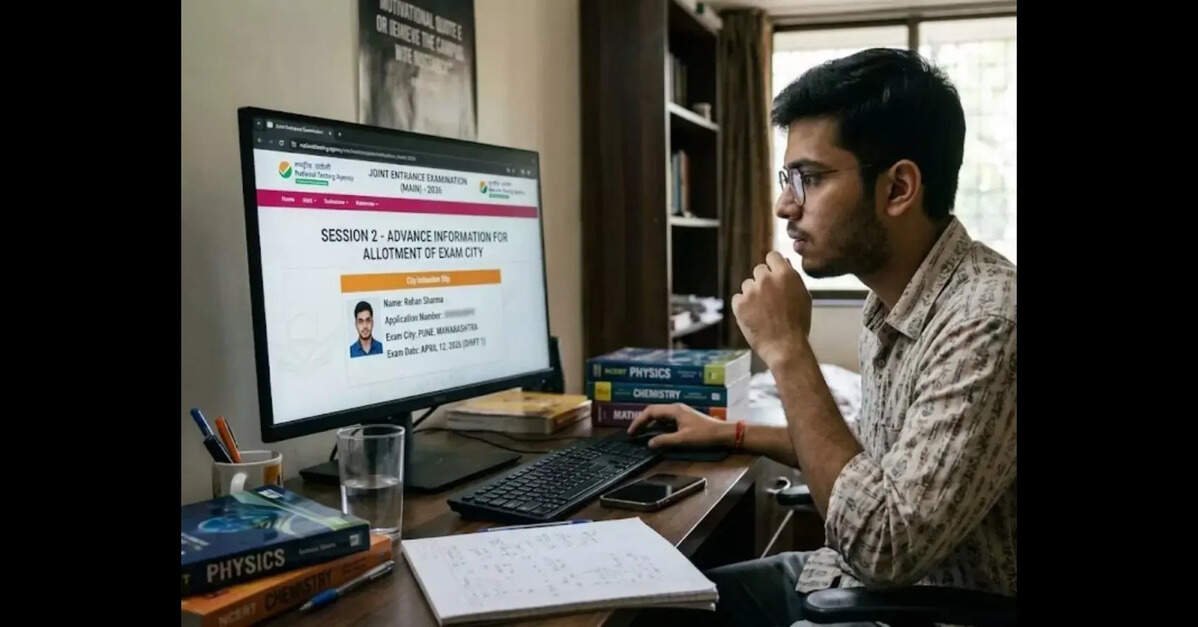
As JEE Main Session 2 begins this April, the country’s largest engineering entrance exam is increasingly reflecting a shift beyond qualification — towards rank optimisation, strategic attempts, and evolving career choices among over 15 lakh aspirants competing for roughly 50,000–60,000 seats across NITs, IIITs and GFTIs.
The trend signals a broader transformation in how students navigate India’s engineering talent pipeline, balancing performance, college hierarchy, and growing preference for industry-aligned branches such as artificial intelligence and data science.
Session 2: From second chance to rank race
The April attempt, once seen as a backup, is now being treated by a majority of serious candidates as a decisive opportunity to improve rank. An estimated 10–12 lakh candidates reappear in Session 2, underlining how the second attempt has become central — not optional — to exam strategy.
“JEE Main Session-2 has increasingly become a ‘Rank Booster’ attempt. Most students treat Session-1 as a diagnostic test to understand their standing and then refine their preparation,” said Jeevan Jyoti Agarwal, Vice-President and Head, IIT-JEE Division at ALLEN Career Institute.
With syllabus completion often incomplete before January, many aspirants use the first attempt to benchmark performance and identify gaps, reserving their peak preparation for April.
“Session 2 is now more about improvement than qualification. Students come in with a clearer understanding of their mistakes and often target a 30–50 mark increase, which can significantly impact their percentile,” said Pankaj Sijairya, Chief Content Officer at PhysicsWallah.
Even high scorers are increasingly choosing to reappear — not out of necessity, but to optimise rank and secure more competitive college–branch combinations.
Improvement is real, but increasingly strategic
Coaching data suggests that score improvements between the two sessions are both common and targeted. Students in the 70–80 percentile band tend to show the sharpest gains after focused revision, while those already above the 98 percentile often see smaller but decisive improvements that can influence final outcomes.
“It is not about studying more, but studying better. Students who analyse their Session-1 performance carefully are able to improve accuracy, time management and question selection, which drives most of the gains,” said Anil Kapasi, Co-Founder of Arihant Academy.
Typical improvements range from 30–50 marks or up to 5–10 percentile, but the impact is far from linear. Even a 1–2 percentile gain at the top end can shift ranks by thousands, making marginal improvements disproportionately valuable in a highly competitive pool.
Board examinations between the two sessions also play a role, particularly strengthening NCERT-based preparation and improving accuracy in subjects like Chemistry.
Marks vs percentile: Competition tightens in Session 2
While Session 2 offers a second opportunity, it also brings sharper competition. With better-prepared candidates and greater familiarity with the exam format, the marks required to achieve a given percentile tend to increase.
“Students often need higher marks in Session-2 to achieve the same percentile as in Session-1. The competition becomes denser because a larger proportion of serious candidates are appearing again,” Agarwal noted.
At the top end, even a difference of 10–15 marks can separate candidates by several thousand ranks, intensifying the pressure to optimise every attempt.
Faculty members at IIT Patna note that this shift is also changing how students approach the exam, with greater emphasis on rank optimisation rather than just clearing cut-offs. Small percentile differences, they point out, now play a critical role in determining final seat allocation during JoSAA counselling.
Effectively, around 60,000–80,000 candidates are competing within a narrow band for marginal rank improvements that decide access to top NITs and IIITs.
Aspirations shift: Branch choices take centre stage
Beyond exam strategy, a more structural shift is visible in student aspirations. Increasingly, candidates are prioritising branch selection over institution hierarchy, particularly in high-demand areas.
“Students today are far more aware of career outcomes. Many are willing to compromise slightly on the institution if it allows them to secure branches like Computer Science, AI or Data Science,” Sijairya said.
Faculty at IIT Tirupati also point to a growing preference for interdisciplinary and emerging technology programmes, indicating a shift towards outcome-driven decision-making rather than legacy perceptions of engineering streams.
As a result, programmes such as AI, data science and mathematics & computing are gaining preference, even over traditional core branches in some cases.
Two attempts: Reduced panic, extended pressure
The two-attempt format has altered the psychological arc of preparation. On one hand, it has reduced exam-day anxiety by providing a safety net and familiarising students with the pattern.
“Students approach Session-2 with more confidence and significantly less panic because they have already experienced the exam environment,” Agarwal said.
At the same time, it has extended the preparation cycle and increased expectations around improvement.
“There is now an implicit expectation that students should perform better in the second attempt, which adds a different kind of pressure,” Kapasi noted.
From exam to strategy: A changing ecosystem
Taken together, these shifts point to a more strategic approach to JEE Main. The first attempt is increasingly used as a diagnostic and benchmarking exercise, while the second is treated as the final execution phase.
Students are no longer preparing for a single high-stakes moment, but navigating a two-stage competitive strategy that balances score improvement, rank movement and college–branch trade-offs.
This evolution also reflects a broader shift in how engineering education is being perceived — with career alignment and future opportunities beginning to outweigh traditional notions of institutional prestige.
Conclusion
JEE Main remains India’s most competitive entrance exam, but its evolving format is quietly reshaping how students approach opportunity — not just as a test of knowledge, but as a strategic gateway into an increasingly competitive and outcome-driven engineering ecosystem.
