


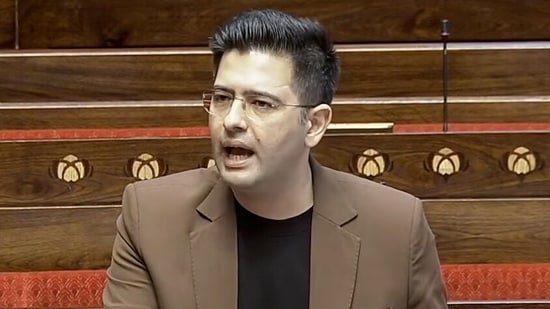
Raghav Chadha has proposed allowing married couples in India to file joint income tax returns, saying optional joint filing would ensure that households with uneven incomes are not unfairly penalised, reduce the tax burden on single-income families, and bring greater tax equity, similar to systems followed in countries like the US, Germany and France.
Speaking in Parliament on March 16, the Rajya Sabha MP and Aam Aadmi Party (AAP) spokesperson, said the move would help ensure that families with uneven incomes are not unfairly penalised. If implemented, he argued, households with similar overall earnings, regardless of how income is split between spouses, could receive comparable tax benefits, potentially easing everyday financial anxieties for many Indian families.

Also Read: Raghav Chadha pushes for a National Blockchain Property Register to make land records tamper-proof
Raghav Chadha, in a post on X, said that he had delivered a speech in Parliament titled ‘I Do Not Oppose, I Rise to Propose,’ advocating for optional joint filing of income tax returns for married couples so that those with uneven incomes are not penalised.
Illustrating the disparity, he cited two examples: in one case, both spouses earn ₹10 lakh each and pay zero tax, while in another, a single-income household earning ₹20 lakh pays ₹1.92 lakh in tax, despite both families having the same total income.
“The only difference is how the salary is split between the two spouses,” he said, adding, “One roof. One kitchen. One household budget. But when tax time comes, the family disappears. The tax system sees two individuals. A husband and wife become strangers. No clubbing of income or rebates.”
Also Read: Joint tax filing for couples? ICAI’s Budget vision proposes reshaping home loan, rental tax math
“If there is joint filing of ITR, marital couples will get greater relief of income tax,” he said.
Raghav Chadha cited another example of a married couple to highlight the disparity. In this case, an IT professional earns ₹18 lakh while his wife earns ₹6 lakh, taking their combined income to ₹24 lakh. Under the current system, the husband pays around ₹1.5 lakh in tax while the wife pays none. However, if their incomes were clubbed through joint filing, the total tax liability could drop to zero.
He argued that introducing joint filing of income tax returns would allow married couples to be treated as a single economic unit, enabling better tax equity. It would also allow a single-income or higher-earning spouse to utilise the unused tax exemptions of the other. According to him, such a system could curb income diversion and, he added on a lighter note, may even encourage more people to marry to avail of tax benefits.
Chadha further pointed out that while India’s tax framework recognises entities such as partnerships, joint tax structures and the Hindu Undivided Family (HUF) as separate assessees, it does not treat the most fundamental unit, the nuclear family of a husband and wife, as a single taxable entity, something he believes should be addressed.
He added that joint income taxation for married couples is already followed in several developed economies, including France, Germany, the United States and the United Kingdom. The proposal, he said, aims to bring greater equity for single-income households while ensuring they receive tax benefits comparable to dual-income families.
